Skillcept Online
Key takeaways
- AI Engineer was number two on LinkedIn’s Jobs on the Rise list for India in 2026, and AI engineering job postings in India grew 59.5% in a year (LinkedIn, April 2026).12
- No CS degree needed: seven stages take about 9–10 months from zero at 10 hours a week, and about 6–7 months if you already use Python and SQL as an analyst.
- Python is the entry ticket: foundit found it in nearly three-quarters of AI job postings, and SQL and data engineering in more than half.3
- With 1–3 years’ experience, AI Engineers in India earn ₹10.4–11.5 lakh a year; with 3–6 years, ₹15.3–16.9 lakh (AmbitionBox, 15 Oct 2026).4
Is AI Engineer a real job in India in 2026?
Yes. It is one of the fastest-growing job titles in India, and the work is concrete.
An AI Engineer is a developer who builds software on top of AI models: assistants that answer from a company’s own documents, agents that finish tasks using tools, and the systems that test, ship and monitor them. Unlike a research scientist, an AI Engineer rarely trains a large model from scratch. The job is choosing, connecting, measuring and deploying models so they work for real users.
The demand is measurable. LinkedIn’s Jobs on the Rise report for India put Prompt Engineer, AI Engineer and Software Engineer in its top three for 2026.1 LinkedIn also found AI engineering job postings in India up 59.5% on the year, with Bengaluru and Hyderabad leading and growth spreading to smaller cities.2 On Naukri, AI/ML hiring rose 45% across FY26,5 and 20% on the year in September 2026, when fresher AI/ML hiring rose 19%.6
The skills are still scarce. TeamLease Digital estimates that only about 16% of India’s IT professionals hold AI skills, and puts the generative AI talent gap at about 53%.7
The honest catch: most AI jobs ask for experience. In foundit’s data, roles open to people with 0–3 years were 18% of AI jobs in 2025.3 That’s why this roadmap builds on what you already have, an analyst’s SQL and business sense or the domain you studied, and has you ship real projects you can show. It’s also why Infinity adds 3 paid 30-day internships with multinational partners once you complete, each with a letter of recommendation.
Where do you start?
It depends on what you can already do. Find your row, join the roadmap at that stage, and expect roughly the time shown at about 10 hours a week.
| You are | Start at | What carries over | Time to job-ready |
|---|---|---|---|
| A data analyst who uses Python, SQL and pandas | Stage 2 | SQL, cleaning data, statistics, business questions | 6–7 months |
| An analyst who works in Excel, Power BI and SQL | Stage 1, the Python part | SQL, dashboards, business sense | About 8 months |
| An IT professional: testing, support or development | Stage 1, quickly | Coding, Git, how software ships | 7–8 months |
| A graduate of any stream with no coding: B.Com, B.Sc, B.Pharm, mechanical, civil | Stage 1, all of it | Your domain: finance, health, manufacturing | 9–10 months |
Our estimate, from our curriculum’s hours at about 10 hours a week. Your pace will differ.
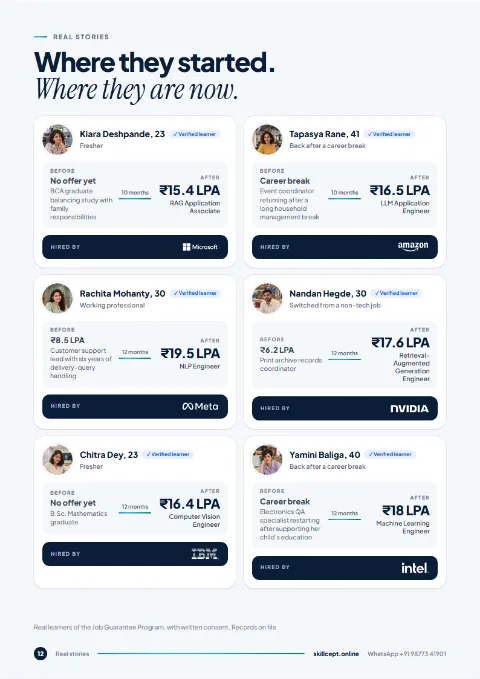
A non-CS degree is not a wall. AI products need people who understand the problem they solve: a pharmacy graduate knows what a drug-interaction question looks like, and a commerce graduate knows a balance sheet. Of the learners we placed, 46% came from a non-tech degree. Records on file.
And the maths? School maths is enough to start. You’ll learn the statistics you need in stage 1 and the idea behind how networks learn in stage 3, through examples rather than proofs. You don’t need a powerful computer either: small open models run on an ordinary laptop, and Google Colab, which is free, runs notebooks in your browser with limited access to GPUs.10
The roadmap, step by step
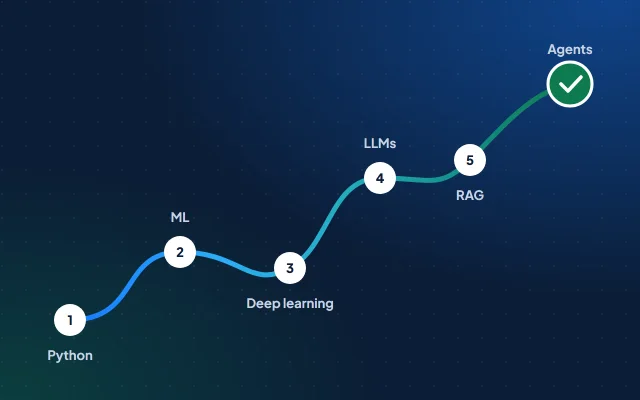
Seven stages over about 38 weeks, counted from zero: if you start at stage 2, take ten weeks off. Each stage ends with a milestone project. Tick each step off as you finish it.
Weeks 1–10 · about 100 hours
Python, SQL and data
The foundation everything else stands on. Analysts: skim what you know and move on. Graduates new to code: this is the longest stage, and the one that matters most.
Free: The Python Tutorial · The PostgreSQL tutorial · pandas: Getting startedIn the program: Modules 1–4
Weeks 11–13 · about 19 hours
Machine learning
How a model is trained, tested and measured honestly. An engineer who can’t tell a good evaluation from a lucky one ships products that break.
Weeks 14–21 · about 65 hours
Deep learning
How neural networks learn, up to the attention mechanism inside every large language model. It’s the stage that lets you reason about why a model fails, and interviewers test it.
Weeks 22–24 · about 19 hours
LLMs and open models
Now you build with models instead of training them: open models you run yourself, and the big model APIs. Prompting is a skill here, measured like any other.
Free: The Hugging Face LLM Course · OpenAI API docs · Claude docsIn the program: Modules 7 and 8
Weeks 25–27 · about 10 hours
RAG
RAG (retrieval-augmented generation) is a pattern where an app first finds the passages in your documents that match a question, then has the model answer from those passages, with citations. It’s how most companies first put LLMs to work.
Free: LlamaIndex docs · LangChain docs · RAGAS docs · The RBI’s FAQsIn the program: Modules 8 and 9
Weeks 28–30 · about 13 hours
Agents and MCP
An AI agent is a program in which a model decides which tools to call, and in what order, to finish a task. MCP (Model Context Protocol) is an open standard for connecting AI applications to data and tools, so one connector works across many apps.
Free: MCP docs · The Hugging Face Agents Course · LangGraph docsIn the program: Modules 8 and 10
Weeks 31–38
Ship it, then interview
Companies hire AI Engineers who can ship. Put one project online the way a team would, then prepare for the rounds below.
Free: The FastAPI tutorial · Docker: Get startedIn the program: interviews assured and mock interviews
What hiring tests
AI Engineer hiring tests whether you can build, and whether you know when your system works. Not every company runs all five rounds, but preparing for each covers you.
| Round | What it checks | How to prepare |
|---|---|---|
| Online test | Python coding, often SQL, sometimes aptitude | Timed practice in Python and SQL |
| ML fundamentals | Metrics, overfitting, how training and attention work | Explain stages 2 and 3 out loud, without notes |
| LLM system design | Designing a RAG or agent system: data, retrieval, evaluation, cost and safety | Stage 7’s design question, on a whiteboard |
| Project deep-dive | What you built, what broke and what you’d change | Your README, your demo and your evaluation numbers |
| HR round | Why AI, notice period, pay and joining date | Your story in a minute, and your numbers ready |
Prepare one question for every round: how do you know it works? Answer with numbers you measured: the size of your evaluation set, how often the answers were right, what each answer cost and how fast it came back. Stages 4 to 7 build that habit into every project.
Coming from data analysis? Lead with it. Interviewers value someone who can write the SQL, understands the business question and can also build the AI layer on top. If you’re still choosing between the three data careers, read our comparison of Data Analyst, Data Scientist and AI Engineer.
What AI Engineers earn
With 1–3 years’ experience, AI Engineers in India earn ₹10.4–11.5 lakh a year on AmbitionBox, and ₹15.3–16.9 lakh with 3–6 years.4 Here is that figure beside the titles close to it.
| Title | Experience | Yearly pay | Source |
|---|---|---|---|
| AI Engineer | 1–3 years | ₹10.4–11.5 L | AmbitionBox2,800 salaries |
| AI Engineer | 3–6 years | ₹15.3–16.9 L | AmbitionBox2,300 salaries |
| ML Engineer | 1–3 years | ₹9.2–10.2 L | AmbitionBox5,100 salaries |
| ML Engineer | 3–6 years | ₹13.1–14.5 L | AmbitionBox4,600 salaries |
| Gen AI Engineer | 1–3 years | ₹7.1–8.1 L | AmbitionBox234 salaries |
| Gen AI Engineer | 3–6 years | ₹10.1–11.3 L | AmbitionBox289 salaries |
| GenAI Developer | 0–2 years | ₹11.2 LPA₹34.5 LPA at 6–8 years | TeamLease Digital37,000 roles analysed |
Sources: AmbitionBox, as of 15 Oct 202648 and TeamLease Digital’s Digital Skills & Salary Primer FY2026–27, reported 29 Sep 2026.7
By city, AmbitionBox put AI Engineers in Bengaluru highest (₹16.8 lakh), then Gurugram (₹15.9 lakh), Mumbai (₹15 lakh), Hyderabad (₹14.8 lakh) and Pune (₹14.3 lakh).4
Titles matter less than skills. Prompt Engineer topped LinkedIn’s Jobs on the Rise list,1 yet AmbitionBox showed an average of ₹6.3 lakh for that title.8 Prompting pays when it sits inside the full skill set this roadmap builds. Naukri’s AI Jobs Report found median salaries 53% higher for AI-skilled roles.9 For why salary sites disagree, and what CTC leaves out, read our Data Scientist salary guide.
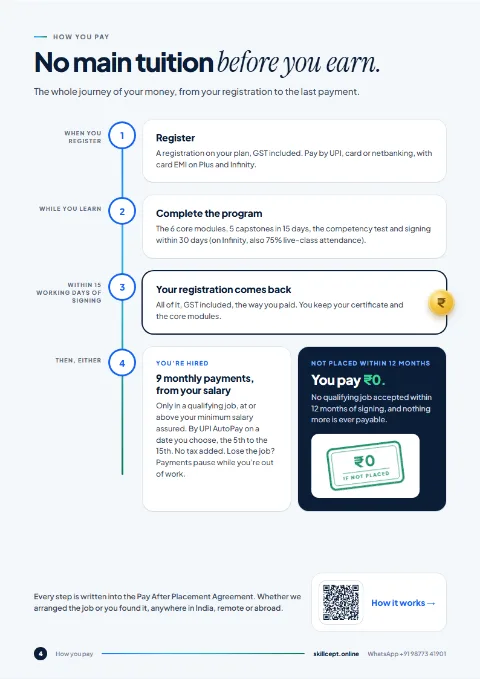
On Infinity, our plan for AI/ML Engineer roles, no fee after placement is due until a job pays at least ₹12 LPA or your salary + 85%, whichever is higher. Work out yours. Data Science & AI Job Guarantee Program: not placed after completing the program? You pay ₹0.
Questions
Can I become an AI Engineer without a CS degree?
Yes. AI Engineer hiring tests what you can build and explain: Python, how models are evaluated, and a project that runs. Of the learners we placed, 46% came from a non-tech degree. Records on file.
How long does it take to become an AI Engineer?
About 9–10 months from zero at about 10 hours a week, or about 6–7 months if you already use Python and SQL as an analyst. The longest stages are the foundation (about 100 hours of Python, SQL and data) and deep learning (about 65 hours).
Do I need a GPU to learn AI engineering?
No. Small open models run on an ordinary laptop with Ollama, and Google Colab, which is free, runs notebooks in your browser with limited access to GPUs, according to Google’s Colab FAQ.
How much maths does an AI Engineer need?
School maths to start. You need statistics to evaluate models and the idea of gradient descent to understand deep learning; both are learnt through examples, not proofs.
Is prompt engineering a career on its own?
Prompt Engineer topped LinkedIn’s Jobs on the Rise list for India in 2026, but AmbitionBox showed an average of ₹6.3 lakh for the title (15 Oct 2026). Treat prompting as one skill inside AI engineering, alongside RAG, agents and evaluation.
What’s the difference between an AI Engineer and a Data Scientist?
A Data Scientist answers business questions with data and builds predictive models. An AI Engineer builds and ships products on top of AI models, such as RAG assistants and agents. On AmbitionBox, both earn similar pay at 1–3 and 3–6 years.
Sources
- LinkedIn, Jobs on the Rise 2026 (India), reported in Storyboard18, 8 Jan 2026.
- LinkedIn AI labour-market data, reported by IANS: AI engineering hiring in India jumps 59.5%, 24 Apr 2026.
- foundit Insights Tracker, reported in Storyboard18, 13 Jan 2026 (read 17 Oct 2026).
- AmbitionBox, AI Engineer salary in India, as of 15 Oct 2026 (bands re-read 17 Oct 2026).
- Naukri, JobSpeak, March 2026, 6 Apr 2026.
- Naukri, JobSpeak, September 2026, 6 Oct 2026.
- TeamLease Digital, Digital Skills & Salary Primer FY2026–27, reported in CXOToday, 29 Sep 2026.
- AmbitionBox, ML Engineer, Gen AI Engineer and Prompt Engineer salaries, as of 15 Oct 2026.
- Naukri, AI Jobs Report, 16 Jul 2025.
- Google, Colab FAQ, read 17 Oct 2026.