Skillcept Online
Key takeaways
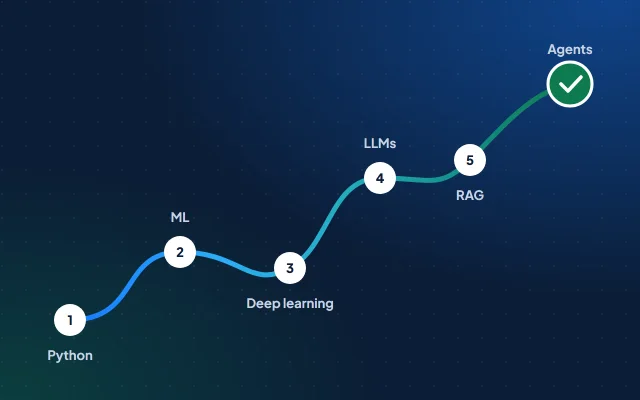
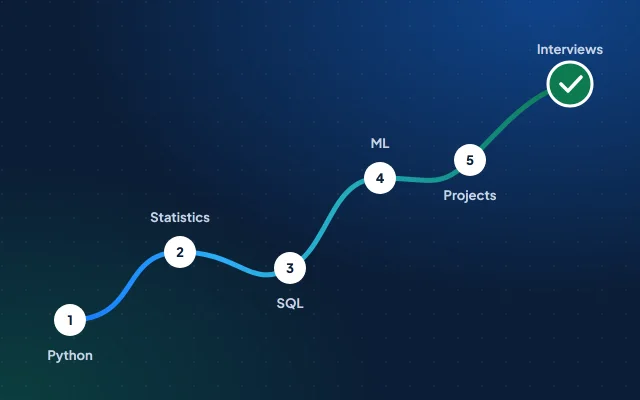
- Eight stages at about 10 hours a week take 6–8 months: Python, statistics, SQL, data analysis, machine learning, deep learning and GenAI, projects, then interviews.
- AI is now part of the job: 39% of data and analytics postings in India mention AI,1 and fresher AI/ML hiring on Naukri rose 19% in September 2026.2
- With 1–3 years’ experience, Data Scientists earn ₹11.3–12.5 lakh a year; with 3–6 years, ₹15–16.6 lakh (AmbitionBox, 16 Oct 2026).4
- First jobs usually carry another title and pay less: a Junior Data Scientist averages ₹6.5 lakh (AmbitionBox, 0–4 years).5
What does a Data Scientist do?
A Data Scientist uses data to predict and decide: which customers are about to leave, how much stock a store will need next month, whether a payment is fraud, and whether a change actually worked.
Day to day, that means pulling data with SQL, cleaning and exploring it in Python, building and testing models, running experiments such as A/B tests, and explaining the results to people who don’t read code. A Data Analyst reports what happened; a Data Scientist estimates what will happen and what to do about it. For the full picture, read our comparison of Data Analyst, Data Scientist and AI Engineer.
The job is changing with AI. Indeed found AI mentioned in 39% of data and analytics job postings in India.1 On Naukri in September 2026, AI/ML hiring rose 20% on the year and fresher AI/ML hiring 19%, while fresher hiring overall rose just 1%.2 Generic data and analytics postings on Indeed fell 14% in the three months to July 2026.3 The Data Scientists in demand can model data and work with AI, which is why this roadmap ends its learning with deep learning and GenAI.
Why this order?
Each stage uses the one before it, so skipping ahead costs you time later:
- Python first, because every later tool runs in it.
- Statistics before machine learning, because a model’s result is a statistical claim. Without statistics you can’t tell a real result from a lucky one.
- SQL early, because it’s how you get data out of company databases, and data interviews test it.
- Data analysis before modelling, because you explore and clean data before any model sees it.
- Machine learning before deep learning, because deep learning builds on the same ideas: training, testing and choosing a metric.
Already know some of it? Skim the stage and do its milestone project to prove it: that’s how 8 months becomes 6. Stages 1 to 4 cover the same skills as our Data Analyst roadmap, so if you’ve finished that, start at stage 5.
The roadmap, step by step
Eight stages over about 34 weeks, counted from zero. Each ends with a milestone project. Tick each step off as you finish it.
Weeks 1–6 · about 51 hours
Python from zero
Python is the language Data Scientists work in every day. You don’t need any coding to start.
Weeks 7–8 · about 10 hours
Probability and statistics
What separates a Data Scientist from someone who only runs models: knowing whether a result is real.
Free: OpenIntro Statistics, a free textbook · statsmodels docsIn the program: Module 2
Weeks 9–10 · about 11 hours
SQL
How you get data out of company databases, and a skill data interviews test.
Weeks 11–14 · about 30 hours
Data analysis and visualisation
Explore before you model: understanding and cleaning the data comes before any model, and a clear chart makes a finding land.
Free: pandas: Getting started · The Seaborn tutorial · data.gov.in, India’s open government dataIn the program: Module 3
Weeks 15–18 · about 19 hours
Machine learning
The models Data Scientists use every day, and how to test them honestly.
Free: scikit-learn: Getting started · Kaggle LearnIn the program: Module 5
Weeks 19–26 · about 77 hours
Deep learning, and a first look at GenAI
Enough deep learning to use it well, and a first look at the language models that are changing the job.
Free: PyTorch: Learn the Basics · The Hugging Face LLM CourseIn the program: Modules 6 and 7
Weeks 27–30
Projects that get interviews
Three projects, each answering a business question. Say what the model means for the business, such as customers kept or stock not wasted, not just its accuracy.
On Plus, the capstone library has projects like these, each with a step-by-step guide: ride-demand and inflation forecasts, customer churn prediction and UPI fraud detection.
Free data: data.gov.in · MoSPI, India’s official statisticsIn the program: the capstones
Weeks 31–34
Interview-ready
Hiring usually runs in rounds (below). Prepare for each, and apply to the titles first jobs carry.
What hiring tests
Data Scientist hiring in India usually runs in rounds. Not every company runs all five, but preparing for each covers you.
| Round | What it checks | How to prepare |
|---|---|---|
| Online test | Python and pandas, SQL, statistics and probability, often aptitude | Timed practice: SQL and pandas questions, probability problems |
| Technical interview | Machine learning ideas: overfitting, metrics, how a model you used works | Explain stage 5 out loud, using your own projects |
| Case round | Turning a business problem into a data problem: the metric, the data, the model | Practise with the questions behind your projects |
| Project deep-dive | Your choices: why this model and this metric, and what you’d change | Two minutes per project, then the details |
| HR round | Why data science, pay and joining date | Your story in a minute, and your numbers ready |
What sets candidates apart is proof. In a NASSCOM and Indeed survey, 40% of employers said they prefer demonstrable AI skills or certifications over degrees.8 In the World Economic Forum’s survey, 30% of employers in India said skills-based hiring, which drops degree requirements, was effective, against 19% worldwide.9 Projects you can explain in two minutes are that proof.
Your first job, and what it pays
Few people are hired straight into a “Data Scientist” title. First jobs usually carry another title and pay less, and the bigger jump comes with a year or more of experience.
| Title | Experience | Yearly pay | Source |
|---|---|---|---|
| Junior Data Scientist | 0–4 years | ₹6.5 L average₹6.1–6.9 L typical | AmbitionBox292 salaries |
| Associate Data Scientist | 0–1 year | ₹6.5–9.7 L | AmbitionBox67 salaries |
| Associate Data Scientist | 1–3 years | ₹8.2–9 L | AmbitionBox2,200 salaries |
| Data Scientist | Under 1 year | ₹5,95,255 average total pay | PayScale307 salaries |
| Data Scientist | 1–3 years | ₹11.3–12.5 L | AmbitionBox24,000 salaries |
| Data Scientist | 3–6 years | ₹15–16.6 L | AmbitionBox35,500 salaries |
Sources: AmbitionBox (14–16 Oct 2026)45 and PayScale (9 Jul 2026).6
AI skills move the number most: Naukri’s AI Jobs Report found median salaries 53% higher for AI-skilled roles.7 For pay by city, CTC against in-hand pay, and why the salary sites disagree, read our Data Scientist salary guide.
On Plus, our plan for Data Scientist roles, no fee after placement is due until a job pays at least ₹9 LPA or your salary + 35%, whichever is higher. Work out yours. Data Science & AI Job Guarantee Program: not placed after completing the program? You pay ₹0.
Questions
Can a fresher become a Data Scientist in India?
Yes, though the first title is often Junior or Associate Data Scientist. AmbitionBox showed ₹6.5–9.7 lakh a year for Associate Data Scientists with under a year’s experience (15 Oct 2026), and fresher AI/ML hiring on Naukri rose 19% in September 2026.
How long does it take to become a Data Scientist?
About 8 months from zero at about 10 hours a week, as laid out here, and about 6 months if you already know some Python, Excel or SQL.
Do I need a maths or computer science degree?
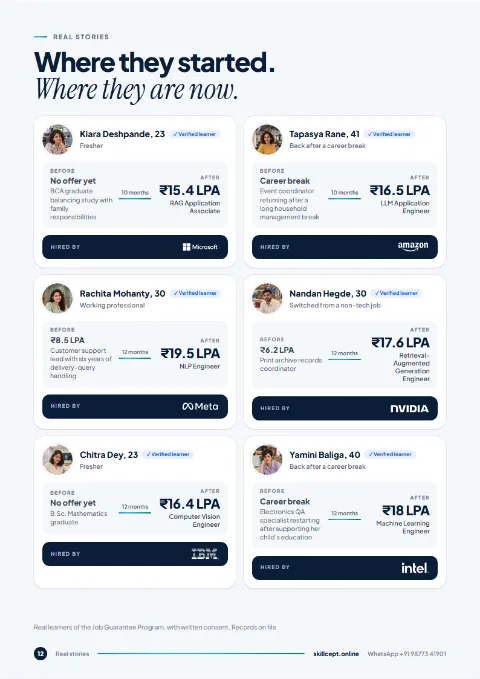
No. School maths is enough to start, and stage 2 teaches the statistics you need. Of the learners we placed, 46% came from a non-tech degree. Records on file.
Should I become a Data Analyst first?
If you want a job sooner, it’s a sound route. The first four stages here cover the same skills as our Data Analyst roadmap, which takes about six months, and the machine learning stages can follow while you work.
Do Data Scientists need deep learning and GenAI?
Statistics, machine learning and SQL are the core of the job. But 39% of data and analytics postings in India mention AI (Indeed, September 2025), so a first look at deep learning and language models helps you stand out.
Sources
- Indeed Hiring Lab, September 2025 labour market update, 25 Oct 2025.
- Naukri, JobSpeak, September 2026, 6 Oct 2026.
- Indeed, July 2026 postings data, reported in CXOToday, 26 Aug 2026.
- AmbitionBox, Data Scientist salary in India, as of 16 Oct 2026.
- AmbitionBox, Junior Data Scientist (14 Oct 2026) and Associate Data Scientist (15 Oct 2026) salaries.
- PayScale, Data Scientist salary in India, 9 Jul 2026.
- Naukri, AI Jobs Report, 16 Jul 2025.
- NASSCOM and Indeed, India’s AI Talent Inflection Point, May 2026.
- World Economic Forum, The Future of Jobs Report 2025, 7 Jan 2025.