Skillcept Online
Key takeaways
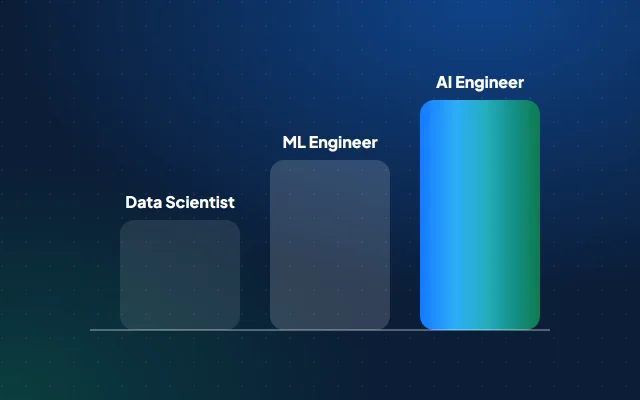
- A Data Scientist asks what the data says, an ML Engineer makes the model run reliably for millions, and an AI Engineer builds products on large pre-trained models. All three start from the same Python, statistics and machine learning.
- With 1–3 years’ experience, AmbitionBox shows Data Scientists at ₹11.3–12.5 lakh a year, AI Engineers at ₹10.4–11.5 lakh and ML Engineers at ₹9.2–10.2 lakh (19 Oct 2026).123
- The employer moves pay more than the title: AI Engineers average ₹24–26.9 lakh in software product companies, against ₹12.2–13.5 lakh in IT services, on the same site.3
- Python is the shared entry ticket: foundit found it in nearly three-quarters of AI job postings in 2025, and SQL or data engineering in more than half.5
- AI Engineer is rising fastest: number two on LinkedIn’s Jobs on the Rise list for India in 2026, with AI engineering postings up 59.5% in a year.67
The short answer
The difference between an AI engineer and an ML engineer, and between an ML engineer and a data scientist, is mostly where each sits on the road from a question to a product.
- A Data Scientist uses statistics and machine learning to answer a business question: what drives churn, which payments look like fraud, how many orders arrive tomorrow. The output is an answer and a model, tested honestly.
- A Machine Learning (ML) Engineer takes models into production: the pipelines that feed them, the services that run them in milliseconds, and the monitoring and retraining that keep them right as the world changes.
- An AI Engineer builds applications on large pre-trained models, usually large language models (LLMs): assistants that answer from a company’s documents, agents that complete tasks, and the evaluation and guardrails that make them safe to ship.
Pick by the work you’d enjoy on an ordinary Tuesday: experiments and explanation, systems and reliability, or building products with LLMs.
One problem, three jobs
Take one problem at a payments company: fraud on UPI payments. All three roles work on it, and each asks a different question.
| Data Scientist | ML Engineer | AI Engineer | |
|---|---|---|---|
| The question | Which payments are fraud, and what gives them away? | How do we score every payment in milliseconds, reliably? | How do we help the people and customers handling flagged payments? |
| What they build | Features such as amount against the usual, a new device or payee; a model; the threshold that balances missed fraud against blocked good payments | The feature pipeline, a scoring service, drift monitoring, automatic retraining and safe rollback | An assistant that reads a flagged case, the customer’s history and the dispute policy and drafts a summary with its sources; a support agent for dispute questions |
| How they know it works | Precision and recall on held-out data; an A/B test | Latency, uptime, drift alerts, accuracy in production | An evaluation set of real questions, answers checked against sources, cost and speed per answer, tests against prompt injection |
| Tools they reach for | SQL, pandas, scikit-learn, XGBoost, statsmodels | Python, Docker, Kubernetes, MLflow, Spark, a cloud ML platform | LLM APIs, LangChain or LlamaIndex, a vector store such as FAISS or pgvector, FastAPI, evaluation tools |
In a small team one person may do two of these columns; in a large one each is a separate job. Either way, the columns depend on each other: an assistant is only as good as the data and models under it.
Side by side
The three share a core and split on what they spend most of the day doing.
| Compare | Data Scientist | ML Engineer | AI Engineer |
|---|---|---|---|
| Spends most time on | Exploring data, experiments, models, explaining results | Pipelines, deployment, monitoring, scale | LLM applications: retrieval, agents, evaluation, guardrails |
| Maths | Most: statistics, probability, experiment design | Solid: how models train and fail | Working knowledge: embeddings, attention, evaluation metrics |
| Software engineering | Good Python and SQL | Most: production code, systems, cloud | Strong: APIs, back ends, testing |
| Typical first titles | Associate or Junior Data Scientist, Data Analyst | ML Engineer, MLOps Engineer, often after a software or data role | AI Engineer, Gen AI Engineer, often after a software or data role |
| Interview rounds | SQL, statistics, ML theory, a case or take-home, a project deep-dive | Coding, ML fundamentals, ML system design, MLOps | Python coding, LLM fundamentals, LLM system design (RAG, agents, cost, safety), a project deep-dive |
| Suits | People who like questions, numbers and some uncertainty | People who like building systems that don’t break | People who like shipping products, fast, at the AI end |
Where the lines blur
Titles overlap more each year, and the companies that certify these jobs show it. Google Cloud describes its Professional Machine Learning Engineer as someone who builds, deploys and monitors both traditional and generative AI models, including solutions built on foundation models.10 AWS’s Machine Learning Engineer – Associate certification validates putting ML workloads into production and operating them, for ML and MLOps engineers.11
On the AI Engineer side, Microsoft’s Azure AI Apps and Agents Developer Associate (exam AI-103) describes an AI engineer who builds, manages and deploys agents and AI solutions, working alongside data scientists and DevOps engineers.12 Databricks’ Generative AI Engineer Associate tests designing LLM-enabled solutions and building RAG applications; application development carries 30% of its exam, and evaluation and monitoring 12%.13 So read the job description, not just the title.
What each pays
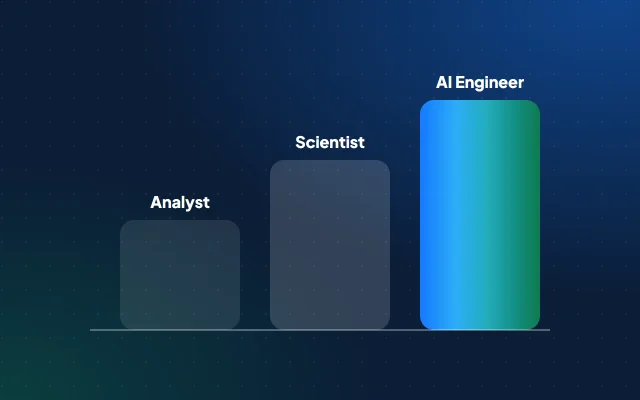
Within a band, the three sit close together on AmbitionBox’s figures; Data Scientists lead at 1–3 years and AI Engineers at 3–6 years.
| Role | 1–3 years | 3–6 years | 6–9 years |
|---|---|---|---|
| Data Scientist | ₹11.3–12.5 L24,100 salaries | ₹15–16.6 L35,500 salaries | ₹20.5–22.6 L2,800 salaries |
| ML Engineer | ₹9.2–10.2 L5,400 salaries | ₹13.1–14.5 L4,600 salaries | ₹20.2–22.3 LAn AmbitionBox estimate |
| AI Engineer | ₹10.4–11.5 L2,800 salaries | ₹15.3–16.9 L2,300 salaries | ₹20.9–29.8 L54 salaries, a small sample |
| Gen AI Engineer | ₹7.1–8.1 L236 salaries | ₹10.1–11.3 L295 salaries | ₹18–24.9 L31 salaries |
| MLOps Engineer | ₹8–11.9 L23 salaries, a small sample | ₹13.1–15.5 L146 salaries | ₹15.8–22.2 L30 salaries |
Typical yearly pay. Source: AmbitionBox, as of 19 Oct 2026 for Data Scientist, ML Engineer and AI Engineer,123 21 Oct 2026 for Gen AI Engineer and 16 Oct 2026 for MLOps Engineer,4 read 22 Oct 2026.
Notice what’s missing: none of the three main titles shows a band under one year. Few people are hired straight into them. The nearest entry title, Associate Data Scientist, shows ₹6.5–9.6 lakh with 0–1 year, on 70 salaries.4
By kind of employer
The employer moves pay more than the title. Average pay across experience levels, by industry:
| Industry | Data Scientist | ML Engineer | AI Engineer |
|---|---|---|---|
| IT services and consulting | ₹12.9–14.3 L | ₹10.3–11.4 L | ₹12.2–13.5 L |
| Management consulting | ₹15.9–17.6 L | ₹14.3–15.9 L | ₹16.4–18.6 L |
| Software product | ₹19.3–21.4 L | ₹18.6–20.5 L | ₹24–26.9 L |
Source: AmbitionBox, industry-wise salary, as of 19 Oct 2026, read 22 Oct 2026.123
For cities, CTC against in-hand pay and why salary sites disagree, see our AI/ML Engineer salary guide and Data Scientist salary guide.
Where demand is going
All three are growing; AI engineering is growing fastest, and all three hire more experienced people than freshers.
| Signal | What the data shows | Source |
|---|---|---|
| AI Engineer | No. 2 on Jobs on the Rise, India 2026; AI engineering postings up 59.5% year on year | |
| Machine learning | ML roles expected to hold a 34% share of AI jobs in 2026; demand for GenAI and LLM skills projected to rise 58% | foundit |
| AI/ML hiring overall | +20% in September 2026, +19% for freshers, +11% inside IT while IT hiring fell 4% | Naukri |
| Growth to 2030 | Employers in India expect AI and Machine Learning Specialists to grow 176%, and Data Analysts and Scientists 54% | World Economic Forum |
| Who gets hired | 18% of AI jobs in 2025 were open to 0–3 years’ experience; 28% to 4–6 years | foundit |
Sources: LinkedIn,67 foundit,5 Naukri8 and the World Economic Forum (net growth, 2025–2030).9
The honest reading: ML and AI engineering are the fastest-growing, but also the hardest to enter straight from college. A first job as a Data Analyst, Data Scientist or software engineer, or projects strong enough to stand in for experience, is how most people get there.
Which fits you, and the route in
Start from where you are; the best target is the one you can reach soonest without closing the door to the next.
| You are | Natural target | Add first |
|---|---|---|
| A fresher with a non-CS degree | Data Scientist, via a Data Analyst or Associate Data Scientist role | Statistics, SQL, Python, machine learning |
| A CS or IT fresher | Data Scientist now; ML or AI Engineer with strong, deployed projects | Machine learning, then LLM apps or deployment |
| A software developer or tester | AI Engineer or ML Engineer | Machine learning fundamentals, then RAG and agents, or MLOps |
| A data analyst | Data Scientist, or AI Engineer | Statistics and ML; then LLM applications |
| A DevOps or cloud engineer | MLOps or ML Engineer | Python for ML, model serving, monitoring |
From zero at about 10 hours a week, we estimate 6–8 months to job-ready for Data Scientist roles and 9–10 months for AI Engineer roles, from our curriculum’s hours; if you already use Python and SQL, about 6–7 months for AI Engineer. Our AI Engineer roadmap and Data Scientist roadmap lay out each step. Still weighing the analyst route? Read Data Analyst vs Data Scientist vs AI Engineer.
How they map to our plans
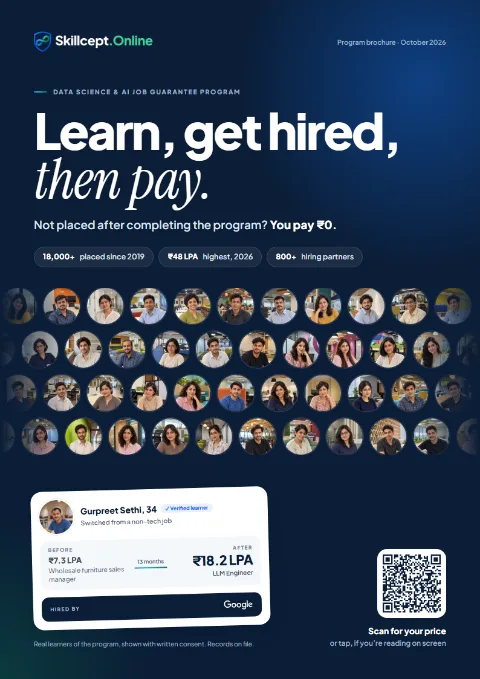
Our Data Science & AI Job Guarantee Program maps Plus to Data Scientist roles and Infinity to AI/ML Engineer roles; Go, for Data Analyst roles, teaches the same core and Modern AI.
| Plan | For | AI modules | Minimum salary assured |
|---|---|---|---|
| Plus | Data Scientist roles | Modern AI and GenAI & LLMs (Modules 7 and 8), at your pace | ₹9 LPA or your salary + 35%, whichever is higher |
| Infinity | AI/ML Engineer roles | Modules 7 to 10, live on weekends: GenAI & LLMs, Production RAG & LLMOps, Agentic AI | ₹12 LPA or your salary + 85%, whichever is higher |
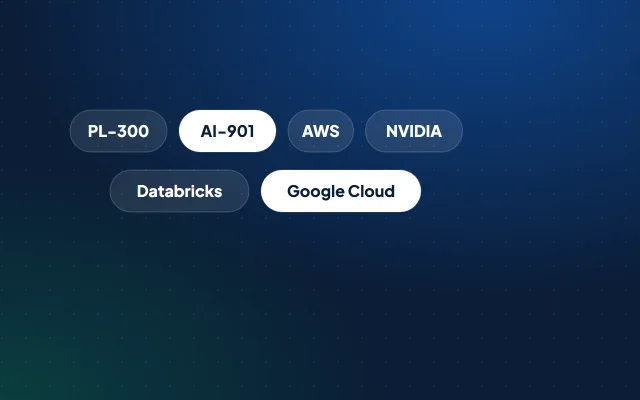
Once you complete the program, Infinity’s free certification exams include several for the jobs above, among them Google Cloud’s Professional Machine Learning Engineer, AWS’s Machine Learning Engineer and Databricks’ Generative AI Engineer; Plus’s include Microsoft’s AI-103. In the words of our FAQ:
Go suits a Data Analyst role, with ₹6 LPA minimum salary assured. Plus suits a bigger Data Scientist role: ₹9 LPA or your salary + 35%, whichever is higher. Infinity suits the biggest AI/ML Engineer roles: ₹12 LPA or your salary + 85%, whichever is higher, with live weekend classes. Compare the plans
- Go: a Data Analyst role
- Plus: a bigger role
- Infinity: the biggest roles, live
In writingTerms, section 3
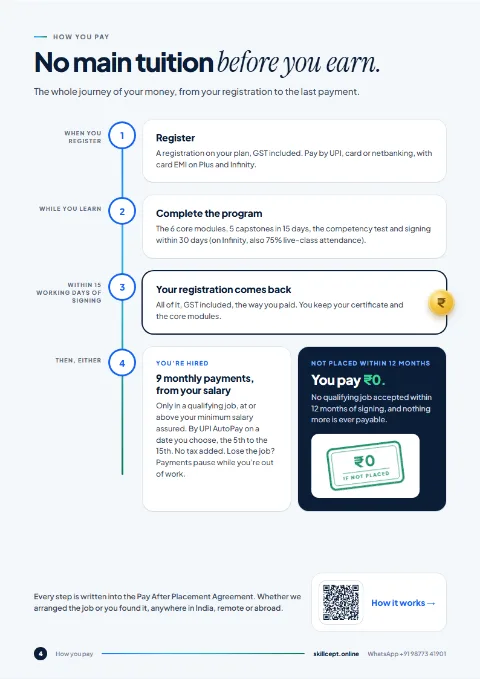
Interviews start once you complete the program: the 6 core modules, 5 capstones in 15 days, the competency test and signing within 30 days (on Infinity, also 75% live-class attendance). See every difference on Pricing.
Questions
What is the difference between an AI engineer and an ML engineer?
An ML Engineer trains, deploys and maintains machine learning models, such as fraud scores and forecasts, and the pipelines around them. An AI Engineer builds applications on large pre-trained models, such as assistants, document readers and agents, with retrieval, evaluation and guardrails. The skills overlap, and many job posts mix the two.
ML engineer vs data scientist: which is better?
Neither; they suit different people. Data Scientists spend more time on questions, experiments and statistics, ML Engineers on code, infrastructure and reliability. On AmbitionBox (19 Oct 2026), Data Scientists earn ₹11.3–12.5 lakh with 1–3 years’ experience and ML Engineers ₹9.2–10.2 lakh.
Who earns more, an AI engineer or a data scientist?
They’re close. AmbitionBox shows ₹10.4–11.5 lakh for AI Engineers and ₹11.3–12.5 lakh for Data Scientists with 1–3 years, and ₹15.3–16.9 lakh against ₹15–16.6 lakh with 3–6 years (19 Oct 2026). The kind of employer moves pay more than the title.
Can a fresher become an AI engineer or ML engineer?
Yes, but it’s the hardest way in: foundit found 18% of AI jobs in 2025 open to people with 0–3 years’ experience. Strong Python, a deployed project and numbers showing how well it works make the difference; many people start as a Data Analyst or Data Scientist first.
Do AI engineers need to know machine learning?
Yes, the fundamentals: how models are trained and evaluated, overfitting, embeddings and attention. AI Engineers rarely train large models from scratch, but they must know when a model is wrong and why.
Which should I learn first?
Python and SQL, then statistics and machine learning: that core serves all three roles. Then specialise: experiments and modelling for Data Scientist, deployment and MLOps for ML Engineer, LLM apps, RAG and agents for AI Engineer.
Sources
- AmbitionBox, Data Scientist salary in India, as of 19 Oct 2026, read 22 Oct 2026.
- AmbitionBox, Machine Learning Engineer salary in India, as of 19 Oct 2026, read 22 Oct 2026.
- AmbitionBox, AI Engineer salary in India, as of 19 Oct 2026, read 22 Oct 2026.
- AmbitionBox, salaries for Gen AI Engineer (21 Oct 2026), MLOps Engineer (16 Oct 2026) and Associate Data Scientist (19 Oct 2026), read 22 Oct 2026.
- foundit Insights Tracker, reported in Storyboard18, 13 Jan 2026, read 22 Oct 2026.
- LinkedIn, Jobs on the Rise 2026 (India), reported in Storyboard18, 8 Jan 2026, read 22 Oct 2026.
- LinkedIn data, reported by IANS: AI engineering hiring in India jumps 59.5%, 24 Apr 2026, read 22 Oct 2026.
- Naukri, JobSpeak, September 2026, 6 Oct 2026.
- World Economic Forum, The Future of Jobs Report 2025, India economy profile, 7 Jan 2025.
- Google Cloud, Professional Machine Learning Engineer, read 22 Oct 2026.
- AWS, AWS Certified Machine Learning Engineer – Associate, read 22 Oct 2026.
- Microsoft Learn, Microsoft Certified: Azure AI Apps and Agents Developer Associate, read 22 Oct 2026.
- Databricks, Databricks Certified Generative AI Engineer Associate, read 22 Oct 2026.