Skillcept Online
Key takeaways
- The move is usually a raise: AmbitionBox shows Customer Support Executives at ₹2.7–3 lakh a year with 1–3 years’ experience, against ₹5.2–5.7 lakh for Data Analysts (pages updated 19–20 Oct 2026).1
- The steps in between pay more as you climb: at 1–3 years, Real Time Analysts earn ₹3.8–4.1 lakh, Operations Analysts ₹4.5–4.9 lakh and Reporting Analysts ₹4.6–5.1 lakh (AmbitionBox, October 2026).1
- The ladder decides the long run: TeamLease Digital projects FY27–28 pay growth of 6.6% for technical support engineers, against 12.0% for data engineers (September 2026).2
- BPO/ITES hiring on Naukri grew 4% on the year in September 2026, ahead of white-collar hiring overall at 2%.3
Can you move from BPO to data analyst?
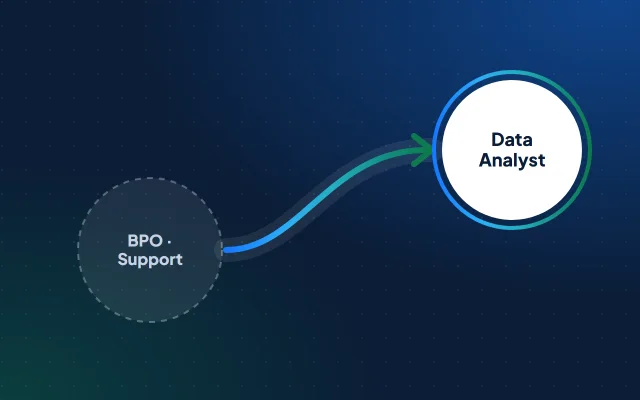
Yes. A data analyst turns raw records into answers a business can act on, and a contact centre runs on records: every call, chat and ticket is logged, timed and scored. You already read those numbers every day; the switch is learning to produce them.
It’s also a raise for most people. Here is where support roles sit and where the switch leads, on AmbitionBox:1
| Where you are | 1–3 years | 3–6 years |
|---|---|---|
| Customer Care Executive | ₹2.5–2.8 L | ₹2.8–3.1 L |
| Customer Support Executive | ₹2.7–3 L | ₹3.3–3.6 L |
| Customer Service Executive | ₹2.9–3.2 L | ₹3.3–3.7 L |
| Process Associate | ₹2.9–3.2 L | ₹3.5–3.8 L |
| Senior Process Associate | ₹3.6–4 L | ₹4.2–4.7 L |
| Where the switch leads | 1–3 years | 3–6 years |
|---|---|---|
| Operations Analyst | ₹4.5–4.9 L | ₹5.6–6.2 L |
| Reporting Analyst | ₹4.6–5.1 L | ₹5.9–6.5 L |
| Data Analyst | ₹5.2–5.7 L | ₹7.2–7.9 L |
| Business Intelligence Analyst | ₹6.8–7.5 L | ₹9.4–10.4 L |
| Business Analyst | ₹7–7.7 L | ₹8.7–9.7 L |
Source: AmbitionBox, typical yearly pay by experience, pages updated 19–21 Oct 2026 and read 22 Oct 2026.1
The gap widens with time. TeamLease Digital’s salary primer puts a Technical Support Engineer at ₹5.2 LPA rising to ₹14.6 LPA with experience, and a Data Engineer at ₹9.1 LPA rising to ₹29.6 LPA.2 Staying on the support ladder is the slower road.
The ladder inside your BPO
Many BPOs have analyst jobs one floor up: quality, MIS, real-time and workforce management (WFM), and reporting. They’re the shortest route to a data analyst title, because you can apply internally with process knowledge no outside candidate has.
| Step | The job | Pay, 1–3 years | The skill that gets you there |
|---|---|---|---|
| Quality Analyst | Audits calls against a scorecard and runs calibration | ₹4.2–4.6 LIn BPO, all experience | Sampling, Excel, clear feedback |
| MIS Executive | Builds the daily and weekly reports from dialler, CRM and ticket exports | ₹2.8–3.1 L | Excel: PivotTables, XLOOKUP, Power Query |
| Real Time Analyst | Watches queues in the shift and moves agents to protect the service level | ₹3.8–4.1 L | Intraday data, fast Excel |
| WFM Analyst | Forecasts volumes and plans rosters and shrinkage | ₹3.8–4.5 L67 salaries | Forecasting, Erlang C staffing |
| Reporting Analyst | Owns the dashboards and KPI reporting | ₹4.6–5.1 L | SQL, Power BI |
| Data Analyst | Answers business questions with data | ₹5.2–5.7 L | SQL, Power BI, Python |
Source: AmbitionBox, read 22 Oct 2026.1 Samples under 1,000 salaries are marked.
One honest warning: an MIS Executive earns about what an agent does, ₹2.8–3.1 lakh at 1–3 years, so treat MIS as a skills step, not a pay step.1 The pay step comes at reporting and data analyst roles. To get the first step, tell your team lead you want to help with one report, and learn what the MIS team uses.
Your KPIs are data
Everything you’re measured on is an analyst’s raw material. AHT, average handle time, is talk time plus hold time plus after-call work, divided by the calls handled; an analyst asks which calls and which agents sit in its long tail. Here’s each KPI turned into the analysis behind it:
| The KPI you know | What an analyst does with it | The skill |
|---|---|---|
| AHT | Looks at the spread, not the average: which call types run long, and why | Percentiles in Excel or SQL |
| FCR (first contact resolution) | Finds customers who came back within 7 days, by reason | SQL joins on customer and date |
| CSAT and NPS | Links survey scores to wait time, call reason and agent | Joins, PivotTables, statistics |
| Service level and ASA | Measures calls answered within target, interval by interval | Time-window calculations |
| Occupancy and shrinkage | Works out how many agents each half-hour needs | Erlang C, forecasting |
| Attrition | Tracks who leaves by training batch, month and team | Cohort analysis |
| QA scores | Checks whether audit samples are big enough to trust | Sampling, confidence intervals |
In an interview, this is your advantage: you can explain why a number moved, because you were on the floor when it did. For the paths from other backgrounds, see our non-IT switch guide.
Is AI shrinking support jobs?
It is shrinking the scripted part. In the World Bank’s study of 28 million South Asian job postings, mostly white-collar roles in Indian cities, generative AI cut monthly listings by about 20% for the most exposed, least complementary jobs, such as call-centre agents, and labour demand for call-centre agents fell 24% relative to machine operators.4 Listings for exposed jobs where AI complements people did not fall.4
Analysis jobs increasingly ask for AI as a skill: Indeed found AI mentioned in 39% of data and analytics job postings in India in September 2025.5 So learn the tools as you go: ask an AI assistant to draft a formula or a query, then check every number it gives you.
Three projects that use what you know
Recruiters want proof on data like their own. These three use public data, never your employer’s: don’t take company data home, even anonymised.
1. A grievance SLA dashboard on government dataBeginner
Data: the Department of Administrative Reforms and Public Grievances’ CPGRAMS Monthly Report, June 2026: by ministry, grievances received and resolved, resolution within the timeline, average disposal time and feedback. It reads like a support floor’s MIS. In June 2026, central ministries received 1,96,133 grievances and resolved 1,99,968; of the 78,793 pending, about 68% were under 21 days old, the closing time DARPG’s 2024 guidelines set. From January to June, its feedback call centre logged 2,66,560 feedback cases, about 57% of them resolved.6 Skills: Power Query, Excel, Power BI.
- Collect six monthly reports and pull the ministry table from each into one sheet.
- Compute resolution within 21 days, backlog and its age, and the satisfied share.
- Rank ministries, and chart the backlog month by month.
Show it: a one-page Power BI report, opened by the three ministries that most need help.
2. Complaint analysis in SQLIntermediate
Data: the US Consumer Financial Protection Bureau’s Consumer Complaint Database, generally updated daily, as a CSV download or an API, with fields such as Date received, Product, Issue, Submitted via, Company response to consumer and Timely response?.7 It’s US data, but the questions are the ones a support floor asks. Skills: SQL, Excel.
- Load a year of complaints into MySQL or PostgreSQL.
- Timely-response rate by product and channel; days from receipt to the company.
- Which issues grow month on month, with
LAG.
Stretch: the bureau’s page says 99% of complaints sent to companies get timely responses; reproduce that figure from the data.7
3. An Erlang C staffing calculatorIntermediate
Data: none to download: build it with made-up interval volumes. Erlang C is the classic formula WFM teams use to work out how many agents a queue needs to answer a target share of calls within a target time. Skills: Excel, then Python.
- Inputs: calls per half-hour, AHT, the target (for example, 80% of calls answered in 20 seconds) and shrinkage.
- Output: agents needed for each interval, and the service level each staffing level gives.
- Rebuild it in Python, and chart staffing needed against a roster.
Show it: the workbook and a short README. It speaks straight to WFM roles. For more, see our 15 projects on Indian public data.
A 6-month plan that fits shifts
About 10 hours a week for six months, planned around your roster: short sessions on working days and one long block on your weekly off. Every month ends with something you can show.
| Month | Focus | You finish with |
|---|---|---|
| 1 | Excel to analyst level: PivotTables, XLOOKUP, Power Query | A weekly MIS rebuilt from a raw export of public data |
| 2 | SQL, from SELECT to joins and GROUP BY | Twenty questions answered on the complaint data |
| 3 | SQL window functions; statistics basics | Repeat-contact and SLA queries |
| 4 | Power BI | The grievance dashboard, published |
| 5 | Python basics; the staffing calculator | Three projects, each with a README |
| 6 | Resume, interview practice, internal and outside applications | Five internal conversations and 20 applications |
- On night shifts, study soon after you wake, not straight after a shift.
- Keep the same slots every week, even when your shift rotates.
- Use weekly offs for the long building sessions.
On our program, Module 3 (Excel, Power BI and pandas, about 30 hours) and Module 4 (SQL, about 11 hours) cover most of months 1 to 4. See the curriculum. In the words of our FAQ:
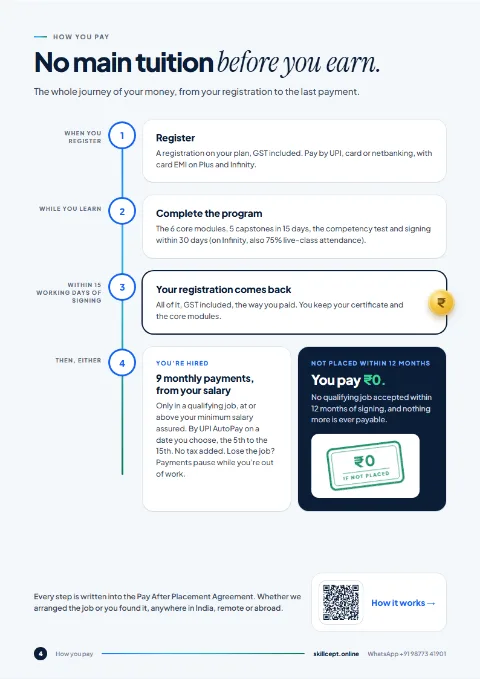
Yes, it’s made to fit around a job. Go and Plus are self-paced, at about 10 hours a week. Infinity’s live classes are on weekends, Saturday and Sunday, 11 AM to 2 PM IST, and every class is recorded the same day. The job you have when you register doesn’t affect your refund, and on Plus and Infinity your minimum salary assured can be set from your current pay: ₹9 LPA or your salary + 35%, whichever is higher, on Plus, and ₹12 LPA or your salary + 85%, whichever is higher, on Infinity.
- Self-paced, about 10 hours a week
- Infinity: weekends, recorded the same day
- Your current job doesn’t affect your refund
Your resume and interview
Rewrite your support work as data work, with your own numbers, and expect interviews to test the KPIs you already know.
| Instead of | Write |
|---|---|
| Handled inbound calls for a telecom process | Found the call reasons behind [x]% of repeat contacts with SQL; the fix cut repeats by [y]% |
| Prepared daily MIS reports | Automated the daily MIS with Power Query, saving [n] hours a week |
| Top performer in CSAT | Analysed [n] CSAT surveys to find the wait time after which scores fall |
Questions to practise: “How would you cut AHT without hurting CSAT?”, “Write a query for customers who called again within 7 days”, “What’s the difference between service level and occupancy?” and “CSAT fell last week. What do you check first?”. Our SQL interview questions cover the queries.
Questions
Can a BPO employee become a data analyst?
Yes. Contact centres run on data, and the steps in between, quality, MIS, real-time, WFM and reporting roles, are often inside your own company. Learn Excel, SQL and Power BI, and build projects on support-style public data.
Is MIS a good career after BPO?
As a step, yes; as a destination, check the pay. AmbitionBox (October 2026) shows MIS Executives at ₹2.8–3.1 lakh a year with 1–3 years’ experience, against ₹4.6–5.1 lakh for Reporting Analysts and ₹5.2–5.7 lakh for Data Analysts.
Will my BPO experience count in analytics?
Yes, in operations, customer-experience and workforce analytics, where knowing the floor is half the job. Present your years as process knowledge plus new data skills, not as a fresh start.
Can I learn data analytics while working night shifts?
Yes, at about 10 hours a week: short sessions soon after you wake on working days and one long block on your weekly off. Keep the same slots every week, even when your shift rotates.
How much more does a data analyst earn than a BPO executive?
On AmbitionBox (October 2026), Data Analysts with 1–3 years’ experience earn ₹5.2–5.7 lakh a year, against ₹2.7–3 lakh for Customer Support Executives and ₹2.9–3.2 lakh for Process Associates.
Sources
- AmbitionBox salary profiles, read 22 Oct 2026 (each updated 19–21 Oct 2026): Customer Care Executive, Customer Support Executive, Customer Service Executive, Process Associate, Senior Process Associate, Quality Analyst, MIS Executive, Real Time Analyst, WFM Analyst, Reporting Analyst, Operations Analyst, Data Analyst, Business Intelligence Analyst and Business Analyst.
- TeamLease Digital, Digital Skills & Salary Primer FY2026–27, reported in CXOToday, 29 Sep 2026, read 22 Oct 2026.
- Naukri, JobSpeak, September 2026, 6 Oct 2026, read 22 Oct 2026.
- World Bank, South Asia Development Update, October 2025, read 22 Oct 2026.
- Indeed Hiring Lab, September 2025 labour market update, 25 Oct 2025.
- Department of Administrative Reforms and Public Grievances, CPGRAMS Monthly Report for Central Ministries/Departments, June 2026, published through PIB, read 22 Oct 2026.
- Consumer Financial Protection Bureau, Consumer Complaint Database and its field reference, read 22 Oct 2026.