Skillcept Online
Key takeaways
- A job guarantee in a course is a promise of a remedy, such as a refund or a fee you never pay, if you complete the program and aren’t placed; no course can promise that an employer will hire you.
- Placement assistance is help with no remedy, and interviews assured is a number of interviews; only a guarantee puts a remedy in writing.
- India’s coaching-ad guidelines, in force since 13 November 2024, treat false success rates and false claims of guaranteed selection, job security or salary increases as misleading advertisement.1
- They are enforced: by 30 May 2026 the CCPA had issued more than 60 notices to coaching institutes and imposed penalties of more than ₹1.46 crore.2
- A guarantee is only as strong as five definitions: completing, a qualifying job, the minimum salary, the time window and the remedy.
What does a job guarantee in a course cover?
It covers what happens to your money if you don’t get a job, not whether you get one. A job guarantee, or placement guarantee, in a course is a written promise of a remedy, such as a full or partial refund or a fee that is never charged, if you meet the program’s conditions and aren’t placed within a set time.
No training provider controls hiring. Employers decide whom to interview, whom to hire, what to pay and when you start. An honest guarantee says so plainly, and puts what the provider does control into the contract: the training, the interviews and support it arranges, and what you pay if they don’t lead to a job.
The words, decoded
Course ads use these terms loosely. Here is what each one means when it’s written properly, and the question that pins it down.
| Term | What it means, and what to ask |
|---|---|
| Job guarantee, placement guarantee | A remedy, such as a refund or a fee never charged, if you complete and aren’t placed in time. Not a promise of a job. Ask: what exactly do I get back or never pay, and by when? |
| Pay after placement | The main fee falls due only after you join a job that meets the contract’s terms. Ask: is it a fixed amount or a share of my salary, and is a lender involved? |
| Placement assistance, placement support | Help finding a job, such as resume reviews, job leads and mock interviews. No remedy if you aren’t hired. Ask: what exactly, how much of it, and for how long? |
| Interview guarantee, interviews assured | A promised number of interviews. Ask: what counts as an interview, with whom, and over what period? |
| Money-back guarantee, refund if not placed | You pay upfront and get money back if you met every condition and aren’t placed. Ask: all of it or part, what’s deducted, and within how many days? |
| Qualifying job | A job that counts as a placement under the contract. Ask: full-time only, in the field, and do internships or contracts count? |
| Salary floor, minimum salary | The lowest pay a job must offer to count: a threshold for the fee, not a promise of pay. Ask: what number, and is it fixed pay or CTC? |
| Placement period | How long the provider has to place you. Ask: when does it start and end, and what extends it? |
| Completing, eligibility | Everything you must do for the guarantee to apply. Ask: is each condition in my control, with a date? |
| Placement rate, placement record | The share of learners placed. Ask: out of how many, over what period, and what counted as placed? |
Notice which terms carry a remedy. Placement assistance and interviews assured are real help, and worth having in writing with numbers, but neither one changes what you pay if no job comes. Only a guarantee, or a fee that waits for a job, does that.
Claims to question
Treat any claim that every learner is placed, or that a salary rise is certain, as a question to ask rather than a fact. India’s coaching-ad guidelines list false claims about the number of selections, ranks or success rate, and false claims such as guaranteed selection, job security, promotions or salary increases, as misleading advertisement.1 While the guidelines were still being drafted, the CCPA said coaching institutes should not claim that every candidate is selected or that a job is fully guaranteed.3
Placement percentages
A placement rate can be honest, but only with three facts beside it: the base (out of how many learners), the period, and what counted as placed. Without them a rate can’t be checked. Ask whether learners who dropped out, or never finished, are left out of the base.
Salary claims
A minimum salary in a fee contract is a threshold: the fee waits for a job that pays at least that much. It isn’t a promise that you’ll earn it, and an honest contract says so. Ours calls it “a threshold for the fee, not a promise of any salary” (Agreement 2.3).
Pressure to decide today
A deadline that isn’t real, or scarcity that isn’t true, is misleading too: the guidelines name a false sense of urgency or scarcity, and false popularity, among the conditions for a misleading advertisement.1 A real guarantee reads the same tomorrow, so take the contract home and read it.
What India’s rules say
The Central Consumer Protection Authority’s Guidelines for Prevention of Misleading Advertisement in Coaching Sector, 2024 came into force on 13 November 2024. They apply to every form of advertisement by anyone engaged in coaching, including endorsers, and they define coaching broadly: academic support, imparting education, guidance, instructions, study programs and tuition.1
| Clause | What it says, and what it means when you compare courses |
|---|---|
| 3(a) Fees and refunds | No false claims about courses, duration, faculty credentials, fees or the exit and refund policy. The refund terms in an ad must match the contract. |
| 3(b) Success rates | No false claims about the number of selections, ranks or success rate. Ask for the base and the period behind any rate. |
| 3(c) Guarantees | No false claims such as guaranteed selection, job security, promotions or salary increases. Read a guarantee as a remedy in the contract, not a promised job. |
| 3(e) Urgency | No false sense of urgency or scarcity, and no false popularity. A true deadline is fine; pressure built on a false one isn’t. |
| 4(1)(b) Disclaimers | Shown prominently, in the same font as the claim. The conditions can’t hide in small print. |
| 4(1)(d) Recognition | Approval by bodies such as AICTE or UGC stated truthfully, where it applies. A certificate isn’t a degree unless it’s approved as one. |
| 4(2) Testimonials | No successful candidate’s name, photo or testimonial without written consent, taken after selection. Success stories should be real people who agreed. |
Source: CCPA, Guidelines for Prevention of Misleading Advertisement in Coaching Sector, 2024, in our words.1
They are enforced
By 30 May 2026 the CCPA had issued more than 60 notices to coaching institutes and imposed penalties of more than ₹1.46 crore, the Union Minister for Consumer Affairs said.2
Where to complain
Start with the program’s grievance officer, in writing, and keep copies of the ad and the contract. If that fails, the National Consumer Helpline takes complaints on 1915 (8 AM to 8 PM), on WhatsApp at +91 88000 01915, and online.4 Through it, the Department of Consumer Affairs got ₹1.56 crore refunded to more than 600 students in the education sector who said they had been denied refunds, it reported in February 2025.5
The five definitions a guarantee needs
Five definitions decide whether a guarantee protects you. If one of them is missing from the contract, the guarantee is weaker than the ad.
- Completing. Every condition you must meet, each with a date, and each one something you control.
- A qualifying job. Full-time, in the field you trained for, with a written list of what doesn’t count, such as internships and contracts.
- The minimum salary. A number, measured on fixed pay rather than a CTC that counts bonuses. For an analyst course, compare it with entry pay: AmbitionBox put Data Analysts with 0–1 year at ₹3.5–5.2 lakh a year (16 Oct 2026, a small sample).6
- The time window. When the placement period starts, how long it runs, and what extends it.
- The remedy. What you get back or never pay, how much of it, and within how many days.
Our agreement defines the first four in one section, Words that matter, and the fifth in another, Not placed: ₹0. And here is our answer to the question this guide is about, word for word:
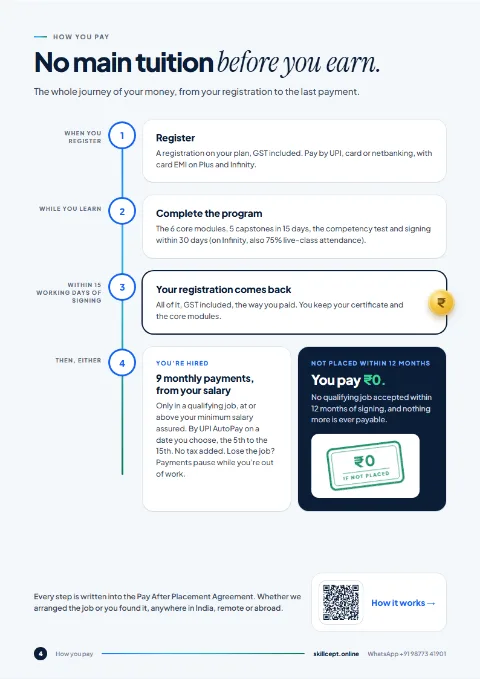
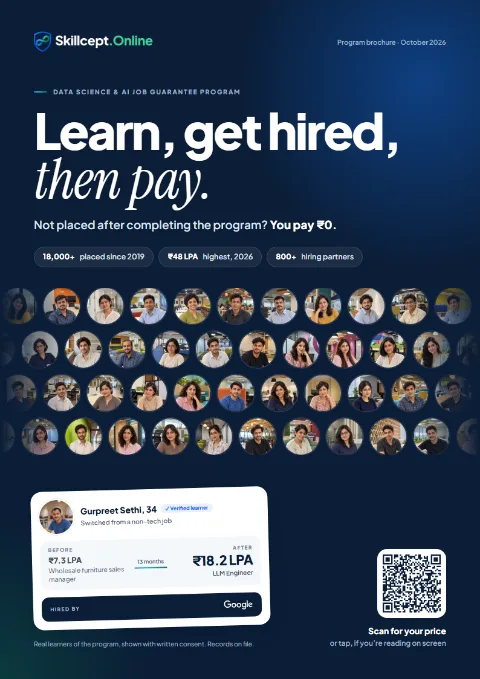
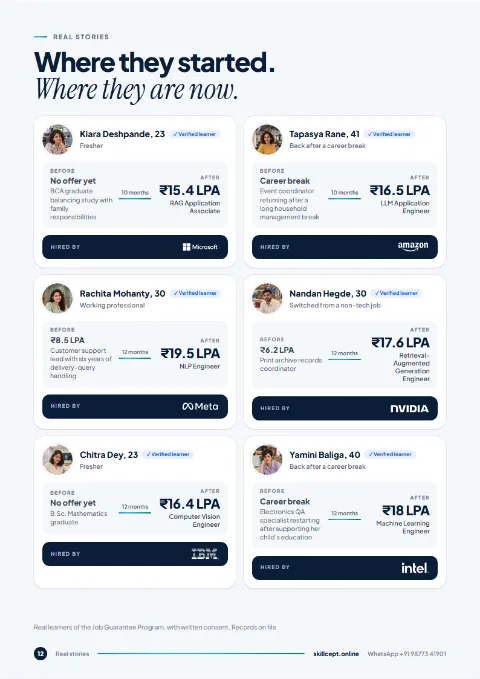
Not placed after completing the program? You pay ₹0. That’s the Job Guarantee Program, in writing in the agreement you sign: complete the program, and if you don’t accept a qualifying job within 12 months of signing, the main fee is never due and you keep your registration refund. Employers make every hiring decision, so no one can promise you a particular job; what we commit to, in writing, are the interviews, preparation and support your plan includes. Read the agreement
- ₹0 if you’re not placed
- Interviews assured, in writing
- Employers decide whom they hire
In writingAgreement 1.6Agreement 5.1Legal notices, section 2
Red flags
Slow down, and ask for the contract, if you see any of these:
- A guarantee that lives only in the ad, a brochure or a counsellor’s message, and not in the contract.
- “Placed” left undefined, or defined to include internships, contracts or any offer letter.
- No minimum salary, or one below what entry-level jobs pay anyway.
- Conditions you can’t control, or rules the provider can change after you pay.
- A refund “at our discretion”, or one with no deadline in days.
- A loan agreement signed together with the enrolment form.
- Success rates with no base, no period and no definition of placed.
To test any program on the money as well, send it our 12 questions to ask before you pay. For how the fee models compare, read pay after placement courses, explained.
Questions
Can a course really guarantee a job?
No course can guarantee that an employer will hire you, because employers make every hiring decision. What a course can guarantee, in writing, is a remedy if you complete it and aren’t placed, such as a refund or a fee that is never charged.
What is the difference between placement assistance and a placement guarantee?
Placement assistance is help finding a job, such as resume reviews, job leads and mock interviews, with no remedy if you aren’t hired. A placement guarantee adds a written remedy, such as a refund or a waived fee, if you meet the conditions and aren’t placed in time.
Are job guarantee courses legal in India?
Yes, if the advertising is true and the contract matches it. India’s CCPA guidelines on coaching ads, in force since 13 November 2024, treat false success rates and false claims of guaranteed selection, job security or salary increases as misleading advertisement.
What should a job guarantee agreement include?
Five definitions: what completing the program means, which jobs count, the minimum salary and how it’s measured, how long the placement period runs, and exactly what you get back or never pay, with a deadline in days.
Where can I complain about a false placement claim?
Write to the program’s grievance officer first. If that fails, contact the National Consumer Helpline on 1915 (8 AM to 8 PM) or WhatsApp +91 88000 01915; in February 2025 the Department of Consumer Affairs reported ₹1.56 crore refunded through it to more than 600 students in the education sector.
Is a data analyst course with a placement guarantee any different?
The same checks apply. Make sure analyst and BI roles count as qualifying jobs, and that the salary floor sits above entry pay, which AmbitionBox put at ₹3.5–5.2 lakh a year for Data Analysts with 0–1 year (16 Oct 2026).
Sources
- Central Consumer Protection Authority, Guidelines for Prevention of Misleading Advertisement in Coaching Sector, 2024, 13 Nov 2024 (read 22 Oct 2026).
- News On AIR, CCPA penalises a coaching centre over a misleading advertisement, 30 May 2026.
- Careers360, the CCPA on selection and job claims in coaching ads, 9 Jan 2024.
- Department of Consumer Affairs, National Consumer Helpline, read 22 Oct 2026.
- PTI, reported in Outlook Business, 22 Feb 2025.
- AmbitionBox, Data Analyst salary in India, as of 16 Oct 2026.