Skillcept Online
Key takeaways
- A pay after placement course charges its main fee only after you join a job that meets the contract’s terms; before that you pay a registration, a deposit or nothing.
- Four fee models sit behind the label: a fixed fee after placement, a share of your salary, a refund if you aren’t placed, and the full fee upfront with “placement assistance”.
- If a bank or NBFC pays the course provider for you, you’re a borrower: every new retail term loan since 1 October 2024 must come with a Key Facts Statement whose APR includes all charges (RBI).1
- Time matters as much as the fee: fresher hiring on Naukri grew just 1% in September 2026, so check how long the program keeps supporting you.2
- India’s coaching-ad guidelines, in force since 13 November 2024, treat false claims about fees, refunds and success rates, and false promises of job security or salary increases, as misleading.3
What is a pay after placement course?
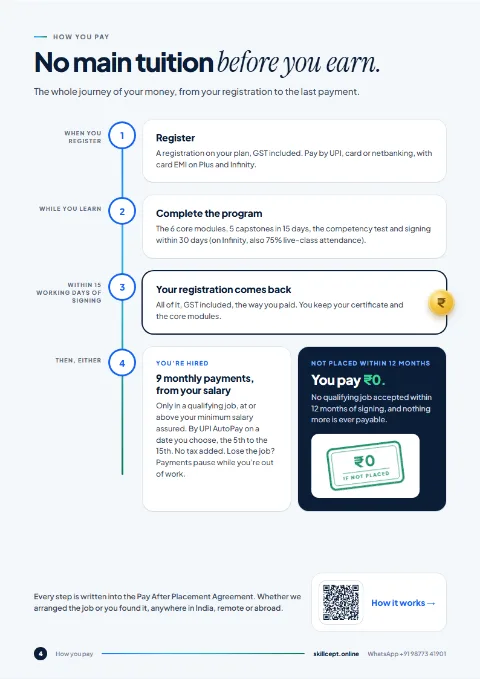
A pay after placement course is a training program whose main fee falls due only after you join a job that meets the conditions in your contract. You may pay something smaller first, such as a registration or a deposit, and the rest comes from your salary, as a fixed amount or as a share of it.
The idea is to move the risk: if the training doesn’t lead to a job, the provider carries the cost instead of you. How much of that risk really moves depends on the contract, so two courses with the same label can cost you very different amounts.
The four models, side by side
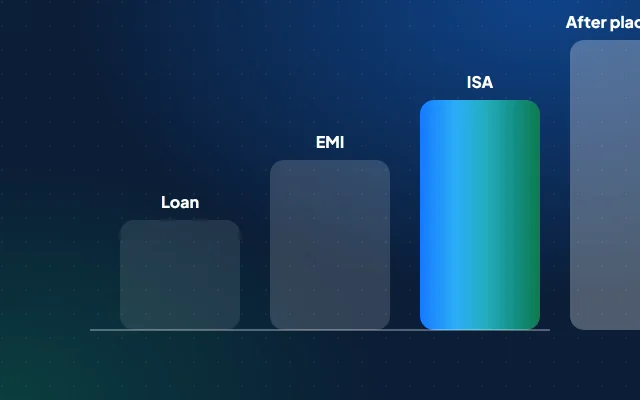
Behind labels like “pay after placement” and “no upfront fees” you’ll find one of four fee models, or a mix of them. They differ in what you pay before a job, what you pay after one, and what happens if no job comes.
| Model | Before a job | After you’re hired | If you’re not placed |
|---|---|---|---|
| Fixed fee after placement | A registration, a deposit or nothing | A set amount in set instalments, the same at any salary above the floor | Nothing more once the placement period ends; check whether your registration comes back |
| Income share agreement (ISA) | Little or nothing | A percentage of your salary for a set number of months, with or without a cap on the total | Nothing while you earn below the threshold; check how long the agreement can run |
| Refund if not placed | The full fee | Nothing more | Money back, if you met every condition, by the date in the contract |
| Upfront fee with “placement assistance” | The full fee, in one go or in instalments | Nothing more | Nothing back: assistance is help, not a promise |
The models in outline. The contract you sign decides the details.
Two of these terms need a definition. An income share agreement (ISA) is a contract to pay a fixed percentage of your income for a fixed period once you earn above an agreed threshold. Placement assistance is help finding a job, such as resume reviews, job leads and mock interviews, with no remedy if you aren’t hired.
Any of these can sit on top of a loan: if a bank or NBFC pays the provider and you repay it, you owe that lender whatever happens to your job search. Our guide to ISAs, EMIs and education loans covers what RBI requires of lenders.
Three outcomes, four models
Compare the models by what each one costs you in three futures: no job in time, a job below the salary floor, and a well-paid job.
| Model | No job in time | A job below the floor | A well-paid job |
|---|---|---|---|
| Fixed fee after placement | Nothing more | Nothing: the fee doesn’t start | The fixed fee, the same at any salary |
| Share of salary (ISA) | Nothing while you’re below the threshold | Nothing, if it’s below the threshold | More: the share grows with your pay |
| Refund if not placed | A refund, if you met every condition | Depends on whether that job counts as “placed” | No refund; the fee is already paid |
| Upfront fee with assistance | Nothing back | Nothing back | The fee is already paid |
Here is the share-of-salary effect in numbers, using made-up terms that belong to no real program: an ISA that takes 15% of your salary for 24 months.
| Your salary | What that ISA costs you |
|---|---|
| ₹5 LPA | ₹1.5 lakh |
| ₹8 LPA | ₹2.4 lakh |
| ₹12 LPA | ₹3.6 lakh |
Worked example: 15% for 24 months is 3.6 months of your pay, whatever you earn.
Neither model is always cheaper: a share can cost less on a modest first salary and more on a big one, while a fixed fee doesn’t move. What makes either one fair is the floor and the window around it.
What decides what you pay
Seven clauses decide your real cost, more than the model’s name does. Find each one in the contract before you pay.
1. The salary floor
A salary floor is the lowest pay a job must offer before any fee is due. A floor close to entry-level pay protects you little: AmbitionBox put Data Analysts with 0–1 year at ₹3.5–5.2 lakh a year, and with 1–3 years at ₹5.2–5.7 lakh (16 Oct 2026; the 0–1 year band rests on a small sample).4
Check how pay is measured, too. Fixed pay is what you can count on; a CTC figure can include variable pay, bonuses and your employer’s PF. Our guide to CTC and in-hand salary explains each part of an offer. If you already work, look for a floor tied to your current pay, so that a “placement” can’t be a pay cut.
2. Which jobs count
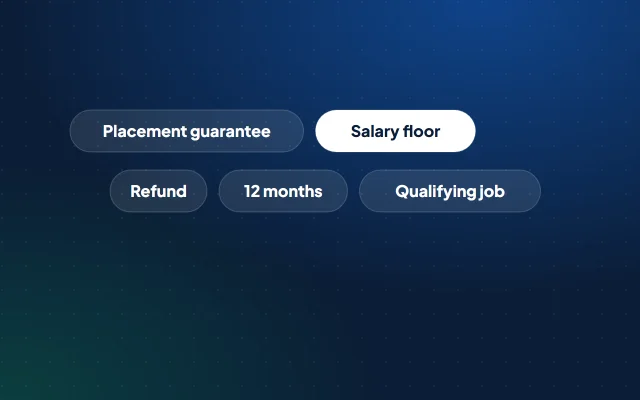
A qualifying job is a job that counts as a placement under your contract. Look for full-time roles in the field you trained for, and a written list of what doesn’t count: if an internship, a contract or a job in another field counts, a provider can call you placed when you aren’t. Check whether a job you find yourself, a remote job or one abroad counts. Here is one written definition, from our own FAQ:
A full-time job in data science, analytics, AI/ML, BI or software work that uses data, with fixed annual pay at or above your minimum salary assured, that you accept within 12 months of signing the agreement (and join within 90 days after those 12 months end, if it starts later). It counts whether we arranged it or you found it, anywhere in India, remote or abroad.
- A full-time job
- In data science, analytics, AI/ML or BI
- At or above your minimum salary assured
In writingAgreement 2.2Agreement 2.4
3. The time window
The placement period is how long the provider has to place you, and it decides when “not placed” becomes true. Job searches take time: in September 2026, fresher hiring on Naukri grew 1% on the year, against 20% for AI/ML roles.2 A short window can close while you’re still interviewing. Check when it starts (enrolment, completion or signing), how long it runs, and whether it’s extended when the provider can’t support you.
4. The completion rules
A guarantee applies only if you complete the program, so the definition of completing is part of the price. Attendance, assignments, tests and deadlines are fair conditions when each one is written down, dated and in your control; be wary of rules the provider can change after you pay.
5. When your upfront money comes back
If you pay a registration, a deposit or the full fee before a job, find out exactly when it comes back and on what conditions: a number of working days, the method, and whether GST comes back with it. “Refunds at our discretion” is not a refund policy.
6. A lender, or not
If a bank or NBFC pays the provider for you, you have a loan: a credit check, a contract with the lender, and instalments you owe even if you never get a job. RBI requires a Key Facts Statement for every new retail term loan sanctioned from 1 October 2024, with an annual percentage rate (APR) that includes all the lender’s charges; a charge that isn’t in it can’t be added later without your explicit consent.1 For loans made through apps and websites, RBI’s Digital Lending Directions add a cooling-off period of at least one day to exit without a penalty, and require the lender to report the loan to credit information companies.5
7. What happens after you’re hired
Count the instalments, check for interest or late fees, and look for three protections: payments that pause if you lose the job, early payment without a penalty, and a promise that only you are contacted about money.
How to read the agreement in 15 minutes
Read it before you pay anything, in this order. If a program won’t show you the agreement before you pay, that is your answer.
- The definitions first. “Completing”, “placed” or “qualifying job”, “salary” and “placement period” decide every other clause.
- Every amount and every date. What you pay before and after a job, when each payment falls due, and anything added on top: interest, tax, late or processing fees.
- The exits. Stopping midway, falling ill, getting a job before you finish, turning down an offer, losing a job.
- The remedy. What you get back, or never pay, if you complete and aren’t placed, and within how many days.
- Who you’re dealing with. A registered company you can look up, a named grievance officer, and whether a lender signs too.
- The ad against the contract. Anything an ad or a counsellor promised that isn’t in the contract isn’t a promise.
| Clause | A good answer | A red flag |
|---|---|---|
| Salary floor | A number, measured on fixed pay | No number, or a CTC that counts bonuses |
| Qualifying job | Full-time, in the field, with a list of what doesn’t count | Internships, contracts or any offer letter count |
| Placement period | A clear start date, and long enough for a real job search | A window that starts before you finish, or lasts weeks |
| Completion | Conditions you control, each with a date | Rules the provider can change after you pay |
| Refund | In full, within a stated number of days | “At our discretion”, or no deadline |
| Lender | None, or a named lender with a Key Facts Statement | A loan signed with your enrolment form |
| After you’re hired | Fixed instalments, no interest, a pause if you lose the job | Interest, late fees, calls to your employer or family |
For the full set of questions to send any program in writing, use our 12 questions to ask before you pay. For what the guarantee words themselves mean, read what a job guarantee really covers. Our own agreement is public: you can read its definitions and every other clause before you register.
Is pay after placement legit?
Yes, the model is legal, and it can work in your favour; whether a particular course is legit depends on whether its ads match its contract. India’s Central Consumer Protection Authority (CCPA) issued guidelines on coaching ads that have applied since 13 November 2024, to every form of advertisement by anyone engaged in coaching, including endorsers.3 Under them, a provider is engaged in misleading advertisement if it:
- makes false claims about its courses, their duration, its faculty, its fees or its exit and refund policy;
- makes false claims about its number of selections, ranks or success rate;
- makes false claims such as guaranteed selection, job security, promotions or salary increases;
- creates a false sense of urgency or scarcity to rush you into paying.
If a program doesn’t keep its word
Write to its grievance officer first, and keep everything in writing. If that fails, go to the National Consumer Helpline: call 1915 (8 AM to 8 PM), WhatsApp +91 88000 01915, or complain online.6 Through the helpline, the Department of Consumer Affairs got ₹1.56 crore refunded to more than 600 students in the education sector, it said in February 2025.7 If a lender is involved and doesn’t resolve your complaint within 30 days, you can take it to the RBI’s Integrated Ombudsman.5
Questions
What is a pay after placement course?
A training program whose main fee falls due only after you join a job that meets the contract’s terms, such as a minimum salary. You may pay a registration or a deposit first; the rest comes from your salary, as a fixed amount or as a share of it.
Is pay after placement the same as an income share agreement?
Not always. In an income share agreement you pay a percentage of your salary for a set period, so a better-paid job costs you more; in a fixed-fee model the amount after placement is the same at any salary above the floor.
Is pay after placement a loan?
Only if a lender is involved. If a bank or NBFC pays the course provider and you repay it, you have a loan, with a credit check and a credit record; if you pay the provider itself after you’re hired, with no lender, it’s a deferred fee, not a loan.
What happens if I don’t get placed?
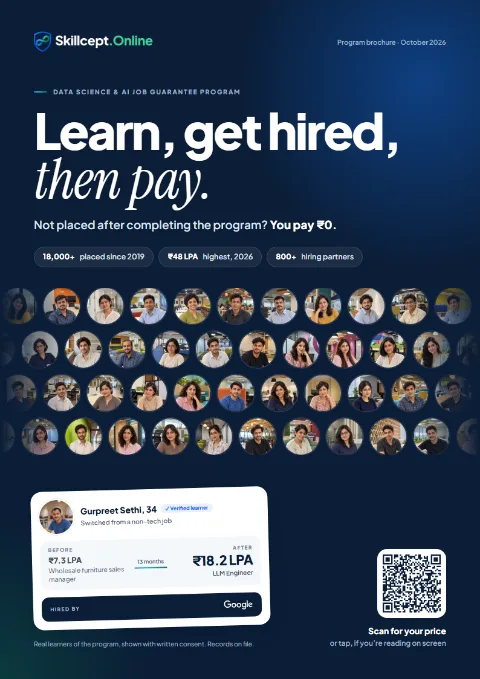
It depends on the contract. In a fixed-fee model you owe nothing more once the placement period ends; in a refund model you get money back only if you met every condition. Ours is the Job Guarantee Program: not placed after completing the program? You pay ₹0.
Are pay after placement courses legit in India?
The model is legal; judge each course by its written agreement. India’s CCPA guidelines on coaching ads, in force since 13 November 2024, treat false claims about fees, refunds and success rates, and false promises of job security or salary increases, as misleading; the National Consumer Helpline (1915) takes complaints.
Is a pay after placement data analyst course worth it?
It can be, if analyst roles count as qualifying jobs and the salary floor sits above entry pay: AmbitionBox put Data Analysts with 0–1 year at ₹3.5–5.2 lakh a year (16 Oct 2026). Check the floor, the window and whether a lender is involved before you pay.
Sources
- Reserve Bank of India, Key Facts Statement (KFS) for Loans & Advances, 15 Apr 2024 (read 22 Oct 2026).
- Naukri, JobSpeak, September 2026, 6 Oct 2026.
- Central Consumer Protection Authority, Guidelines for Prevention of Misleading Advertisement in Coaching Sector, 2024, 13 Nov 2024 (read 22 Oct 2026).
- AmbitionBox, Data Analyst salary in India, as of 16 Oct 2026.
- Reserve Bank of India, Reserve Bank of India (Digital Lending) Directions, 2025, 8 May 2025 (read 22 Oct 2026).
- Department of Consumer Affairs, National Consumer Helpline, read 22 Oct 2026.
- PTI, reported in Outlook Business, 22 Feb 2025.