Skillcept Online
Key takeaways
- A course EMI is a loan whenever a bank or NBFC pays the course provider for you: you owe every instalment whether or not you get a job.
- Every new retail term loan sanctioned since 1 October 2024 must come with a Key Facts Statement whose APR includes all the lender’s charges (RBI).1
- RBI’s digital lending rules give you a cooling-off period of at least one day to exit a loan by repaying the principal and the proportionate APR, without a penalty.2
- An income share agreement costs more the more you earn; a fixed fee after placement stays the same at any salary above its floor.
- A fee you owe the course provider itself, with no bank or NBFC involved, isn’t a loan: no lender, no credit check and nothing for a credit bureau to record.
The short answer
If you can avoid borrowing, a fee that waits for a job carries the least risk. If you must borrow, choose a loan with a clear Key Facts Statement over a vague “EMI”, and borrow only what you could repay without the job you’re training for. Here is how the options compare.
| Option | Who pays the provider | Whom you owe | On your credit report | If no job comes |
|---|---|---|---|---|
| Course EMI through a lender | A bank or NBFC | The lender, with interest or fees | Yes | You still repay in full |
| No-cost EMI on your card | Your card’s bank | Your bank, in instalments that add up to the price | Yes, on your card account | You still repay in full |
| Education or skill loan | A bank | The bank, with interest, after a moratorium | Yes, and on your co-borrower’s | You still repay in full |
| Income share agreement | The provider, or a lender behind it | A share of your salary, for a set period | Ask: it depends on who funds it | Nothing while you earn below the threshold |
| Fixed fee after placement, no lender | No one, until you’re hired | The provider, a fixed amount | No: it isn’t a loan | Nothing more, if the contract says so |
The options in outline. Each contract decides the details.
Course EMI: a loan by another name
When a course offers “EMI”, ask who is lending. It can be one of three things: the provider’s own instalment plan (you pay the provider, and no lender is involved), an EMI on your own credit card, or a loan from a bank or NBFC that pays the provider for you. The third is a loan in every sense: a credit check, a contract with the lender, interest or fees, and instalments you owe whether or not you finish the course or get a job.
A loan is a separate contract from the course. If you leave the course, or the provider doesn’t deliver, you still owe the lender unless the loan agreement says otherwise, so read both before you sign either.
What RBI requires of the lender
- A Key Facts Statement before you sign. For every new retail term loan sanctioned from 1 October 2024, the lender must give you a Key Facts Statement (KFS) with the annual percentage rate (APR), which includes every charge the lender levies. A charge that isn’t in the KFS can’t be added later without your explicit consent.1
- Repayment straight to the lender. For loans made through apps and websites, you repay into the lender’s own bank account, never through a pool account of a third party such as the course provider.2
- No fees to the middleman. What a lending service provider earns is paid by the lender; it can’t be charged to you or collected from you.2
- A cooling-off period. You can exit a digital loan within its cooling-off period, at least one day, by repaying the principal and the proportionate APR without a penalty; the lender may keep a one-time processing fee only if the KFS discloses it.2
- A named grievance officer. The lender and its service provider must each name one, with contact details in the KFS; if your complaint isn’t resolved within 30 days, you can take it to the RBI.2
- Credit reporting. The lender must report its digital loans to credit information companies, whatever their nature or tenure.2
The RBI also publishes the lending apps that lenders report to it, though a listing isn’t an endorsement.2
What it costs
The APR is the number to compare, not the monthly instalment. Here is what every ₹1 lakh borrowed for 12 months costs at three APRs, chosen to show the effect rather than any lender’s rates.
| APR | Monthly instalment | Extra you pay in a year |
|---|---|---|
| 12% | ₹8,885 | ₹6,619 |
| 18% | ₹9,168 | ₹10,016 |
| 24% | ₹9,456 | ₹13,472 |
Worked example: 12 equal monthly instalments, with the APR as a yearly rate. The Key Facts Statement shows the real figure for your loan.
Is no-cost EMI really free?
Close to it, when it’s done properly. A no-cost EMI is a card EMI in which the seller or the bank gives you the interest back as an upfront discount, so your instalments add up to the price. Your bank may still charge GST on the interest, or a processing fee. In September 2013 the RBI told banks that zero per cent interest doesn’t really exist, because the interest is often passed on as a processing fee instead.3 Card EMIs also sit outside the Key Facts Statement rule, which exempts credit card receivables, so your card’s terms decide.1 Read the total on the payment screen, not the word “free”. Here is how card EMI works on our program, word for word:
Yes, at checkout: for the registration on Plus and Infinity, and for Pay once on every plan. On the registration, for up to 6 months on eligible bank cards, it’s No Cost EMI: the interest comes off upfront, so your monthly payments add up to the registration, though your bank may still charge GST on the interest or a processing fee. Longer tenures carry your bank’s interest. Razorpay shows what applies to your card before you confirm. If your payment is refunded, we refund its full price, including the No Cost EMI discount; your bank’s interest and charges stay between you and your bank.
- No Cost EMI up to 6 months
- Longer: your bank’s interest
- Bank charges aren’t refunded by us
In writingBilling 5.2Billing 5.4Refund 2.3
Education and skill loans
A bank education loan is a loan like any other, with interest and a credit record; what’s different is which courses it’s for. Banks lend for courses and institutions they recognise. State Bank of India’s Skill Loan Scheme, for example, covers courses run by ITIs, polytechnics, training partners affiliated to the National Skill Development Corporation (NSDC) or a Sector Skill Council, and State Skill Missions, as well as schools and colleges recognised by education boards or universities, preferably leading to a certificate, diploma or degree under the National Skills Qualification Framework (NSQF).4 Its page, updated on 23 July 2026, also lists:
- loans from ₹5,000, with no collateral or third-party guarantee;
- a parent or guardian as co-borrower;
- repayment over up to 3, 5 or 7 years, depending on the amount;
- repayment starting 6 months after a course of up to a year, or 12 months after a longer one;
- no processing fee.4
Two things follow. Ask the course provider and the bank whether the course is eligible before you plan around a bank loan, and get the answer in writing. And remember that a co-borrower is equally responsible for the loan, so a missed payment affects your parent’s credit record as well as yours.
Income share agreements
An income share agreement (ISA) is a contract to pay a fixed percentage of your income for a fixed period once you earn above an agreed threshold, instead of a fixed fee. Its appeal is real: nothing is due while you earn below the threshold. Its cost is less obvious: because you pay a share, a better job costs you more. Here is a made-up ISA, with terms that belong to no real program: 15% of your salary for 24 months, above a ₹4 LPA threshold, with the total capped at ₹3 lakh.
| Your salary | What you pay |
|---|---|
| ₹3.5 LPA | Nothing, while you stay below the threshold |
| ₹6 LPA | ₹1.8 lakh over 24 months |
| ₹12 LPA | ₹3 lakh, the cap; ₹3.6 lakh without one |
Worked example. A fixed fee after placement is the same at every salary above its floor.
Before you sign an ISA, get these in writing:
- The share, the period and the threshold, and whether the threshold is measured on fixed pay or CTC.
- A cap on the total, so a big salary can’t multiply what you owe.
- What counts as income: bonuses, a second job, freelance work.
- What happens while you earn below the threshold: does the agreement end on a date, or wait for you?
- Who funds it: if a bank or NBFC pays the provider, you have a loan, and the lender’s duties above apply.
- Paying early: whether you can settle what’s left, and for how much.
Pay after placement: a fee, not a loan
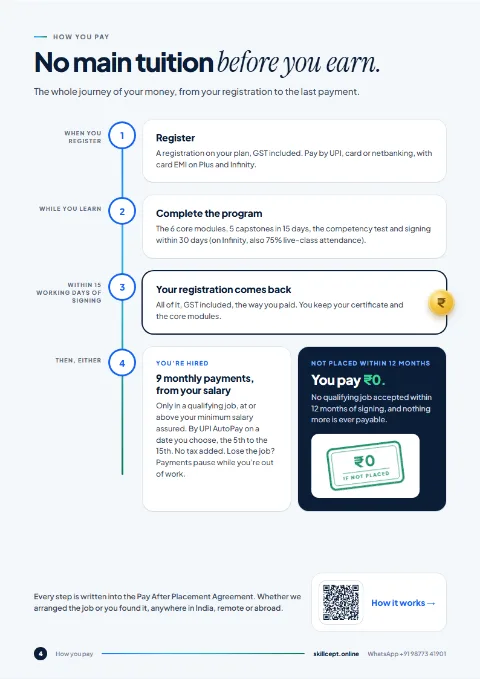
In a fixed-fee pay after placement model, you pay the course provider itself a set amount, in set instalments, starting only after you join a job that meets the contract’s terms. With no bank or NBFC in it, there’s no loan: no lender, no credit check and nothing for a credit bureau to record. Check the contract for interest and late fees all the same.
The same label can be sold with a lender behind it, though: a bank or NBFC pays the provider at the start and you repay it, sometimes before you have a job. So ask the two questions again: whom will I owe, and what do I owe if no job comes? Our guide to pay after placement courses compares the fee models in detail. Here is our own answer to the loan question, word for word:
No. There’s no lender, bank or finance company: you pay us, for our own training, in 9 fixed payments, and only after you start earning. No credit check, no interest, and nothing is reported to credit bureaus; we never sell or pass your payments to a lender without your written consent. The amount is fixed, never a share of your salary, and paying early never costs more.
- No lender, bank or interest
- No credit check or credit bureau
- A fixed amount, never a share of your salary
In writingAgreement 1.3Agreement 11.5
What each option does to your CIBIL score
Any loan from a bank or NBFC goes on your credit report, and so does a card EMI, as part of your card account. Paying on time builds your record; a missed instalment can lower your score and follow you to your next loan application. A fee you owe the course provider itself, with no lender, isn’t credit, so there’s nothing to report.
| Option | On your credit report | If you miss a payment |
|---|---|---|
| Course EMI through a lender | Yes, as a loan | Reported as overdue, with the penal charges in your KFS |
| Card EMI | Yes, on your card account | Your card’s late fee and interest |
| Education or skill loan | Yes, on yours and your co-borrower’s | Reported on both |
| Income share agreement | Only if a lender funds it | The contract decides |
| Fixed fee after placement, no lender | No | The contract decides |
If a course loan is the only way you can afford a course, borrow the least you can, and keep enough set aside to pay the instalments for as long as a job search could take.
Before you sign anything
- Name the lender, if there is one. Get its name in writing, and check that it’s a bank or an NBFC registered with the RBI.
- Read the Key Facts Statement. Compare APRs, not monthly instalments.
- Work out what you owe with no job. If the answer is “everything”, borrow only what you could repay from your current income or savings.
- Check the exits. The cooling-off period, paying early, and what happens to the loan if you leave the course.
- Count everyone who is liable. A co-borrower carries the loan too.
- Know where to complain. The lender’s grievance officer first; if it isn’t resolved within 30 days, the Reserve Bank’s Integrated Ombudsman at cms.rbi.org.in, or its contact centre on 14448.5
For the questions to ask the course itself, not just the lender, use our 12 questions to ask before you pay, and for what a guarantee should promise, read what a job guarantee really covers.
Questions
What is an income share agreement in India?
A contract to pay a fixed percentage of your income for a fixed period once you earn above an agreed threshold, instead of a fixed course fee. Nothing is due below the threshold, but a better-paid job costs you more, and if a bank or NBFC funds it, you are borrowing.
Does a course EMI affect my CIBIL score?
Yes, if a bank or NBFC lends it: the loan appears on your credit report, on-time payments build your record and a missed instalment can lower your score. A fee you owe the course provider itself, with no lender, isn’t credit and isn’t reported.
Is no-cost EMI really free?
Close to it: the interest is given back as an upfront discount, so your instalments add up to the price, but your bank may still charge GST on the interest and a processing fee. Check the total on the payment screen before you confirm.
Can I get an education loan for an online data science course?
Only if the bank accepts the course. State Bank of India’s Skill Loan Scheme, for example, covers courses from ITIs, polytechnics, training partners affiliated to NSDC or a Sector Skill Council, State Skill Missions and colleges of recognised universities (page updated 23 Jul 2026), so ask the provider and the bank in writing.
Is pay after placement a loan?
Not when you pay the course provider directly and no lender is involved: then it’s a deferred fee, with no lender and no credit check. It is a loan if a bank or NBFC pays the provider and you repay that lender, so ask whom you will owe.
What does RBI require of course loan apps?
A Key Facts Statement with an APR that includes all charges, repayments straight to the lender’s own account, a cooling-off period of at least one day to exit without a penalty, a named grievance officer, and reporting of the loan to credit information companies (RBI’s Digital Lending Directions, 8 May 2025).
Sources
- Reserve Bank of India, Key Facts Statement (KFS) for Loans & Advances, 15 Apr 2024 (read 22 Oct 2026).
- Reserve Bank of India, Reserve Bank of India (Digital Lending) Directions, 2025, 8 May 2025 (read 22 Oct 2026).
- Reserve Bank of India, circular on zero per cent EMI schemes and other practices, 17 Sep 2013 (read 22 Oct 2026).
- State Bank of India, Skill Loan Scheme, updated 23 Jul 2026 (read 22 Oct 2026).
- Reserve Bank of India, Complaint Management System: Reserve Bank – Integrated Ombudsman Scheme, 2026, read 22 Oct 2026.