Skillcept Online
Key takeaways
- IT hiring on Naukri fell 4% on the year in September 2026, while AI/ML hiring inside IT grew 11%.1
- TeamLease Digital projects FY27–28 pay growth of 16.2% for GenAI developers and 12.0% for data engineers, against 6.6% for technical support engineers (September 2026).3
- Only about 16% of IT professionals hold AI skills, by the same TeamLease Digital report.3
- With 3–6 years’ experience, AmbitionBox shows Data Engineers at ₹11.3–12.5 lakh and AI Engineers at ₹15.3–16.9 lakh, against ₹5.4–6 lakh for Technical Support Engineers (as of 15–16 Oct 2026).4
Why move now?
Because the work inside IT is shifting towards data and AI, and the people already inside IT are best placed to move with it. AI/ML hiring means roles that build, deploy and run machine learning models and the AI applications built on them.
In June 2026, IT hiring on Naukri fell 3% on the year while AI hiring within the sector grew 16%.2 In September, IT and software services hiring fell 4%, and AI/ML hiring within IT grew 11%.1 Across all sectors that month, AI/ML hiring grew 20%.1
Experience counts in this market. In the same September report, demand for AI/ML talent was strongest among experienced people: hiring grew 54% for 13–16 years and 28% for 8–12 years, while the 4–7 year band was stable.1 Job postings are changing too: in September 2025, 23% of software development postings in India mentioned AI (Indeed Hiring Lab).5
And few people have the skills yet. TeamLease Digital estimates that only about 16% of IT professionals hold AI skills.3 That gap is your opening.
What the move does to pay
On every source we checked, data and AI roles pay more than testing and support roles at the same experience, and the gap widens with the years.
Where you are now
| Role | 1–3 years | 3–6 years |
|---|---|---|
| Manual Test Engineer | ₹3.3–3.6 L | ₹4.8–5.3 L |
| Automation Test Engineer | ₹4.5–5 L | ₹6.8–7.6 L |
| Technical Support Engineer | ₹3.8–4.2 L | ₹5.4–6 L |
| Application Support Engineer | ₹3.8–4.2 L | ₹5.6–6.2 L |
| Production Support Engineer | ₹3.9–4.3 L | ₹5.8–6.4 L |
| .NET Developer | ₹3.7–4.1 L | ₹6.2–6.9 L |
| Java Developer | ₹4.3–4.8 L | ₹7.2–7.9 L |
Where you can go
| Role | 1–3 years | 3–6 years |
|---|---|---|
| Analytics Engineer | ₹6.4–7.6 L | ₹9.8–11.4 L333 salaries |
| Data Engineer | ₹7.6–8.3 L | ₹11.3–12.5 L |
| Machine Learning Engineer | ₹9.2–10.2 L | ₹13.1–14.5 L |
| MLOps Engineer | ₹8–11.9 L23 salaries | ₹13–15.5 L143 salaries |
| AI Engineer | ₹10.4–11.5 L | ₹15.3–16.9 L |
| Data Scientist | ₹11.3–12.5 L | ₹15–16.6 L |
Source: AmbitionBox, typical yearly pay by experience, pages updated 10–16 Oct 2026 and read 17 Oct 2026.4 Samples under 1,000 salaries are marked; the Data Engineer band for 3–6 years rests on 72,700.
TeamLease Digital’s salary primer tells the same story. It puts a Technical Support Engineer’s pay at ₹5.2 LPA rising to ₹14.6 LPA with experience, a Data Engineer’s at ₹9.1 LPA rising to ₹29.6 LPA, and a GenAI Developer’s at ₹11.2 LPA at 0–2 years, rising to ₹34.5 LPA at 6–8 years.3 For FY27–28 it projects pay growth of 16.2% for GenAI developers, 12.0% for data engineers and 6.6% for technical support engineers.3
Waiting for raises is the slow road. Aon’s survey put India’s average salary increase at 9% in 2026.6 At 9% a year, a ₹6 lakh salary takes about five years to pass ₹9 lakh. A move into data engineering, data science or AI can cover that in one step.
What you already have
More than you think. Much of the daily work in data engineering and MLOps is work you already do, pointed at data instead of an application.
| Your skill | Where it counts in data and AI |
|---|---|
| SQL: queries, joins, checking test data | Data and analytics engineering, and every data interview |
| Scripting: Shell, PowerShell, Python | Pipelines, automation and MLOps |
| Test design and automation | Data-quality checks, model evaluation and LLM evaluation |
| Debugging and root-cause analysis | Pipeline failures and model monitoring |
| Production support, monitoring, on-call | MLOps and LLMOps: deploying, tracing and alerting |
| Releases and CI/CD | ML pipelines and model registries |
| Java or .NET services | The APIs and back ends of AI applications |
| Domain: banking, insurance, telecom, retail | Every role: you know what the data means |
What’s new for most people: Python for data (pandas), statistics, machine learning basics and a cloud data platform, and for AI roles, LLM APIs, RAG and evaluation. RAG (retrieval-augmented generation) is a way of making an AI model answer from your own documents, with sources.
The bridge roles
Four roles sit closest to IT services work. Pick the one nearest your current job, and the move is a step, not a restart.
Data engineer
A data engineer builds and runs the pipelines that move data from source systems into a warehouse, clean and on time. It’s the closest step from support, operations and maintenance work. Learn first: advanced SQL, Python, one cloud data platform, scheduling, and Spark basics.
Analytics engineer
An analytics engineer turns raw warehouse tables into tested, documented data models that analysts and dashboards rely on. Testers fit well: the job is largely writing checks that catch bad data before anyone sees it. Learn first: advanced SQL, data modelling, version control and data testing.
MLOps engineer
An MLOps engineer deploys, monitors and updates machine learning models in production; LLMOps does the same for applications built on large language models. It’s the natural home for production support, DevOps and release engineers. Learn first: Python, Docker, CI/CD, a model registry such as MLflow, and monitoring.
AI engineer
An AI engineer builds applications on top of AI models: assistants that answer from company documents, agents that call tools and APIs, and the evaluation that keeps them reliable. Java and .NET developers and automation testers have a head start. LinkedIn ranked AI Engineer among the top three roles on its Jobs on the Rise list for India in 2026.7 Learn first: Python, LLM APIs, RAG, evaluation and agents. Our AI Engineer roadmap lays out the steps.
On our Infinity plan, Modules 9 and 10, Production RAG & LLMOps and Agentic AI, teach the MLOps and AI engineer side live on weekends, with Docker, MLflow, Langfuse, GitHub Actions, LangGraph and MCP. See them week by week.
The 6-month plan, around a full-time job
About 10 hours a week for 26 weeks: three weekday evenings of an hour for lessons, and about seven hours at the weekend for building. Every month ends with something you can show.
Six months suits data and analytics engineering, where most of your work carries over. For AI Engineer roles, allow a little longer: our AI Engineer roadmap plans about 6–7 months if you already use Python and SQL, and 9–10 months from zero.
| Month | Weekday evenings | Weekends | You finish with |
|---|---|---|---|
| 1 | Python for data: syntax, files, pandas | Automate one dull task from your own work, without client data | A script on GitHub |
| 2 | Advanced SQL (window functions, CTEs); statistics basics | A SQL analysis on a public dataset | Ten business questions answered |
| 3 | Data modelling, pipelines and Docker | A small pipeline: load, clean, test, schedule | A pipeline that runs every day |
| 4 | Machine learning with scikit-learn | Train and evaluate a model on your pipeline’s data | A model with honest metrics |
| 5 | AI track: LLM APIs, RAG, evaluation. Data track: Spark and a cloud platform | A RAG app over public documents, or a cloud pipeline | Your showcase project |
| 6 | Interview practice: SQL, Python, designing a data or LLM system | Resume rewrite, applications, mock interviews | Twenty applications and three internal conversations |
Free to start: The Python Tutorial · pandas: Getting started · The PostgreSQL tutorial · Docker: Get started · scikit-learn: Getting started · the Hugging Face LLM course.
Two rules that keep the plan alive. Never put client or employer data in a portfolio project: use public datasets such as the Olist e-commerce data on Kaggle or India’s data.gov.in. And protect the weekend block: a missed evening can be caught up, a missed weekend usually can’t.
Move inside or outside?
Try inside first: an internal move keeps your seniority, and there’s no new notice period to serve. Go outside when the inside route stalls, or when you want the bigger jump in pay.
| Compare | Inside your company | A new employer |
|---|---|---|
| Who decides | Your manager and the data or AI team’s lead | A new interview panel |
| What you need | One project and someone to vouch for you | A portfolio, interview practice and references |
| Pay | Can stay in your current band | Set by the market for the new role |
| Timing | As fast as a role opens | After your notice period |
Inside
- Find your company’s data or AI practice and ask its lead which skills their projects are short of.
- Volunteer for data work on your current project: test-data automation, a reporting job, a migration, an AI pilot. Put it in your appraisal goals.
- Apply through internal job postings once you have one project you can show.
Outside
- Look beyond IT services: global capability centres (GCCs), the in-house technology and analytics centres of global companies, are a large employer. NASSCOM counts 2,117 of them in India, employing 2.36 million people.8 Product companies and the data teams of banks and insurers hire too.
- Rewrite your resume in data terms. “Executed regression test cycles” becomes, for example, “Built SQL checks that validate every nightly data load”.
- Negotiate on your total experience. Years spent running production systems count for data engineering and MLOps roles.
Questions
Can a manual tester move into data engineering or data science?
Yes. Testing builds the habits data work needs: checking data, writing test cases and finding the cause of a failure. With SQL, Python and one data project, analytics or data engineering is the closest first step; data science needs statistics and machine learning on top.
Will I have to start again as a fresher?
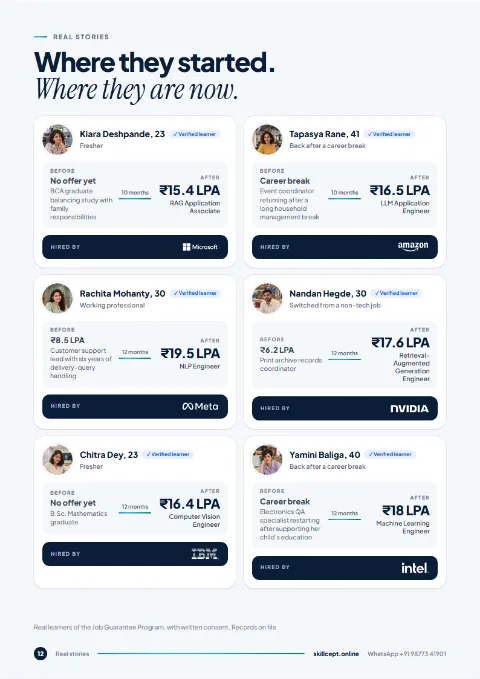
Usually not. In September 2026, Naukri found AI/ML hiring strongest among experienced professionals, up 54% for 13–16 years and 28% for 8–12 years. Your years in production systems count, especially for data engineering and MLOps roles.
Should I quit my job to learn data and AI?
No. About 10 hours a week on weekday evenings and weekends is enough for a 6-month plan, and keeping your job keeps your income and your experience growing while you build proof.
Will AI replace testing and support jobs?
The data shows slower growth, not an end. TeamLease Digital projects FY27–28 pay growth of 6.6% for technical support engineers, against 16.2% for GenAI developers, and estimates that only about 16% of IT professionals hold AI skills.
Data engineer or AI engineer: which should I aim for first?
From support, operations or production work, data engineering is the closer step. From Java or .NET development, AI engineering builds on what you know. On AmbitionBox (3–6 years, read 17 Oct 2026), Data Engineers showed ₹11.3–12.5 lakh and AI Engineers ₹15.3–16.9 lakh.
Sources
- Naukri, JobSpeak, September 2026, 6 Oct 2026.
- Naukri, JobSpeak, June 2026, 3 Jul 2026.
- TeamLease Digital, Digital Skills & Salary Primer FY2026–27, reported in CXOToday, 29 Sep 2026.
- AmbitionBox salary profiles, read 17 Oct 2026 (each updated 10–16 Oct 2026): Manual Test Engineer, Automation Test Engineer, Technical Support Engineer, Application Support Engineer, Production Support Engineer, .NET Developer, Java Developer, Analytics Engineer, Data Engineer, Machine Learning Engineer, MLOps Engineer, AI Engineer and Data Scientist.
- Indeed Hiring Lab, September 2025 labour market update, 25 Oct 2025.
- Aon, Salary Increase and Turnover Survey 2026–27, reported in Telangana Today, 14 Oct 2026.
- LinkedIn, Jobs on the Rise 2026, reported in Storyboard18, 8 Jan 2026.
- NASSCOM, GCC Runway Monitor, 9 Oct 2026.