Skillcept Online
Key takeaways
- On AmbitionBox, Mechanical Engineers with 3–6 years’ experience earn ₹4.3–4.7 lakh a year and Civil Engineers ₹4–4.4 lakh, while Data Analysts with 1–3 years earn ₹5.2–5.7 lakh (October 2026).123
- The ladder above is steeper: Data Scientists earn ₹11.3–12.5 lakh with 1–3 years and ₹15–16.6 lakh with 3–6 years, on the same site.3
- The maths carries over: the GATE 2027 syllabi for mechanical and civil engineering both include linear algebra, calculus, probability and statistics, and numerical methods; the mechanical paper adds forecasting models and Six Sigma, the civil paper linear regression.5
- AI is reaching core industries: LinkedIn found AI engineering talent in Indian manufacturing grew four-fold to 2% of the workforce in 2025 (April 2026).7
- Core hiring is growing too: Naukri saw Construction & Site Engineering hiring up 17% on the year in September 2026, so switch for the work and the pay ladder, not out of fear.4
Can a mechanical or civil engineer become a data scientist?
Yes, and it’s one of the shorter switches. Data science is using data, statistics and code to predict and decide: which machine will fail next week, how strong a concrete mix will be at 28 days, how many trucks a depot needs on Monday. Going from mechanical engineer to data scientist, or civil engineer to data science, starts from a strong base, because engineers already think in models, measurements and error.
What carries over: the maths (linear algebra, statistics, optimisation), the habit of testing a model against reality, and years of knowing how a plant or a site actually runs. What doesn’t: Python, SQL and machine learning, which most core degrees teach lightly or not at all, and a portfolio that shows them.
The honest part: few switchers start with the Data Scientist title. The usual first step is a Data Analyst, Associate Data Scientist or domain analytics role in manufacturing, supply chain or project controls, then Data Scientist after a year or two. The pay table below shows why that first step is usually a raise, not a cut.
What core and data roles pay
On AmbitionBox’s bands, a first data role pays more than a core engineering job at the same experience, and the gap widens as you go up.
| Role | 1–3 years | 3–6 years | 6–9 years |
|---|---|---|---|
| Mechanical Engineer | ₹3.2–3.6 L15,700 salaries | ₹4.3–4.7 L25,300 salaries | ₹5.7–6.3 L14,700 salaries |
| Civil Engineer | ₹3–3.3 L11,900 salaries | ₹4–4.4 L20,600 salaries | ₹5.3–5.8 L11,800 salaries |
| Data Analyst | ₹5.2–5.7 L84,200 salaries | ₹7.2–7.9 L66,500 salaries | ₹7.7–11.3 L58 salaries, a small sample |
| Associate Data Scientist | ₹8.2–9 L2,200 salaries | ₹9.6–10.6 L1,100 salaries | No band shown |
| Data Scientist | ₹11.3–12.5 L24,100 salaries | ₹15–16.6 L35,500 salaries | ₹20.5–22.6 L2,800 salaries |
| Machine Learning Engineer | ₹9.2–10.2 L5,400 salaries | ₹13.1–14.5 L4,600 salaries | ₹20.2–22.3 LAn AmbitionBox estimate |
Typical yearly pay. Source: AmbitionBox, as of 21 Oct 2026 for Mechanical and Civil Engineer12 and 19 Oct 2026 for the data roles,3 read 22 Oct 2026. Ranges as AmbitionBox shows them.
Read it as a ladder, not a single jump. From the 3–6 to the 6–9 year band, a Mechanical Engineer’s range rises by about ₹1.5 lakh; a Data Scientist’s by nearly ₹6 lakh (our arithmetic on the midpoints of AmbitionBox’s ranges).13
Two cautions. Core pay depends heavily on the industry: AmbitionBox shows Mechanical Engineers at ₹10.4–11.5 lakh in management consulting and ₹5.9–6.5 lakh in engineering and construction, against ₹3.4–3.7 lakh in auto components.1 If you already earn above an entry analyst band, aim straight for Associate Data Scientist or a data science role in your own industry.
And core hiring isn’t shrinking. In September 2026, Naukri saw hiring for Construction & Site Engineering up 17% and Research & Development up 19% on the year, and the auto sector up 11%, while white-collar hiring overall rose 2%.4 The case for switching is the work you want and the ladder you climb, not that core jobs are vanishing. For how a switch affects pay in general, read will you restart at fresher pay?
The maths and skills you already have
Most of the maths. The official GATE 2027 syllabus, set by IIT Madras, lists the engineering mathematics every mechanical and civil engineer prepares: linear algebra, calculus, differential equations, probability and statistics, and numerical methods.5 Here is where each part shows up in data science.
| In your syllabus | Where it shows up in data science |
|---|---|
| Matrices, eigenvalues and eigenvectors | Principal component analysis, embeddings, and how every model stores what it learns |
| Maxima and minima, partial derivatives | Gradient descent, the way machine learning models learn |
| Binomial, Poisson and normal distributions | Hypothesis tests, A/B tests and confidence intervals |
| Linear regression Civil paper | The first model every data scientist builds |
| Forecasting models, inventory control Mechanical paper | Demand forecasting and time-series models |
| Six Sigma, quality and reliability Mechanical paper | Process analytics, anomaly detection and predictive maintenance |
| Linear programming, queuing, PERT and CPM | Optimisation, scheduling and operations analytics |
| Statistical analysis of traffic data, travel demand modelling Civil paper | Transport and mobility analytics |
| Surveying, GNSS, maps and photogrammetry Civil paper | Geospatial analysis and GIS data |
Topics as the GATE 2027 syllabi for Mechanical (ME) and Civil (CE) Engineering list them, read 22 Oct 2026.5
And the habits count as much as the maths. You’ve worked with measurements that carry error, read test reports, fitted curves in Excel or MATLAB and defended a decision with data in a design review. Data interviews test exactly that judgment.
What you’ll need to add: Python with pandas, SQL, one dashboard tool such as Power BI, machine learning with scikit-learn, and the habit of explaining a model to someone who isn’t an engineer.
The first roles to aim for
Start where your domain counts double: an analytics or data science role in the industry you know. There you compete with your engineering years, not against them.
| You work in | First roles to search for | Why you fit |
|---|---|---|
| Production, maintenance or quality | Manufacturing data analyst, process or quality analyst, reliability and predictive-maintenance analyst | You know what the sensor readings mean and which failures cost money |
| Design, CAE or R&D | Associate Data Scientist, test-data or simulation analyst, ML engineer if your Python is strong | You already build models and validate them against tests |
| Planning, procurement or logistics | Supply-chain, demand-planning or operations analyst | Forecasting and inventory control were in your syllabus |
| Site execution or project management | Project-controls or planning analyst, construction data analyst | You know schedules, quantities and cost overruns from the inside |
| Transport, surveying or water | Transport or mobility analyst, GIS and geospatial analyst, infrastructure analytics | Traffic studies, maps and hydrology are data problems already |
AI is spreading into these industries, which raises the value of an engineer who also knows data. Indeed found AI mentioned in 17% of industrial engineering and 11% of mechanical engineering job postings in India in September 2025.6 LinkedIn found AI engineering talent in Indian manufacturing grew four-fold in 2025, to 2% of the workforce.7 And foundit counted manufacturing at 6% of India’s AI jobs in 2025, with AI hiring in logistics up 30% on the year.8
Outside your domain, the usual entry titles apply: Data Analyst, Junior or Associate Data Scientist. You won’t need a second degree for them: 30% of employers in India expect skills-based hiring, which drops degree requirements, to be effective, against 19% globally.9
Projects on engineering data
Build one project for each kind of role you’re targeting, on public engineering data, and put each on GitHub with a README: the question, the data, the method, what you found and what you’d do next.
| Project | Data | What you build | What it proves |
|---|---|---|---|
| Predict machine failure | AI4I 2020 Predictive Maintenance, UCI Machine Learning Repository | A classifier that flags failures from torque, speed, temperatures and tool wear, and says which readings matter most | Classification, rare events, explaining a model to a plant manager |
| Remaining life of an engine | NASA’s C-MAPSS jet engine simulated data, on Data.gov | A model that predicts how many cycles each engine has left before failure | Time-series features, regression, honest validation |
| Concrete strength from the mix | Concrete Compressive Strength, UCI Machine Learning Repository | A regression that predicts strength from cement, water, fly ash, aggregates and age, beaten against a simple baseline | Regression, feature effects, checking a model against engineering sense |
| Road safety, state by state | State/UT-wise road accidents, 2020 to 2022, on data.gov.in | A Power BI dashboard of accidents by state and year, with three questions it answers | Cleaning, dashboards, writing for people who decide |
Data from your own employer is the strongest proof of all, but only with written permission and with nothing confidential in it. Otherwise these public datasets show the same skills. For more ideas on Indian public data, see our 15 data analyst projects.
On our program, Plus’s capstone library includes a ride-demand forecast and an inflation forecast: the forecasting you studied for production planning, on real business problems.
A 6-month plan while you work
Keep your job. About 10 hours a week for six months gets most engineers ready for analyst roles: two weekday evenings and one longer weekend session, every week.
| Month | Learn | By the end |
|---|---|---|
| 1 | Python basics with the official Python tutorial; pandas in 10 minutes | One messy plant or site dataset cleaned and summarised |
| 2 | SQL; statistics, revised from your GATE notes | Ten business questions answered in SQL |
| 3 | Power BI, with Microsoft Learn | The road-safety dashboard, published |
| 4 | Machine learning with scikit-learn: regression and classification | The concrete-strength model |
| 5 | Validation, and a project from your own field | The machine-failure or engine-life model, with a README |
| 6 | Resume, LinkedIn and GitHub; mock interviews | 20 tailored applications, tracked |
- Same slots every week. Shift work and site visits break plans; fixed slots survive them.
- Revise, don’t relearn, the maths. Your statistics comes back in days, not months.
- Ask about an internal move first. Plants and project offices have analytics teams, and an internal move keeps your pay history and a manager who knows your work.
Doing this around a full-time job is the norm, not the exception. Here is how our program fits around one, in the words of our FAQ:
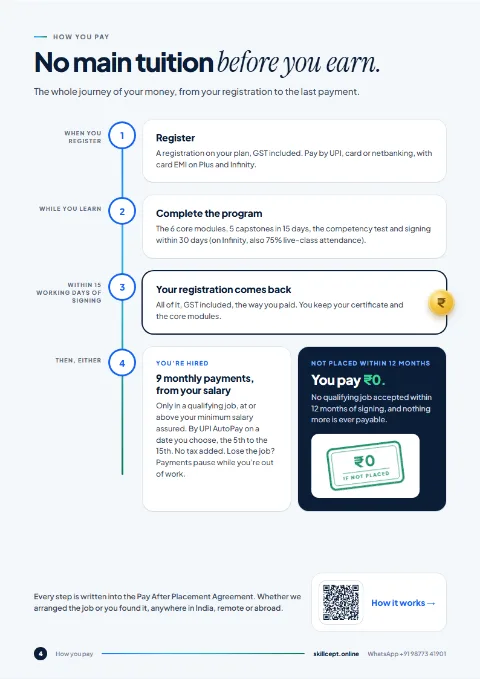
Yes, it’s made to fit around a job. Go and Plus are self-paced, at about 10 hours a week. Infinity’s live classes are on weekends, Saturday and Sunday, 11 AM to 2 PM IST, and every class is recorded the same day. The job you have when you register doesn’t affect your refund, and on Plus and Infinity your minimum salary assured can be set from your current pay: ₹9 LPA or your salary + 35%, whichever is higher, on Plus, and ₹12 LPA or your salary + 85%, whichever is higher, on Infinity.
- Self-paced, about 10 hours a week
- Infinity: weekends, recorded the same day
- Your current job doesn’t affect your refund
Turn your engineering years into a data story
Lead with the data work you already do, with numbers, in the top third of your resume. Recruiters scan for analysis, not job duties.
| Instead of | Write |
|---|---|
| Responsible for maintenance of CNC machines | Tracked downtime for every CNC machine in Excel, found the two causes behind most stoppages and cut unplanned downtime by X% in a quarter |
| Handled quality inspection | Built a control chart for weld defects and traced a defect spike to one shift’s settings |
| Site engineer on a residential project | Built a weekly progress tracker that flagged schedule slips two weeks before the monthly review |
| Prepared BOQs and estimates | Compared estimated and actual quantities across five projects and found where overruns start |
Put your own numbers where the X is. Only claim what you did, and be ready to explain how.
“Why data, why now?”
Answer in about 30 seconds: what you saw in your core job, what you built since, and what you want to do next. For example: “In four years of plant maintenance, the decisions that mattered came from the downtime data. I learned SQL and Python and built a failure-prediction model on public machine data. I want to do that work full-time, ideally in manufacturing.”
Expect an online test in Python or SQL, a statistics and machine learning round, a project deep-dive and a case on your own domain. The domain case is where you win: few other candidates know a plant or a site from the inside.
Questions
Can a mechanical engineer become a data scientist in India?
Yes. A mechanical engineering degree covers most of the maths data science needs; add Python, SQL and machine learning, and prove them with projects. Most switchers start as a Data Analyst or Associate Data Scientist, often in manufacturing or supply chain, then move up.
Is data science a good option for civil engineers?
Yes, especially in construction, infrastructure, transport and geospatial analytics, where your domain counts. The GATE 2027 civil engineering syllabus already includes linear regression and the statistical analysis of traffic data.
Will I earn less if I move from core engineering to data?
Usually not. On AmbitionBox (October 2026), Mechanical Engineers with 3–6 years earn ₹4.3–4.7 lakh a year and Civil Engineers ₹4–4.4 lakh, while Data Analysts with 1–3 years earn ₹5.2–5.7 lakh and Associate Data Scientists ₹8.2–9 lakh.
Do I need an M.Tech, an MBA or a CS degree to switch?
No. Data roles are hired on skills employers can test, and 30% of employers in India expect skills-based hiring, which drops degree requirements, to be effective (World Economic Forum, January 2025). Projects on real data matter more than a second degree.
How long does the switch from core engineering take?
About six months at 10 hours a week to be ready for analyst roles, then the job search. The Data Scientist title usually comes later, often after a year or two in a first analyst role.
Sources
- AmbitionBox, Mechanical Engineer salary in India, as of 21 Oct 2026, read 22 Oct 2026.
- AmbitionBox, Civil Engineer salary in India, as of 21 Oct 2026, read 22 Oct 2026.
- AmbitionBox, salaries for Data Analyst, Associate Data Scientist, Data Scientist and Machine Learning Engineer, as of 19 Oct 2026, read 22 Oct 2026.
- Naukri, JobSpeak, September 2026, 6 Oct 2026.
- IIT Madras, GATE 2027 exam papers and syllabus (Mechanical Engineering and Civil Engineering), read 22 Oct 2026.
- Indeed Hiring Lab, September 2025 labour market update, 25 Oct 2025.
- LinkedIn data, reported by IANS: AI engineering hiring in India jumps 59.5%, 24 Apr 2026.
- foundit Insights Tracker, reported in Storyboard18, 13 Jan 2026, read 22 Oct 2026.
- World Economic Forum, The Future of Jobs Report 2025, 7 Jan 2025.