Skillcept Online
Key takeaways
- In an Ashoka University study of Indian private-sector employers, women who had taken a career break got 49% fewer callbacks than similar women who hadn’t (September 2024).1
- In the same study, simply listing upskilling certificates made no statistically significant difference. Show work, not only certificates.1
- Returnships work: conversion to full-time roles averages around 70% across major programmes, according to TeamLease Digital (March 2026).2
- About 10 hours a week for six months is enough to rebuild the skills and the three projects that answer “what have you done lately?”
Can you restart after a gap?
Yes. Data analyst roles are hired on skills that can be tested, Excel, SQL, Power BI and projects, and those skills can be learned or refreshed in months, from home, in short blocks of time.
A career gap, or career break, is any stretch out of paid work: caring for children or parents, maternity, illness, a move to a new city, or years of preparation for the UPSC or other exams. Whatever the reason, the question behind every interview question about it is the same: are your skills current? Answer that with recent work, and the gap becomes one line on your resume, not the story.
The honest part: a gap does cost callbacks at the first screen (the data is below). So this plan works around that screen, with a one-line explanation, projects dated this year, and routes where a gap is expected rather than questioned.
What the data says about gaps
The penalty is real, and it is biggest at the first screen, before anyone has spoken to you.
Economists at Ashoka University ran a correspondence study: they sent matched job applications to private-sector employers in India and counted the replies. Women who had taken a career break received 49% fewer callbacks than women with similar profiles who had not.1 The same paper estimates that about 7 million women in India have taken a career break and are seeking work.1 You are far from alone.
Three of its findings shape the plan in this guide:
- Certificates alone didn’t move the needle. Simply listing upskilling certifications made no statistically significant difference to callbacks.1 Projects you can show, and people who have seen your work, have to do that job.
- The penalty varied by sector. It was larger in skill-intensive sectors such as finance than in HR, which needs more general skills.1 Proof of current skills matters most where skills are tested.
- Bigger employers penalised gaps less. The penalty was larger in smaller firms and in north India, and the authors note that large firms often commit to gender-inclusive policies.1 That is where returnships are run.
And the other side of the picture: returnships, structured and paid pathways for professionals coming back after a break, convert well. TeamLease Digital’s Returnship Edition report found conversion to full-time roles averages around 70% across major programmes, reaching 80% in some industry-specific cases.2 The same report found women now hold 36.2% of tech jobs in India, and that firms are training returning professionals for roles that include data science.2
The Ashoka study measured women returning after a break. We found no comparable Indian study for men with a gap, after exam preparation or illness, for example. The advice below works for anyone.
How to explain the gap
In one line, without apology, then move straight to what you have done since. You owe no one the details: a reason, the dates, and what you are doing now is enough.
On your resume
Put the break in your work history as a dated line, like a job, so no one has to guess. Then let the next lines show recent work.
| Reason | One line on your resume |
|---|---|
| Children or caregiving | Career break, Mar 2022–Jun 2025: full-time care for my family. Since then: Excel, SQL and Power BI, with three projects (links below). |
| Health | Career break, 2023–2024: health. Since then: data analysis projects in SQL and Power BI. |
| Relocation | Career break, 2022–2024: moved to Pune with my family. Since then: data analysis projects in SQL and Power BI. |
| Exam preparation | 2021–2023: full-time preparation for the UPSC Civil Services Examination. Since then: data analysis projects in SQL and Power BI. |
In the interview
Use a three-part answer of about 30 seconds: the reason in one line, what you did to get current, and why data now. For example:
- “I took three years out to care for my son. For the last six months I’ve studied data analysis about 10 hours a week and built three projects. This dashboard on delivery delays is the one I’d like to walk you through.”
- “I prepared for the UPSC for two years. It taught me to work through a huge syllabus on a schedule, and I’ve used that to learn SQL and Power BI. Here’s the analysis I’m proudest of.”
Then stop and let them ask. Practise it out loud until it sounds like a fact, not a confession, because that’s what it is.
Returnships and return-to-work programs
A returnship is a paid, fixed-length program that brings people back after a career break, with training, a manager and, for many, a full-time role at the end. Because the people in it are expected to have a gap, it skips the screen where a gap costs the most.
Three employers’ returnship pages we checked on 17 October 2026:
- Amazon India’s rekindle program, for women who have taken a career break of 12 months or more and are ready to return.3
- Goldman Sachs’ India Returnship Programme, a paid 12-week program for previously employed professionals who have been out of the workforce for two or more years, in Bengaluru and Hyderabad.4
- Wipro’s Begin Again, for women returning to work after a break, whether it was for motherhood, elderly care, a sabbatical or any other personal reason.5
Programs open and close through the year, and the roles on offer change, so check each page for current openings. We have no link with these employers. To find more, search careers pages and job boards for “returnship”, “return to work”, “career restart” and “second career”, and start with large employers: in the Ashoka study, they penalised gaps less.1
Show recent work
Three projects, finished this year and public, answer “are your skills current?” better than any certificate. Put each on GitHub with a short README: the question, the data, what you found and what you would do next.
- A dashboard. A one-page Power BI report on Microsoft’s AdventureWorks sample database: sales by region and month, and the products that are slipping.
- A SQL analysis. Ten business questions on the Olist e-commerce dataset on Kaggle, such as which sellers deliver late and what that does to their ratings, each with a two-line answer.
- A Python analysis on Indian public data from data.gov.in, on a topic you care about: your city, your old industry, your children’s schools.
Two more things that count as proof:
- Small, real work. A sales tracker for a relative’s shop or a fee report for a local NGO, with their permission and without anyone’s personal data, gives you a real user and a reference.
- Certificates, paired with projects. They give your study a structure and you the vocabulary of interviews. Just don’t list one without a project beside it.
Our Data Analyst roadmap lays out every step to these projects, with a tracker that remembers what you’ve done. In our program, this recent work is built in: you finish 5 capstones in 15 days, each a business problem from a brand Indian learners know, with a cheat sheet for every step.
Flexible and remote roles
Data work suits flexible arrangements, because the output (a query, a dashboard, a report) can be checked wherever it was made. But filtering only for fully remote jobs shrinks your options; ask about flexibility in the interview instead.
- Ask the right questions once there’s interest on both sides: core hours, days in the office, and how the team handles school holidays or a parent’s hospital visit.
- Prefer predictable work. Roles with a fixed reporting cycle, such as a weekly MIS pack or a monthly business review, are easier to plan around than on-call support roles.
- Look at returnships first. They are built for people managing a return, and they lead to permanent roles more often than not.2
- Treat short contracts as a bridge if they come your way: a few months of paid analytics work, dated this year, is the strongest answer to a gap.
A 6-month plan at about 10 hours a week
Six months, about 10 hours a week, in blocks that fit around care: two weekday slots of about two hours, and one longer session at the weekend.
| Month | Focus | By the end |
|---|---|---|
| 1 | Excel refresh: PivotTables, Power Query; statistics basics | One messy dataset cleaned and summarised |
| 2 | SQL | Ten business questions answered, one with a window function |
| 3 | Power BI | Your first project: a published dashboard |
| 4 | Python basics and pandas | A notebook analysis |
| 5 | Your second and third projects | Three projects on GitHub, dated this year |
| 6 | Resume with the one-line gap; returnship and job applications; mock interviews | 20 applications tracked, returnships included |
- Weekdays: one lesson and its practice in each slot. Early mornings or nap time both work; the same slot every week works best.
- Weekends: the project. Building is what turns lessons into something you can show.
- Keep a learning log with dates and what you built. It becomes your answer to “what have you been doing?”
Before you pay for any course or program, check who it accepts and what happens if life interrupts; our guide to the 12 questions to ask before you pay covers the rest. Here is who can join ours, in the words of our FAQ:
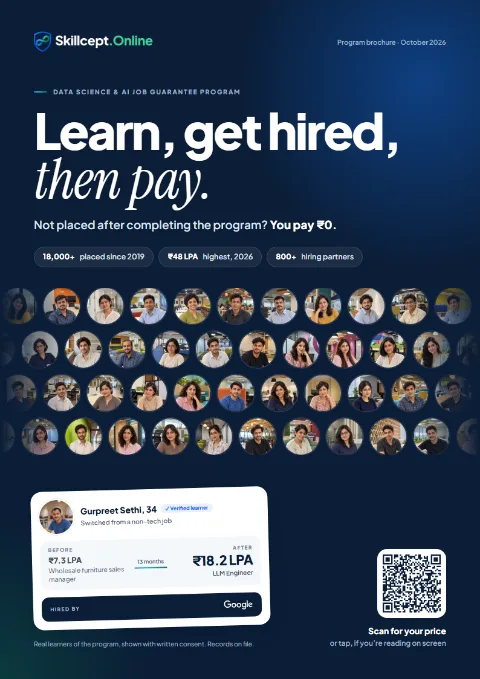
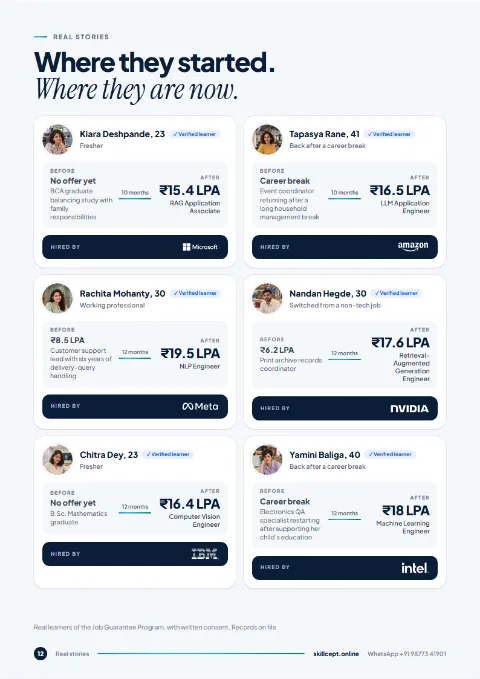
Anyone aged 18 to 55 who has passed Class 12 (or an equivalent) and wants a career in data science and AI: freshers, career switchers, working professionals and people coming back after a break. There’s no CGPA cut-off and no degree filter.
- Aged 18 to 55
- Class 12 pass
- No CGPA cut-off or degree filter
In writingTerms 2.2
Questions
How do I explain a career gap in a data analyst interview?
In one line, without apology, then move to what you’ve done since: “I took two years out to care for my father. For the last six months I’ve been learning SQL and Power BI, and here’s a dashboard I built.” Recent work you can show matters more than the reason.
Does a career gap reduce my chances of getting hired?
At the first screen, yes: in an Ashoka University study (September 2024), women with a career break got 49% fewer callbacks than similar women without one. Returnships, referrals and recent projects help you past that screen.
Are certificates enough to cover a career gap?
Not on their own. In the same Ashoka University study, listing upskilling certificates made no statistically significant difference to callbacks. Pair every certificate with a project an interviewer can open.
What is a returnship?
A paid, fixed-length program that brings people back to work after a career break, with training and, for many, a full-time role at the end. TeamLease Digital (March 2026) found conversion to full-time roles averages around 70% across major programmes.
I took a gap for UPSC preparation. Can I move into data analytics?
Yes. Present the preparation as what it was, years of disciplined study, in one dated line, then show recent data projects. Explain it the way you would any other gap: the reason, what you’ve done since, and why data now.
Can I learn data analytics with a baby at home?
Plan around short, regular blocks: two weekday slots of about two hours and one weekend session, about 10 hours a week. Self-paced lessons you can stop and restart fit around naps and school runs better than a fixed timetable.
Sources
- Kanika Mahajan and Nandini S, Restart: Women, career breaks and employer response, Ashoka University Working Paper 125, 14 Sep 2024.
- TeamLease Digital, AI Career Accelerator: Returnship Edition, reported in Storyboard18, 30 Mar 2026.
- Amazon, rekindle, read 17 Oct 2026.
- Goldman Sachs, India Returnship Programme, read 17 Oct 2026.
- Wipro, Begin Again, read 17 Oct 2026.