Skillcept Online
Key takeaways
- Finance pays analysts more: AmbitionBox shows Data Analysts in financial services at ₹9.2–10.1 lakh a year, against ₹5.7–6.3 lakh in IT services and consulting (updated 19 Oct 2026).1
- The switch is often a raise: Accountants with 3–6 years’ experience show ₹3.1–3.4 lakh, against ₹5.2–5.7 lakh for Data Analysts with 1–3 years (AmbitionBox, October 2026).1
- Banks are taking freshers: fresher hiring in banking and financial services on Naukri grew 14% on the year in September 2026.2
- Banking, financial services and insurance held 15.8% of AI jobs in 2025, and AI hiring in the sector grew 41% (foundit, January 2026).3
Can a B.Com graduate become a data analyst?
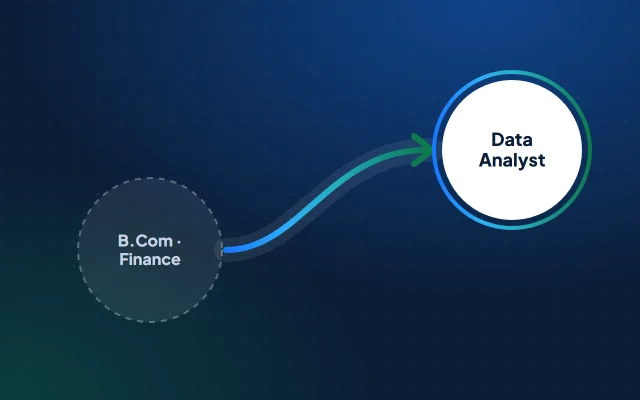
Yes. A data analyst turns raw records into answers a business can act on, and finance runs on records: ledgers, loan books, transactions and statements. You already know what the numbers mean, which many analysts take years to learn. What’s new is getting the data out yourself, with SQL, and showing it, with Power BI.
The pay case is strong. On AmbitionBox, Accountants earn ₹2.5–2.7 lakh at 1–3 years and ₹3.1–3.4 lakh at 3–6 years, while Data Analysts earn ₹5.2–5.7 lakh at 1–3 years; Data Analysts in financial services show ₹9.2–10.1 lakh.1 And banks are hiring early-career people: in September 2026, fresher hiring in banking and financial services on Naukri grew 14% on the year, while white-collar hiring overall grew 2%.2
The honest part: routine bookkeeping is the exposed end of finance. In the World Bank’s study of South Asian job postings, listings fell after ChatGPT’s release for the most AI-exposed jobs where AI complements people least, such as software developers, call-centre agents, accountants and proofreaders; jobs that need judgement and responsibility saw no such fall.4 Analysis is the part of finance to move towards.
The finance roles, and what they pay
Aim for an analyst role where finance knowledge is half the job. On AmbitionBox, credit and risk roles pay the most at the start; KYC, AML and fraud operations pay less, but sit right next to analytics.
| Role | What you do | 1–3 years | 3–6 years |
|---|---|---|---|
| Credit Analyst | Judges whether borrowers can repay | ₹7.6–8.4 L | ₹8.2–9 L |
| Risk Analyst | Measures credit, market or operational risk | ₹7.2–7.9 L | ₹8.9–9.9 L |
| Business Analyst | Turns business needs into data and system requirements | ₹7–7.7 L | ₹8.7–9.7 L |
| Fund Accountant | Calculates NAVs and reconciles fund accounts | ₹6.3–6.9 L | ₹7.1–7.8 L |
| Financial Analyst | Budgets, forecasts and variance analysis | ₹5.4–5.9 L | ₹6.9–7.6 L |
| Data Analyst | Answers business questions with data | ₹5.2–5.7 L | ₹7.2–7.9 L |
| AML Analyst | Reviews transactions for money laundering | ₹4.5–4.9 L | ₹5.9–6.6 L |
| Fraud Analyst | Investigates suspicious transactions | ₹3.9–4.3 L | ₹5.2–5.8 L |
| KYC Analyst | Checks customers against KYC rules | ₹3.8–4.2 L | ₹4.8–5.3 L |
Source: AmbitionBox, typical yearly pay by experience, pages updated 19–21 Oct 2026 and read 22 Oct 2026.1
Where you work moves the number more than the title. Credit Analysts in banking show ₹11.4–12.6 lakh, against ₹5.1–5.6 lakh at NBFCs and ₹4.3–4.7 lakh at fintechs; Risk Analysts in financial services show ₹13.3–14.7 lakh, against ₹5.6–6.2 lakh in IT services and consulting.1 If you already work in KYC, AML or fraud operations, the analytics team that builds your alerts and dashboards is your shortest move. For how these roles differ from a data analyst’s, see data analyst vs business analyst.
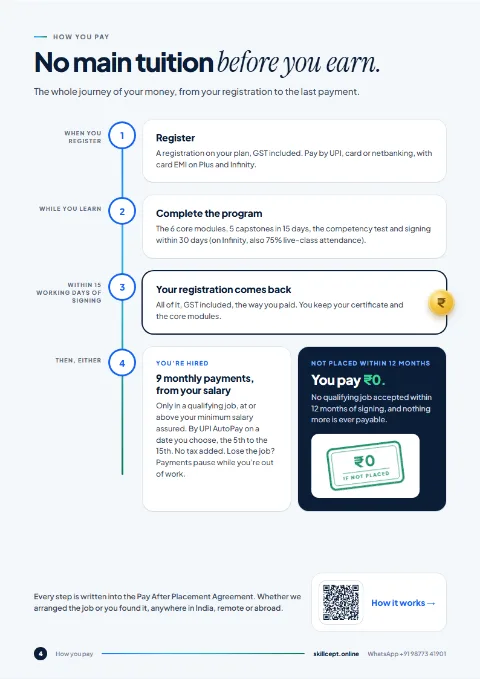
If you join our program, the fee after placement starts only with a qualifying job. In the words of our FAQ:
A full-time job in data science, analytics, AI/ML, BI or software work that uses data, with fixed annual pay at or above your minimum salary assured, that you accept within 12 months of signing the agreement (and join within 90 days after those 12 months end, if it starts later). It counts whether we arranged it or you found it, anywhere in India, remote or abroad.
- A full-time job
- In data science, analytics, AI/ML or BI
- At or above your minimum salary assured
In writingAgreement 2.2Agreement 2.4
Excel, then SQL, Power BI and Python
Push the Excel you know to analyst level, then learn SQL, then Power BI, then Python. Each step replaces a manual task you already do.
| Tool | The task you know | The analyst version | You’re ready when |
|---|---|---|---|
| Excel | Reconciliations, schedules, MIS | Power Query to clean and combine exports; PivotTables; XLOOKUP | Your month-end pack refreshes with one click |
| SQL | Asking IT for a report | Querying transactions yourself: joins, GROUP BY, window functions | You can compute a running balance per account |
| Power BI | The monthly management report | A data model with DAX measures such as year-to-date | Your report answers “why did this change?” without you |
| Python | Repetitive spreadsheet work | pandas to automate it, then a first credit model | You can explain what your model gets wrong |
Free to start: Microsoft’s guides to PivotTables and Power Query, Kaggle Learn’s Intro to SQL, the MySQL tutorial, Microsoft Learn’s Power BI training and its DAX reference. On our program, Module 3 covers Excel, Power Query, DAX and Power BI in about 30 hours, and Module 4 covers SQL in about 11; Module 1 starts with Python, because it leads on to machine learning. See the curriculum.
Four projects on RBI and open data
Build on the data a bank’s interviewer reads every day. Each of these takes a weekend or two.
1. How healthy are India’s banks?Beginner
Data: the RBI’s Handbook of Statistics on the Indian Economy, 2025–26 edition, released on 31 July 2026: Table 50, Gross and Net NPAs of Scheduled Commercial Banks by bank group; Table 49, their consolidated balance sheet; Table 51, banks by CRAR.5 Skills: Excel, Power BI.
- Load every year Table 50 covers, and chart gross and net NPA ratios by bank group.
- Add deposit and advance growth from Table 49.
- Write the one-paragraph story a credit committee would want.
Stretch: explain how a loan becomes an NPA, from the RBI’s Income Recognition, Asset Classification and Provisioning Directions.
2. Who is winning India’s card market?Intermediate
Data: the RBI’s Bankwise ATM/POS/Card Statistics, one table a month (August 2026 was the latest when we checked): by bank, credit and debit cards outstanding and card payments at PoS and online, with values in ₹ thousand.6 Skills: SQL, Power BI.
- Load 12 months into SQL: month, bank, cards, volume, value.
- Each bank’s share of credit cards and of card spends, and average spend per card.
- The fastest risers with
LAG, and a one-page Power BI report.
3. Two banks side by side, from their annual reportsIntermediate
Data: the Form 20-F annual reports that HDFC Bank and ICICI Bank file with the US SEC, free on EDGAR; the latest were filed on 29 July and 20 July 2026.7 Skills: Excel modelling, ratio analysis.
- Build three years of income statements and balance sheets, and note the accounting standard each filing uses.
- Compute margins, cost-to-income, deposit and loan growth, and credit costs.
- Write a one-page comparison, like a credit memo.
4. Who will miss a payment?Advanced
Data: UCI’s Default of Credit Card Clients: 30,000 card customers in Taiwan, with 23 features and their payment records from April to September 2005, under CC BY 4.0.8 It’s not Indian, but it’s open; say so in your README. Skills: Python, pandas, scikit-learn.
- Default rates by payment history, limit and age band.
- A logistic regression, then a tree model; compare them on recall at a fixed false-alarm rate.
- Explain the model the way a credit officer would.
Show it: the confusion matrix, and what one missed default costs against one wrongly declined customer. More Indian datasets: our 15 projects on Indian public data.
What finance analytics interviews ask
Expect three kinds of question: finance concepts, SQL or Excel on transaction data, and a case. Your commerce background wins the first; practise the other two.
| The question | What a good answer covers |
|---|---|
| “How does a loan become an NPA?” | The overdue rule and the asset classes, from the RBI’s Income Recognition, Asset Classification and Provisioning Directions (updated 1 Oct 2026)9 |
| “What are PD, LGD and EAD?” | Probability of default, loss given default and exposure at default; expected loss is their product |
| “Why do banks care about CASA?” | Current and savings deposits cost less than term deposits, so a higher share supports margins |
| “Card delinquency rose last quarter. Where do you look?” | Split by when accounts were opened, product, channel and region; compare days-past-due buckets month on month |
| “Your fraud model flags 2% of transactions. Is that good?” | Precision and recall, and the cost of a missed fraud against a blocked customer |
Two you will be asked to write. A running balance per account in SQL:
SELECT account_id,
       txn_date,
       amount,
       SUM(amount) OVER (PARTITION BY account_id
                         ORDER BY txn_date, txn_id) AS running_balance
FROM transactions;
And year-to-date card spends in Power BI, with DAX:
Spends YTD = TOTALYTD ( SUM ( Cards[Value] ), 'Date'[Date] )Our SQL interview questions and Power BI and DAX questions cover the rest.
A 6-month switch plan
About 10 hours a week for six months, while you keep your job. If you’ve paused CA or CMA, your articleship gives you audit and reconciliation stories for every interview.
| Month | Focus | You finish with |
|---|---|---|
| 1 | Excel to analyst level: Power Query, PivotTables, XLOOKUP | A month-end pack that refreshes with one click |
| 2 | SQL basics on a sample database | Twenty business questions answered |
| 3 | SQL window functions; statistics basics | The card-market analysis (project 2) |
| 4 | Power BI: data model, DAX, report design | The bank-health dashboard (project 1), published |
| 5 | Python and pandas; a first model | The default model (project 4) |
| 6 | Resume, interviews, applications | 20 applications to banks, NBFCs, fintechs and finance teams |
Six months is a plan, not a promise: exams, month-end closes and family can stretch it. Ten steady hours a week beat thirty hours one week and none the next.
Questions
Can a B.Com graduate become a data analyst?
Yes. Analysts are hired on Excel, SQL, a BI tool such as Power BI and projects, and a commerce degree adds what finance teams value: knowing what the numbers mean. AmbitionBox shows Data Analysts in financial services at ₹9.2–10.1 lakh a year (October 2026).
Is data analytics a good career after B.Com?
On pay, often yes: AmbitionBox (October 2026) shows Accountants at ₹2.5–2.7 lakh with 1–3 years’ experience and Data Analysts at ₹5.2–5.7 lakh. Banks are hiring freshers too: fresher hiring in banking and financial services on Naukri grew 14% in September 2026.
Do I need maths or coding for data analytics after B.Com?
Not much to start. Excel, SQL and Power BI need little coding, and the statistics you studied for B.Com is a good base. Python comes later, for automation and data science roles.
Financial analyst or data analyst: which is better after B.Com?
Both use the same tools. On AmbitionBox (October 2026), Financial Analysts showed ₹5.4–5.9 lakh and Data Analysts ₹5.2–5.7 lakh at 1–3 years, while Credit Analysts showed ₹7.6–8.4 lakh; data analyst skills also open doors outside finance.
Can a CA dropout become a data analyst?
Yes. Articleship gives you audit, reconciliation and sampling experience; add SQL, Power BI and projects on financial data, and aim first for credit, risk, FP&A or finance analytics roles.
Sources
- AmbitionBox salary profiles, read 22 Oct 2026 (each updated 19–21 Oct 2026): Data Analyst (with pay by industry), Accountant, Credit Analyst, Risk Analyst, Business Analyst, Fund Accountant, Financial Analyst, AML Analyst, Fraud Analyst and KYC Analyst.
- Naukri, JobSpeak, September 2026, 6 Oct 2026, read 22 Oct 2026.
- foundit Insights Tracker, reported in Storyboard18, 13 Jan 2026, read 22 Oct 2026.
- World Bank, South Asia Development Update, October 2025, read 22 Oct 2026.
- Reserve Bank of India, Handbook of Statistics on the Indian Economy, 2025–26, released 31 Jul 2026, read 22 Oct 2026.
- Reserve Bank of India, Bankwise ATM/POS/Card Statistics, read 22 Oct 2026.
- SEC EDGAR, Form 20-F filing lists of HDFC Bank and ICICI Bank, read 22 Oct 2026.
- UCI Machine Learning Repository, Default of Credit Card Clients, read 22 Oct 2026.
- Reserve Bank of India, Master Directions, including the Commercial Banks – Income Recognition, Asset Classification and Provisioning Directions, 2025 (updated 1 Oct 2026), read 22 Oct 2026.