Skillcept Online
Key takeaways
- A Data Analyst finds answers in data; a Business Analyst defines what should change. IIBA, the professional body for business analysis, describes the work as enabling change “by defining needs and recommending solutions”.1
- With 1–3 years’ experience, Business Analysts earn ₹7–7.7 lakh a year and Data Analysts ₹5.2–5.7 lakh; with 3–6 years, ₹8.7–9.7 lakh against ₹7.2–7.9 lakh (AmbitionBox, updated 19–20 Oct 2026).23
- At entry level the two are close: Junior Business Analysts show ₹4.2–4.7 lakh and Junior Data Analysts ₹3.9–4.4 lakh a year (AmbitionBox, 0–4 years).4
- SQL tops both titles’ skill lists on AmbitionBox. Business Analysts add Agile, Scrum, requirement gathering and JIRA; Data Analysts add Excel, Power BI, Tableau and Python.23
What’s the difference between a data analyst and a business analyst?
A Data Analyst turns a company’s data into answers: what happened, where and why. The day is SQL queries, spreadsheets and dashboards, and the output is a number, a chart or a recommendation backed by data.
A Business Analyst works out what a business needs and how a process or a system should change to deliver it. IIBA, the professional body for business analysts, defines business analysis as enabling change “by defining needs and recommending solutions” that deliver value to stakeholders.1 The day is conversations with users, requirement documents and user stories, and checking that what gets built does what was asked.
In India the title is used both ways. In IT services, “Business Analyst” usually means requirements work on software projects; in consulting, e-commerce and analytics firms it often means analytics work in SQL and Excel. AmbitionBox’s top skills for the title show both: SQL and data analysis beside requirement gathering, BRDs (business requirement documents) and JIRA.3 So read the job description, not the title.
Side by side
The table compares the two on the work, the skills employers list and the pay.
| Compare | Data Analyst | Business Analyst |
|---|---|---|
| The question | What happened, and why? | What do we need, and what should change? |
| A typical day | Writing SQL, cleaning data, updating dashboards, answering managers’ questions | Talking to users, writing requirements and user stories, mapping processes, working with developers and testers |
| Top skills listed | SQL, Excel, Power BI, Tableau, Python, data visualisation | SQL, business analysis, Agile, Scrum, requirement gathering, BRDs, user stories, JIRA |
| What you hand over | Dashboards, reports and analyses that say what to do next | Requirement documents, user stories, process maps and sign-off on what was built |
| Pay, 1–3 years | ₹5.2–5.7 L | ₹7–7.7 L |
| Pay, 3–6 years | ₹7.2–7.9 L | ₹8.7–9.7 L |
| Next steps | Senior Data Analyst, BI Analyst, Data Scientist | Senior Business Analyst, Product Owner, Product Manager |
| Suits people who | Like numbers, puzzles and building things | Like talking, writing and getting people to agree |
Skills: AmbitionBox’s top skills for each title. Pay: AmbitionBox, updated 19 Oct 2026 (Data Analyst) and 20 Oct 2026 (Business Analyst), read 22 Oct 2026.23
The overlap is real and growing. Both roles use SQL and Excel, analysts are expected to explain their numbers in business terms, and business analysts are expected to back their requirements with data. The difference is the centre of gravity: data for one, people and process for the other.
What each pays
From one year’s experience up, Business Analysts earn more than Data Analysts on both AmbitionBox and Indeed. At entry level the two are close.
| Experience | Data Analyst | Business Analyst | Source |
|---|---|---|---|
| Junior titles, 0–4 years | ₹3.9–4.4 L6,900 salaries | ₹4.2–4.7 L2,100 salaries | AmbitionBox |
| 1–3 years | ₹5.2–5.7 L84,200 salaries | ₹7–7.7 L49,800 salaries | AmbitionBox |
| 3–6 years | ₹7.2–7.9 L66,500 salaries | ₹8.7–9.7 L69,200 salaries | AmbitionBox |
| 6–9 years | ₹7.7–11.3 L58 salaries, a small sample | ₹11.4–12.6 L30,800 salaries | AmbitionBox |
| Average, all levels | ₹6,29,449545 salaries | ₹8,90,041638 salaries | Indeed |
Sources: AmbitionBox, updated 19–21 Oct 2026,234 and Indeed, updated 9 and 11 Oct 2026,5 all read 22 Oct 2026.
A month, before deductions, the junior bands come to about ₹32,500–36,667 for Junior Data Analysts and ₹35,000–39,167 for Junior Business Analysts.
Part of the gap is the employer mix (next section), and part is the title. Analysts who move up carry a senior title, and AmbitionBox shows Senior Data Analysts at ₹11.6–12.8 lakh with 3–6 years, above the Business Analyst band for the same years.2 Business Intelligence Analysts, the dashboard and data-model specialists in between, show ₹6.8–7.5 lakh with 1–3 years and ₹9.4–10.4 lakh with 3–6.6 For every level of analyst pay, by city and by industry, see our Data Analyst salary guide.
Who hires each
IT services and consulting firms employ the most of both titles, by the number of salaries on AmbitionBox, and there they pay Business Analysts about ₹3 lakh a year more than Data Analysts.23
| Industry | Data Analyst | Business Analyst |
|---|---|---|
| IT services | ₹5.7–6.3 L48,100 salaries | ₹8.9–9.8 L56,900 salaries |
| Consulting | ₹8–8.8 L13,100 salaries | ₹10.7–11.8 L9,900 salaries |
| Software product | ₹8.4–9.3 L5,800 salaries | ₹9.8–10.8 L9,500 salaries |
| Analytics and KPO | ₹5.6–6.2 L7,500 salaries | ₹7.9–8.7 L8,600 salaries |
| Financial services | ₹9.2–10.1 L6,300 salaries | ₹11.6–12.8 L7,600 salaries |
Source: AmbitionBox, salaries by industry, all experience levels, updated 19–20 Oct 2026, read 22 Oct 2026. IT services is AmbitionBox’s “IT Services & Consulting”; Consulting is its “Management Consulting”.
Of these industries, financial services pays both titles the most, and it is hiring freshers: in September 2026, fresher hiring in banking and financial services on Naukri rose 14% on the year, against 1% for fresher hiring overall.7 Global capability centres (GCCs), the in-house technology and analytics centres of global companies, hire both titles too; Naukri recorded GCC hiring up 4% on the year in the same month.7
Which fits your background?
Choose by the work you’d enjoy, then by what you can prove soonest. A quick test: would you rather spend an afternoon untangling a dataset until it answers a question, or in a meeting getting five people to agree on what a system should do?
| Your background | A natural first step | Why it fits |
|---|---|---|
| Fresher, any degree | Data Analyst | Easier to prove with projects before your first job |
| B.Com, BBA, finance | Either: analyst roles in finance, or Business Analyst in banking and IT services | You know how money moves through a business |
| Engineering, maths, science | Data Analyst, then Data Scientist | Numbers and logic are already your strength |
| IT: testing, support, development | Business Analyst on software projects, or Data Analyst if you enjoy SQL | You know how software is built, tested and fixed |
| Arts, humanities, media | Business Analyst, or Data Analyst with strong SQL | Clear writing and good questions are half of BA work |
| MBA | Business Analyst, or a product analyst role | Strategy and people skills |
For freshers, the analyst route is usually the more direct one. You can show SQL and dashboards with projects on public data, while requirements work is easier to show once you’ve worked inside a real business process.
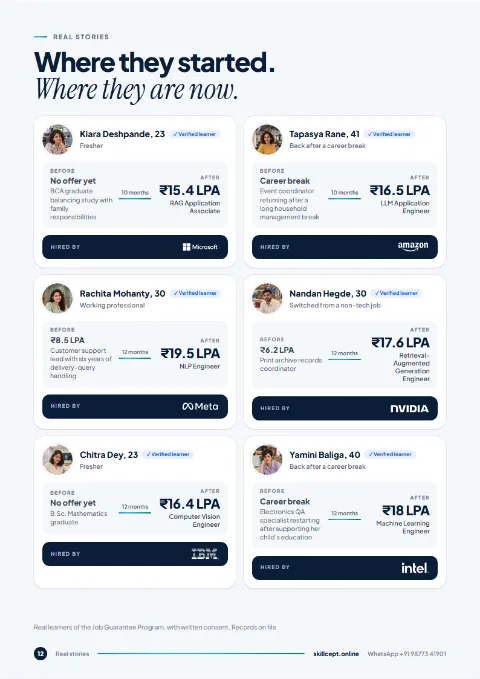
A non-tech degree is no bar to either: of the learners we placed in 2025, 46% came from a non-tech degree. Records on file. Switching from a non-IT job? Our switch guide maps seven backgrounds to their first analyst roles.
Moving from one to the other
Moving between the two is common, because SQL sits at the top of both skill lists. What to add depends on the direction.
- Data Analyst to Business Analyst: learn to write requirements (user stories with acceptance criteria), Agile and Scrum ways of working, and JIRA. Your data skills become an edge few business analysts have.
- Business Analyst to Data Analyst: take SQL to joins and window functions, learn Power BI and some Python, and build two or three projects that answer real questions with data.
- The bridge between them: Business Intelligence Analyst. BI analysts build the dashboards and data models a business runs on, and AmbitionBox lists SQL, data visualisation, data modelling, Power BI and Tableau among their top skills.6
Whichever way you go, learn to use AI and to check it: Indeed found AI mentioned in 39% of data and analytics job postings in India (September 2025).8 Our Data Analyst roadmap lays out the analyst skills in order, with a project at each step.
Do Business Analyst and BI jobs count on our program?
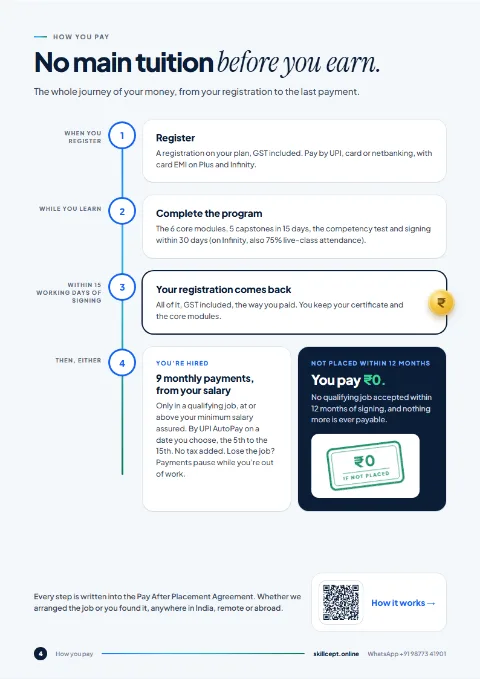
Yes, when the work is analytics or BI: what counts is the work, not the title. On our Data Science & AI Job Guarantee Program, a qualifying job is a full-time job in data science, analytics, AI/ML, BI or software work that uses data, at or above your minimum salary assured, and we confirm each job from its offer letter and payslip. In the words of our FAQ:
A full-time job in data science, analytics, AI/ML, BI or software work that uses data, with fixed annual pay at or above your minimum salary assured, that you accept within 12 months of signing the agreement (and join within 90 days after those 12 months end, if it starts later). It counts whether we arranged it or you found it, anywhere in India, remote or abroad.
- A full-time job
- In data science, analytics, AI/ML or BI
- At or above your minimum salary assured
In writingAgreement 2.2Agreement 2.4
On Go, our plan for analyst roles, the minimum salary assured is ₹6 LPA. Compare the plans to see each one.
Questions
Which is better for freshers, data analyst or business analyst?
For most freshers, Data Analyst is the more direct start, because you can prove SQL and dashboards with projects. Entry pay is close: AmbitionBox shows Junior Data Analysts at ₹3.9–4.4 lakh and Junior Business Analysts at ₹4.2–4.7 lakh a year (updated 20–21 Oct 2026).
Who earns more, a data analyst or a business analyst?
Business Analysts, from one year’s experience up. On AmbitionBox (updated 19–20 Oct 2026) they earn ₹7–7.7 lakh with 1–3 years against ₹5.2–5.7 lakh for Data Analysts, and Indeed’s averages are ₹8,90,041 and ₹6,29,449 a year.
Does a business analyst need coding?
Not much. SQL is the technical skill at the top of AmbitionBox’s list for Business Analysts, and Python isn’t among the title’s top skills. Data Analysts need SQL, Excel and Power BI, and Python helps.
Can a business analyst become a data analyst?
Yes. Take SQL to joins and window functions, learn Power BI and some Python, and build two or three data projects. Business sense is an advantage, because analysts are judged on whether their answers help the business.
Is business analyst an IT job?
Often, not always. In IT services it usually means requirements work on software projects; in consulting, e-commerce and analytics firms it’s often an analytics role. On AmbitionBox, IT services and consulting account for about 56,900 of 1.5 lakh Business Analyst salaries (updated 20 Oct 2026).
Sources
- IIBA, How to Become a Business Analyst?, read 22 Oct 2026.
- AmbitionBox, Data Analyst (updated 19 Oct 2026) and Senior Data Analyst (21 Oct 2026) salaries in India, read 22 Oct 2026.
- AmbitionBox, Business Analyst salary in India, updated 20 Oct 2026, read 22 Oct 2026.
- AmbitionBox, Junior Data Analyst (updated 21 Oct 2026) and Junior Business Analyst (20 Oct 2026) salaries, read 22 Oct 2026.
- Indeed, Data Analyst salaries (updated 9 Oct 2026) and Business Analyst salaries (11 Oct 2026) in India, read 22 Oct 2026.
- AmbitionBox, Business Intelligence Analyst salary in India, updated 20 Oct 2026, read 22 Oct 2026.
- Naukri, JobSpeak, September 2026, 6 Oct 2026.
- Indeed Hiring Lab, September 2025 labour market update, 25 Oct 2025.