Skillcept Online
Key takeaways
- Hiring is growing fastest for experience: in September 2026, Naukri saw hiring for 8–12 years’ experience rise 5% on the year and for 13–16 years 7%, while fresher hiring rose 1%.1
- In AI/ML, demand leans further to experience: hiring for 13–16 years rose 54% and for 8–12 years 28% (Naukri, September 2026).1
- Of the AI jobs foundit tracked in 2025, 54% were for people with 7 or more years’ experience (25% for 7–10 years, 17% for 11–15, 12% for 15+; our sum).2
- Your pay need not reset: with 3–6 years, AmbitionBox shows Business Analysts at ₹8.7–9.7 lakh and Data Scientists at ₹15–16.6 lakh a year (October 2026).4
Is it too late at 30, 35 or 40?
No. On Naukri’s September 2026 data, hiring grew in every band above eight years’ experience and was almost flat for freshers. Data science is the work of turning data into predictions and decisions with statistics, programming and machine learning; first jobs in it often carry other titles, such as Data Analyst or Associate Data Scientist, and AmbitionBox shows no Data Scientist band under a year’s experience.4
| Experience | All white-collar hiring | AI/ML hiring |
|---|---|---|
| Freshers | +1% | +19% |
| 4–7 years | −2% | Stable |
| 8–12 years | +5% | +28% |
| 13–16 years | +7% | +54% |
| 16+ years | +5% | Not reported |
Source: Naukri JobSpeak, September 2026, year on year, published 6 Oct 2026.1
foundit’s tracker shows the same shape in AI jobs: in 2025, 18% were open to people with 0–3 years’ experience, 28% asked for 4–6 years, 25% for 7–10, 17% for 11–15 and 12% for more than 15, mostly in leadership and governance roles.2 And people in mid-career are keen learners: in Indeed’s Work Ahead survey of 3,001 workers and business leaders in India, 56% of those aged 35–54 wanted significantly more training, against 41% of 18–24-year-olds, and 49% said they were ready to work in AI-integrated workplaces, ahead of the youngest group.3
The catch: those growing bands want experience in the field. Your years count when the new role uses them, so the switch that works after 30 is rarely “start again as a fresher”. It’s “add data skills to what you already know”.
What changes at 30, 35 and 40
Three things change with each five years: how much experience you bring, how much pay you could lose, and which first role makes sense. Here’s the map, then each age.
| Age | You often bring | Aim for first | Watch out for |
|---|---|---|---|
| Around 30 | 5–8 years in one field | Data Analyst, Business Analyst or Associate Data Scientist, ideally in your industry | Applying only to fresher roles |
| Around 35 | 10 or more years, often leading a team | Analyst roles where your domain is half the job: risk, supply chain, operations, sales or HR analytics | A wide gap between your pay and entry bands |
| 40 and over | 15 or more years, management, a network | Analytics roles inside your industry or your own company; BI and reporting leads who need domain depth | Competing on coding speed alone |
At 30
For many people outside tech, the switch is a raise. With 3–6 years’ experience, AmbitionBox shows Accountants at ₹3.1–3.4 lakh and Customer Service Executives at ₹3.3–3.7 lakh, against ₹5.2–5.7 lakh for Data Analysts with 1–3 years.4 Use the room: learn Python and machine learning on top of SQL and a BI tool, and aim a step higher, at Associate Data Scientist, which shows ₹8.2–9 lakh at 1–3 years.4
At 35
By 35, your domain is your edge. A risk analyst who worked in a bank, or a supply chain analyst who ran a warehouse, is hired for what they know as much as for SQL. Aim for analyst roles in your own industry, where ten years mean something, and use the AI/ML demand for experienced people as the reason to add machine learning.
At 40 and over
At 40, the strongest move is usually inside your industry or your own company: an internal move keeps your pay history, your tenure and a manager who knows your work. Lead with judgement: knowing which question matters, and explaining results to leaders. Our switch guide by background shows the first role for each field.
Where your years count
Your years count most in roles where the domain is half the job, and in the bands above entry level. Here’s what people with experience in each title earn; a switcher usually enters a band lower and moves up once the new skills are proven.
| Role | 3–6 years | 6–9 years | 9–12 years |
|---|---|---|---|
| Data Analyst | ₹7.2–7.9 L | ₹7.7–11.3 L58 salaries, a small sample | No band shown |
| Business Analyst | ₹8.7–9.7 L | ₹11.4–12.6 L | ₹13.7–15.1 L |
| Senior Data Analyst | ₹11.6–12.8 L | ₹14.5–16.1 L | ₹16.8–18.6 L |
| Senior Business Analyst | ₹13–14.3 L | ₹15–16.5 L | ₹17.9–19.7 L |
| Data Scientist | ₹15–16.6 L | ₹20.5–22.6 L | No band shown |
| Analytics Manager | ₹20.4–22.6 L | ₹26.6–29.4 L | ₹28.4–31.4 L |
Source: AmbitionBox, typical yearly pay by experience, pages updated 19–21 Oct 2026 and read 22 Oct 2026.4 These are people with those years in the title; a switcher’s past years rarely count in full.
What carries over from almost any career:
- Domain knowledge: you know what the numbers mean, and which ones the business acts on.
- Stakeholders: you’ve presented to bosses, clients and auditors; analysts who explain clearly get trusted with bigger questions.
- Managing people: the route to Analytics Manager needs it, and few new analysts have it.
- Process: you know where the data is created and where it breaks.
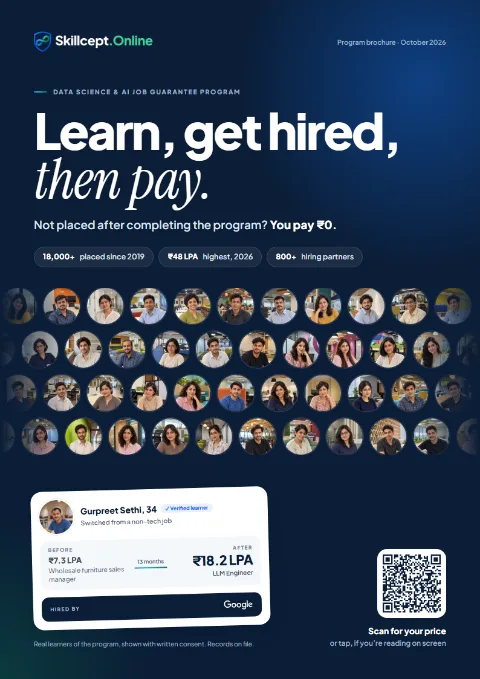
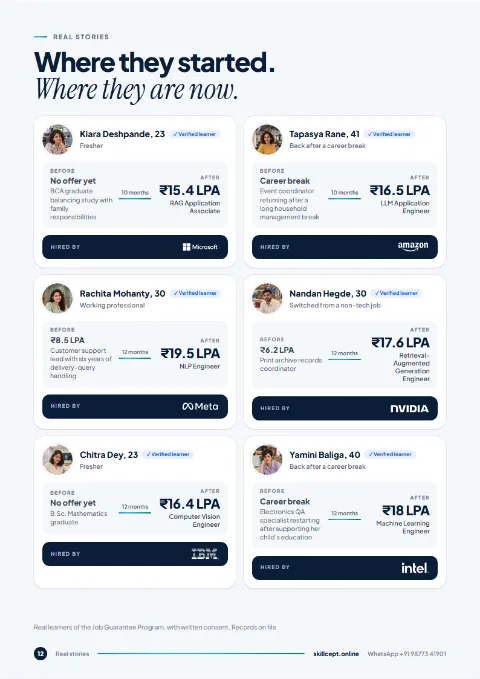
Put the data work you already do at the top of your resume, build projects on your own industry’s problems, and apply to roles that want three or more years plus your domain, not only to fresher roles. In our records, 46% of the learners we placed in 2025 came from a non-tech degree. Records on file.
Will you take a pay cut?
Only if you earn more today than the band you’re hired into. Compare your fixed pay with the 1–3 year band of the role you want; if you’re above it, aim for a domain role or an internal move rather than an entry title.
Waiting for raises is slow. Aon put India’s average salary increase at 9% in 2026 and projects 9.1% for 2027.5 At 9% a year, pay takes about three and a half years to rise 35%, and about seven years to rise 85% (our arithmetic). A change of role is where the big steps come; if you’re in IT services, our IT-to-AI plan covers the bridge roles, and our guide to fresher pay after a switch has the full math.
How our program sets your bar from your pay
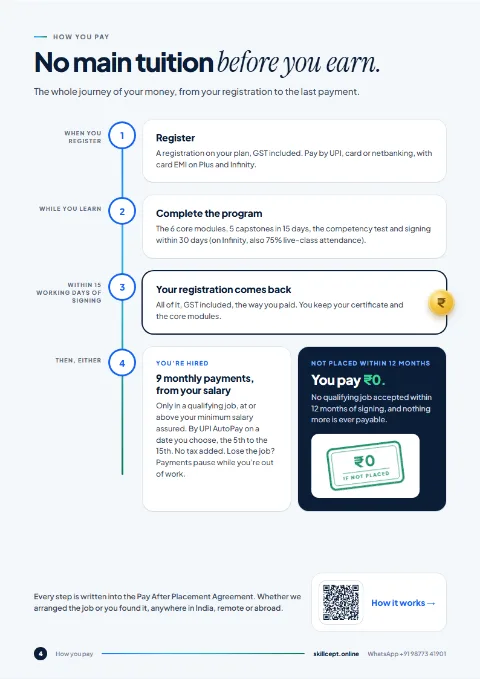
On our Data Science & AI Job Guarantee Program, your current fixed pay can raise the minimum salary assured on Plus and Infinity, so the fee waits for a job that clears it. Enter yours:
- GoData Analyst roles₹6 LPA≈ ₹50,000 a month₹6 LPA on Go, whatever you earn today.
- PlusData Scientist roles₹9 LPA≈ ₹75,000 a month₹9 LPA or your salary + 35%, whichever is higher.
- InfinityAI/ML Engineer roles₹12 LPA≈ ₹1,00,000 a month₹12 LPA or your salary + 85%, whichever is higher.
Your minimum salary assured is the lowest fixed annual pay a job must offer before any fee after placement is due: a threshold for the fee, not a promise of any salary. The salary option uses the fixed pay on your last 3 payslips when you complete, if it’s ₹25 LPA or less and you share them. In writing: Agreement 2.3. Nothing you type here is stored or sent.
| Your fixed pay today | Plus: ₹9 LPA or + 35%, whichever is higher | Infinity: ₹12 LPA or + 85%, whichever is higher |
|---|---|---|
| ₹6 LPA | ₹9 LPA | ₹12 LPA |
| ₹10 LPA | ₹13.5 LPA | ₹18.5 LPA |
| ₹15 LPA | ₹20.25 LPA | ₹27.75 LPA |
| ₹25 LPA | ₹33.75 LPA | ₹46.25 LPA |
| Above ₹25 LPA | ₹9 LPAThe salary option doesn’t apply | ₹12 LPAThe salary option doesn’t apply |
Whichever is higher, by Agreement 2.3. The salary option uses the fixed pay on your last 3 payslips when you complete, if you share them.
The line your job’s pay must clear before anything is due after placement: ₹6 LPA on Go; ₹9 LPA or your salary + 35%, whichever is higher, on Plus; and ₹12 LPA or your salary + 85%, whichever is higher, on Infinity. A job below it never starts the fee. The salary option uses the fixed pay on your last 3 payslips when you complete, if it’s ₹25 LPA or less and you share them.
- Measured on fixed annual pay
- Below it, the fee never starts
- A threshold, not a salary promise
In writingAgreement 2.3Terms 3.3
A plan around a job and a family
Keep your job, give the switch about 10 hours a week, and plan on about six months of learning before you apply. Three weekday evenings of an hour and seven hours across the weekend add up to 10.
| Months | Learn | Build |
|---|---|---|
| 1–2 | Python from zero, then probability and statistics | A clean summary of a dataset from your own industry |
| 3 | Excel, Power BI and pandas, then SQL | A dashboard and ten SQL answers to your industry’s questions |
| 4 | Machine learning | A model that predicts something your industry cares about, tested honestly |
| 5 | Deep learning basics and AI tools | Three projects, each with a one-page summary |
| 6 | Resume, LinkedIn and interview practice | 20 applications, half of them in your own industry |
- Agree the hours at home. Two protected weekend blocks matter more than late nights after work.
- Don’t quit to learn. Your salary pays the bills, and your current job is where your best project ideas come from.
- Ask about an internal move first. Tell your manager what you’re learning; analytics teams hire people who already know the business.
On our program, the same order takes about 6 months on Go and Plus at about 10 hours a week, at your own pace; Infinity runs live on Saturdays and Sundays, 11 AM to 2 PM IST, for about 9 to 10 months. See the curriculum. For timelines by background, read can you become a data analyst in 6 months.
What interviewers ask switchers
Expect questions about why now, why you over a younger candidate, and money. Answer each with your domain and your proof, never with an apology.
| The question | What a strong answer covers |
|---|---|
| “Why switch now?” | A problem from your job that data solved, and what you’ve already built |
| “Why hire you over a fresher?” | Your domain shortens the learning curve; one project on their kind of data |
| “Can you report to someone younger?” | Yes: you’re there to learn the craft and bring the business sense |
| “This band is below your pay. Will you take it?” | Your number in fixed pay, the band’s source, and the role’s next two years |
| “Walk me through a project.” | The question, the data, the method, the result with a number, and what you’d do next |
Questions
Is 30 too late to start a career in data science?
No. In September 2026, Naukri saw hiring for 8–12 years’ experience rise 5% on the year, and AI/ML hiring for 8–12 years rise 28%. Start in a role where your past work counts, and build Python, SQL and machine learning around your job.
Can I become a data analyst at 40?
Yes, especially inside your own industry, where 15 years of domain knowledge is an advantage. Expect to prove the new skills with projects, and to start a band or two below your seniority unless the role uses your domain.
Will I have to start at a fresher salary after 30?
Not necessarily: pay follows the role and band you’re hired into. AmbitionBox (October 2026) shows Business Analysts at ₹8.7–9.7 lakh and Data Scientists at ₹15–16.6 lakh with 3–6 years’ experience; if you earn more than the band you’re aiming for, target a domain role or an internal move.
Am I too old at 45 to join a data science program?
Not for ours: anyone aged 18 to 55 who has passed Class 12 can join the Data Science & AI Job Guarantee Program, with no CGPA cut-off or degree filter. What matters more is about 10 hours a week for about six months.
How long does it take to switch to data science at 35?
About six months of learning at around 10 hours a week to be ready for interviews, then the job search. Keep your job while you learn, and aim first for roles where your domain counts.
Sources
- Naukri, JobSpeak, September 2026, 6 Oct 2026, read 22 Oct 2026.
- foundit Insights Tracker, reported in Storyboard18, 13 Jan 2026, read 22 Oct 2026.
- Indeed, Work Ahead report (research by Censuswide, May 2025), reported by PTI in Outlook Business, 19 Aug 2025, read 22 Oct 2026.
- AmbitionBox salary profiles, read 22 Oct 2026 (each updated 19–21 Oct 2026): Data Analyst, Business Analyst, Senior Data Analyst, Senior Business Analyst, Data Scientist, Associate Data Scientist, Analytics Manager, Accountant and Customer Service Executive.
- Aon, Salary Increase and Turnover Survey 2026–27, reported in Telangana Today, 14 Oct 2026, read 22 Oct 2026.