Skillcept Online
Key takeaways
- Six months at about 10 hours a week is roughly 250 hours: enough for Python, statistics, Excel and Power BI, SQL and three portfolio projects, the skills analyst interviews test.
- Job-ready isn’t hired: LinkedIn found the number of applicants per open role in India has more than doubled since early 2022.1
- Freshers face the flattest market: fresher hiring on Naukri rose 1% on the year in September 2026, while fresher hiring in AI/ML rose 19%.2
- Your background changes the start more than the finish: IT professionals usually move faster through Python, and people returning from a break should plan extra time for the search.
Can you become a data analyst in 6 months?
Yes, to job-ready, if you give it about 10 hours a week and follow one plan in order. Six months at that pace is roughly 250 hours: enough for Python, statistics, Excel and Power BI, SQL and three portfolio projects, which is what analyst interviews in India test.
Two honest caveats. Six months is the learning; the job search comes after it and runs on its own clock (more below). And the time depends on where you start: someone who already writes code, or builds Excel reports every day, isn’t starting from zero.
So the realistic goal is job-ready in about six months, then a search of its own, shorter with strong projects, referrals and steady applications.
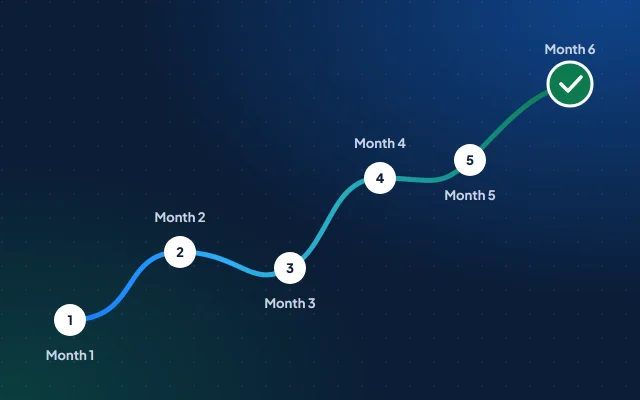
Month by month, at 10 hours a week
This is the order our Data Analyst roadmap follows, at about 40 hours a month. Each month ends with something you can show.
| Month | Learn | Hours | Show at the end |
|---|---|---|---|
| Month 1 | Python from zero: variables, loops, functions, files | About 40 | A script that totals a month of expenses from a CSV file |
| Month 2 | The rest of Python, then statistics: distributions, confidence intervals, hypothesis tests | About 40 | A two-line answer to “is this difference real?” |
| Month 3 | Excel and Power BI (PivotTables, Power Query, DAX), then pandas | About 40 | A one-page Power BI report on an Indian public dataset |
| Month 4 | SQL: joins, subqueries, window functions | About 40 | Ten business questions answered in SQL |
| Month 5 | Two more projects on real data, each on GitHub with a README | About 40 | Three portfolio projects |
| Month 6 | Resume, timed SQL practice, mock interviews, applications | About 40 | 20 applications tracked and 5 mock interviews done |
Our plan, from our curriculum’s hours for each topic: Python about 51, statistics about 10, Excel, Power BI and pandas about 30, SQL about 11, plus practice, projects and interview preparation.
On our program, the 6 core modules go further, into machine learning and deep learning: about 186 hours of lessons in all, and the portfolio comes from your capstones. In the words of our FAQ:
At about 10 hours a week, Go and Plus take about 6 months to become placement-ready, at your own pace. Infinity runs live on weekends for about 9 to 10 months. Every plan gives you 12 months to complete.
- About 10 hours a week
- 12 months to complete, on every plan
In writingTerms 6.1User guidelines 1.2
Timelines by background
Your starting point changes the first months, not the last ones: everyone needs SQL, a portfolio and interview practice. These are our estimates at about 10 hours a week.
| You are | Start at | Job-ready in about | Watch out for |
|---|---|---|---|
| A fresher, any degree, no coding | Month 1, Python from zero | 6 months | No work experience: projects and internships carry your resume |
| Switching from a non-IT jobCommerce, sales, operations, BPO | Month 1; Excel at work shortens Month 3 | 5–6 months | Finding 10 hours a week around a full-time job, and a notice period after the offer |
| Working in ITTesting, support, development | A Python review, then statistics | 4–5 months | Being seen as “IT support”: lead your resume with data projects |
| Back after a career break | Month 1, or a refresher if you coded before | 6 months | A gap on your resume: recent projects answer it |
Our estimates at about 10 hours a week, from the curriculum’s hours. Faster with more hours a week, slower with fewer.
Freshers
Fresher hiring is the flattest part of the market: on Naukri it rose 1% on the year in September 2026, while fresher hiring in AI/ML rose 19%.2 Employers want proof: in TeamLease EdTech’s survey of 1,097 employers, they asked for AI fluency, applied problem-solving and hands-on project experience.3 Projects carry a fresher’s resume. If your college has no campus drives, our off-campus plan shows where to apply.
Switching from a non-IT job
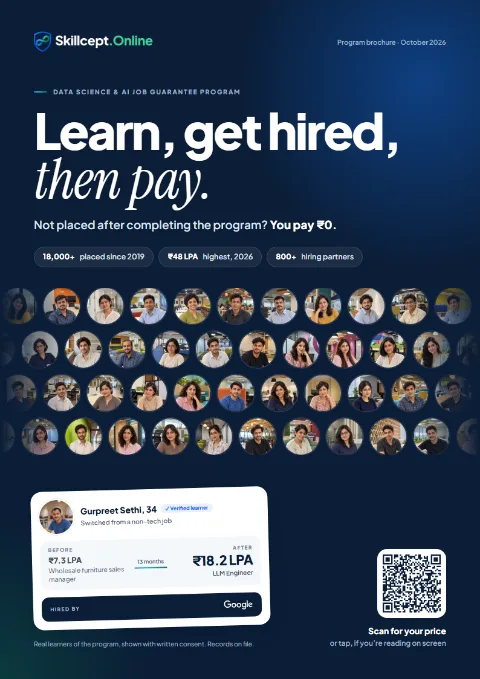
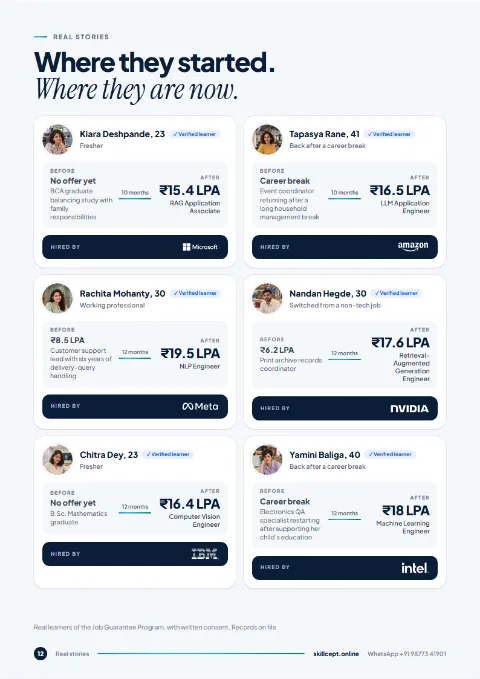
Your domain is your edge: an analyst role in the business you know, in finance, sales, operations or support, is the shortest switch. Keep your job while you learn; 10 hours a week is two evenings and a weekend morning. A non-tech degree is no bar: of the learners we placed in 2025, 46% came from a non-tech degree. Records on file.
Working in IT
You can move faster through Python and SQL basics, so four to five months is realistic. The market is moving your way: in September 2026, IT hiring on Naukri fell 4% on the year, while AI/ML hiring inside IT rose 11%.2 Our guide for IT professionals has a plan for testers and support engineers.
Back after a break
Plan the same six months, and more time for the search. An Ashoka University study found that women who had taken a career break got 49% fewer callbacks than similar women who hadn’t.4 Returnships help: TeamLease Digital put their conversion to jobs at around 70% on average across major returnship programs.5 Two or three recent projects answer the gap before anyone asks, and our career-gap guide shows how to explain it.
How many hours a week do you need?
Hours a week set your finish date. Here is the same plan of roughly 250 hours at different paces.
| Hours a week | Job-ready in about | What it looks like |
|---|---|---|
| 5 | 12 months | Weekends only; easy to lose the thread between sessions |
| 10 | 6 months | Two evenings and a weekend morning: a pace you can keep alongside a full-time job |
| 15 | 4 months | An hour or two on most days |
| 20 | 3 months | Close to half-time; realistic between jobs or after college |
Our arithmetic: about 250 hours of learning, projects and interview practice, divided by the hours you have each week.
A steady 10 hours every week usually beats bursts: each month builds on the last, and a month off means relearning before you move on. On our program, every plan gives you 12 months to complete, so a slower pace still fits.
What slows people down
Most delays come from order and habits, not difficulty.
- Switching tools every week. Pick one sequence (Python, statistics, Excel and Power BI, SQL) and finish each step before the next.
- Watching without building. If a month ends without something you can show, it isn’t finished.
- Leaving SQL for later. AmbitionBox lists SQL first among the top skills for Data Analysts,6 so start it by Month 4 at the latest.
- Ignoring AI. Indeed found AI mentioned in 39% of data and analytics job postings in India.7 Use AI tools on your projects, and check every number they give you.
- Waiting to feel ready. Start applying in Month 5, while you finish your portfolio: interviews show you what to practise.
- Searching one title only. Analyst work is also posted as MIS Analyst, Reporting Analyst, Business Analyst, BI Analyst and Associate Analyst. Read the skills, not the title.
- Learning with no feedback. A mentor, a study group or a friend who reviews your work catches what you can’t see yourself.
Job-ready isn’t hired
Getting hired is its own project, and it runs on the market’s clock, not yours. LinkedIn found that the number of applicants per open role in India has more than doubled since early 2022.1 Employers are still hiring: in TeamLease EdTech’s survey, 75% of employers planned to hire freshers in July–December 2026.3 The candidates who get through are the ones with proof.
How to shorten the search
- Apply every week from Month 5, to roles whose posted skills match yours, and track every application and reply.
- Ask for referrals. Former classmates, colleagues and people whose work you follow can get your resume read.
- Tailor each resume to the posting’s skills, with your projects first.
- Practise out loud: explain each project in two minutes, and solve SQL questions against a timer.
On our program, this is the part we take on with you. Once you complete the program, your interviews are assured (30 on Go, 100 on Plus, unlimited until hired on Infinity), with mock interviews and help with your resume, LinkedIn and GitHub. Compare the plans.
Start this week
Five steps that cost nothing and set the six months in motion.
- Block your 10 hours. Put two evenings and a weekend morning in your calendar, at the same times every week.
- Write your first program. Install Python and work through the first chapters of the official Python tutorial.
- Read 20 job postings for analyst roles in your city, and list the skills they repeat. That list is how you’ll check your plan.
- Pick the data for your first project from data.gov.in, India’s open government data platform, on a subject you could talk about in an interview.
- Put a date on Month 5. Write down the day you’ll send your first application, and tell someone who will ask you about it.
Questions
Can I become a data analyst in 6 months?
Yes, to job-ready, at about 10 hours a week (roughly 250 hours), if you follow one plan: Python, statistics, Excel and Power BI, SQL, then three projects. Getting hired takes longer, because the job search starts after that.
How long does it take to become a data analyst with no experience?
About six months of learning at 10 hours a week, from zero, then a job search of its own. Freshers face a flat market: fresher hiring on Naukri rose 1% on the year in September 2026, so projects and steady applications matter.
Can I learn data science in 6 months?
You can learn the foundations (Python, statistics, SQL and machine learning) in about six months at 10 hours a week. Data Scientist roles usually want more depth and stronger projects, so many people start as analysts and move up.
How many hours a day should I study to become a data analyst?
About 1.5 hours a day, or 10 hours a week, fits a six-month plan of roughly 250 hours; 20 hours a week cuts it to about three months. Steady weekly hours matter more than long weekends.
Can I learn data analytics while working full-time?
Yes. Ten hours a week is two evenings and a weekend morning, the pace a six-month plan assumes. Keep your job until you have an offer, and aim first for an analyst role in the field you already know.
Sources
- LinkedIn research, reported in Storyboard18, 8 Jan 2026 (read 22 Oct 2026).
- Naukri, JobSpeak, September 2026, 6 Oct 2026.
- TeamLease EdTech, Career Outlook HY2 2026, reported in People Matters, 11 Aug 2026.
- Mahajan and S, Restart: Women, career breaks and employer response, Ashoka University working paper 125, 14 Sep 2024.
- TeamLease Digital, AI Career Accelerator: Returnship Edition, reported in Storyboard18, 30 Mar 2026.
- AmbitionBox, Data Analyst salary in India (top skills), updated 19 Oct 2026, read 22 Oct 2026.
- Indeed Hiring Lab, September 2025 labour market update, 25 Oct 2025.