Skillcept Online
Key takeaways
- CTC is not your salary. In our illustration, an ₹8 lakh CTC holds ₹6 lakh of fixed pay and pays ₹46,800 a month in hand, about 70% of the ₹66,667 that CTC ÷ 12 suggests.
- Since 17 September 2026, PF is compulsory on wages up to ₹25,000 a month: you pay 12% of your basic, and your employer adds 12%, of which 8.33% goes to your pension (EPFO).1
- Under the default new tax regime, salaried people pay no income tax on pay up to ₹12.75 lakh a year (Government of India, June 2026).6
- Gratuity in a CTC is paid only when you leave after five years of continuous service, or one year on a fixed-term contract, at 15/26 of a month’s basic for each year.98
CTC vs in-hand: the short answer
CTC (cost to company) is the yearly cost of employing you; in-hand pay is the part that lands in your bank account each month. Fixed pay sits between the two, and it’s the number to compare offers on.
| Term | What it is | What it includes | Where you see it |
|---|---|---|---|
| CTC | Everything the employer spends on you in a year | Fixed pay, variable pay, bonuses, the employer’s PF, gratuity, insurance | The offer’s headline |
| Fixed pay | The cash you’re paid for sure | Basic pay and fixed allowances, such as HRA | The salary breakup |
| In-hand pay | What reaches your bank each month | Fixed pay for the month, minus your PF, professional tax and income tax | Your payslip |
Between CTC and in-hand pay sit money that never arrives monthly (your employer’s PF, gratuity, insurance and one-time bonuses), your own deductions (PF, professional tax where your state levies it, and income tax) and timing: variable pay comes later, and only if earned. So two offers with the same CTC can pay quite different amounts each month.
Every line of an offer, explained
An Indian offer letter usually gives a headline CTC and an annexure that splits it. Here is each line, and whether it reaches your monthly pay.
| Line | What it is | In your monthly pay? |
|---|---|---|
| Basic pay | The core of your salary. PF and gratuity are worked out on it. | Yes |
| HRA | House rent allowance. Fully taxed under the new regime; partly tax-free under the old one if you pay rent. | Yes |
| Special allowance | Usually the balancing figure that makes fixed pay add up. | Yes |
| Variable pay | A bonus tied to your results and the company’s, paid quarterly or yearly. | Only when paid |
| Joining bonus | A one-time payment, often with a clause to repay it if you leave early. | Once |
| Employer’s PF | Your employer’s 12%, paid into your PF and pension. | No |
| Gratuity | A lump sum paid when you leave after five years (one year on a fixed-term contract). | No |
| Insurance | Group health or life cover premiums. | No: it’s cover, not cash |
Why does basic pay matter so much? India’s labour codes define wages as basic pay, dearness allowance and retaining allowance, and if allowances go beyond half of your total pay, the excess is added back to wages when gratuity, pension and social security are worked out.9 That’s why most breakups keep basic near half of fixed pay. Under the codes, appointment letters are to set out your job details, wages and social security,9 so ask for the breakup in writing.
An ₹8 lakh offer, worked through
Here is one way an ₹8 lakh CTC for a first Data Analyst job in Bengaluru could split. Read your own annexure the same way, line by line.
| Line in the offer | A year | A month |
|---|---|---|
| Basic pay | ₹3,00,000 | ₹25,000 |
| HRAHalf of basic | ₹1,50,000 | ₹12,500 |
| Special allowance | ₹1,50,000 | ₹12,500 |
| Fixed pay | ₹6,00,000 | ₹50,000 |
| Variable payTarget, if earned | ₹90,000 | Paid later |
| Joining bonus | ₹50,000 | Once |
| Employer’s PF12% of ₹25,000 | ₹36,000 | ₹3,000To your PF and pension |
| Gratuity15/26 of a month’s basic | ₹14,423 | After five years |
| Group health insurance | ₹9,577 | Cover, not cash |
| CTC | ₹8,00,000 | ₹66,667On paper only |
An illustration, not any employer’s offer. Gratuity is 15/26 of a month’s basic (with dearness allowance) for each completed year of service, so one year’s worth here is 15 ÷ 26 × ₹25,000 = ₹14,423.8
And this is what reaches your bank each month:
| Each month | Amount |
|---|---|
| Fixed pay | ₹50,000 |
| Your PF12% of basic | −₹3,000 |
| Professional taxAssumed; your state sets it | −₹200 |
| Income taxNew regime, 2026–27 | ₹0 |
| In-hand pay | ₹46,800 |
So this ₹8 lakh offer pays ₹46,800 a month: about 70% of the ₹66,667 that “CTC ÷ 12” suggests. The joining bonus comes once, the variable pay later and only if earned, and ₹6,000 a month, your ₹3,000 and your employer’s ₹3,000, goes into your PF and pension. Income tax is nil: even with both bonuses counted, the salary is well under ₹12.75 lakh.
How our program would count this job
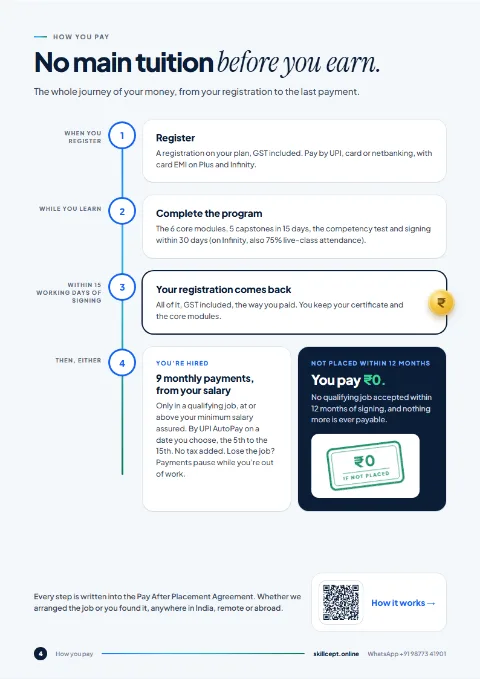
When our program checks a job against your minimum salary assured, it looks only at fixed annual pay. In the words of our FAQ:
The fixed yearly cash pay in your offer letter: basic pay and fixed allowances. It doesn’t include variable pay or bonuses, joining or retention bonuses, stock or ESOPs, your employer’s PF and gratuity, insurance, reimbursements or benefits in kind.
- Basic pay and fixed allowances
- No bonuses or stock
- No employer PF or gratuity
In writingAgreement 2.1
Here, that’s the ₹6,00,000 of fixed pay, which meets Go’s ₹6 LPA bar; the ₹8 lakh CTC doesn’t enter into it. Had the same CTC carried ₹5.6 lakh of fixed pay and a bigger bonus, it would fall below the bar, and no fee after placement would start.
PF after the 2026 change
PF, the Employees’ Provident Fund, is retirement savings run by the EPFO: you and your employer each pay 12% of your PF wages, which are your basic pay plus dearness allowance. Since 17 September 2026, PF is compulsory on PF wages up to ₹25,000 a month, up from ₹15,000, a ceiling unchanged since September 2014. The EPFO expects the change to bring more than 51 lakh more employees under compulsory cover.1
| At ₹25,000 PF wages | A month | Goes to |
|---|---|---|
| Your share, 12% | ₹3,000 | Your PF account |
| Employer, 8.33% | ₹2,083 | Your pension (EPS) |
| Employer, 3.67% | ₹917 | Your PF account |
| Employer, 0.5% | ₹125 | Life cover (EDLI), up to ₹7 lakh |
Source: EPFO, FAQs on the revised wage ceiling (S.O. 5109(E), 17 Sep 2026). The employer also pays 0.5% in administration charges.1
What the EPFO’s own answers mean for a first offer:1
- PF wages, not gross pay, decide cover. With ₹50,000 gross and ₹25,000 of PF wages, you must be covered.
- Above the ceiling in a new job, it’s optional. If your PF wages are above ₹25,000 and you aren’t already a member, PF isn’t compulsory; you can opt in with your employer’s consent.
- Above the ceiling, contributions can stop at ₹25,000. Ask whether yours are on the ceiling or on your full basic; the second means more saving and less in hand.
- CTC is not a PF concept. The EPFO says CTC “is not itself a statutory concept” for PF, and your employer’s share can’t be treated as your deduction just because the offer counts it in CTC.
Your PF isn’t lost money: it earned 8.25% interest in 2025–26, and your employer adds a matching 12%.1
Income tax in 2026–27
For 2026–27, the first tax year under the Income-tax Act, 2025, the new regime is the default, and salaried people pay no income tax on pay up to ₹12.75 lakh a year.6 Above that, these slabs apply to taxable income:
| Taxable income a year | New regime rate |
|---|---|
| Up to ₹4 lakh | Nil |
| ₹4–8 lakh | 5% |
| ₹8–12 lakh | 10% |
| ₹12–16 lakh | 15% |
| ₹16–20 lakh | 20% |
| ₹20–24 lakh | 25% |
| Above ₹24 lakh | 30% |
Source: Income-tax Act, 2025, section 202, unchanged for 2026–27 by the Finance Bill 2026, which also sets a 4% health and education cess on the tax.23
How a salary gets to nil tax
The standard deduction comes off your salary first: ₹75,000 in the new regime, ₹50,000 in the old one.4 Then a rebate of up to ₹60,000 cancels the tax when taxable income is ₹12 lakh or less, with relief just above that line.5 ₹12.75 lakh of salary minus ₹75,000 leaves exactly ₹12 lakh, which is where the nil-tax figure comes from.
Old regime or new?
The old regime has lower thresholds (nil up to ₹2.5 lakh, then 5%, 20% and 30%)3 but keeps deductions the new regime drops, including the HRA exemption and professional tax.2 The HRA exemption is the least of three amounts: the HRA you receive, your rent minus a tenth of your salary, or 50% of salary in Mumbai, Kolkata, Delhi, Chennai, Hyderabad, Pune, Ahmedabad and Bengaluru (40% elsewhere). From 2026–27, Bengaluru, Hyderabad, Pune and Ahmedabad are on that 50% list.7
Which to choose? If your salary is ₹12.75 lakh or less and you have no other income, the new regime’s tax is already nil, so the old regime can’t do better. Above that, compare both on the Income Tax Department’s Income and Tax Calculator. If you have no business income, you choose with your return, every year.2
In-hand pay at common salaries
Start from fixed pay, not CTC. Here is roughly what reaches your bank each month at common fixed salaries, under the new regime in 2026–27.
| Fixed pay a year | A month, before deductions | Income tax a month | In-hand a month |
|---|---|---|---|
| ₹4 lakh | ₹33,333 | ₹0 | ₹31,133 |
| ₹6 lakh | ₹50,000 | ₹0 | ₹46,800 |
| ₹8 lakh | ₹66,667 | ₹0 | ₹63,467 |
| ₹10 lakh | ₹83,333 | ₹0 | ₹80,133 |
| ₹12.75 lakh | ₹1,06,250 | ₹0 | ₹1,03,050 |
| ₹15 lakh | ₹1,25,000 | ₹8,125 | ₹1,13,675 |
| ₹20 lakh | ₹1,66,667 | ₹16,033 | ₹1,47,433 |
Our illustration: basic is half of fixed pay; your PF is 12% of basic up to the ₹25,000 ceiling (₹3,000 at most); professional tax ₹200 a month; the new regime with the ₹75,000 standard deduction and 4% cess; no other income. Bonuses come on top and are taxed when paid.
Two things move these numbers. If your basic is above ₹25,000 in your first job, PF may not apply at all, which adds up to ₹3,000 a month; if your employer contributes on your full basic, you take home less and save more. And bonuses count towards the ₹12.75 lakh line: ₹12 lakh of fixed pay plus a ₹1 lakh bonus crosses it, so some tax becomes due that year.
Switching from another career at a higher salary? Our guide to whether you’ll restart at fresher pay covers what a switch does to it. For what freshers are paid in the first place, see our fresher Data Analyst salary guide.
Before you sign: what to check
Ask for the breakup in writing and check these eight lines before you say yes.
- Fixed pay, a year and a month: what you’ll live on.
- Variable pay: how much, what decides it, when it’s paid.
- Joining bonus: when it’s paid, and whether you repay it if you leave early.
- PF: on the ₹25,000 ceiling or your full basic.
- Gratuity: inside CTC or not; you receive it only after five years.
- Notice period and probation: how long, and whether notice can be bought out.
- Any bond or training agreement: the amount and the period, in writing.
- Title, location and work mode: your title follows you to the next job.
Slow down if you see any of these:
- A request to pay anything to join: a training fee, a laptop deposit, a “security” amount.
- An offer over WhatsApp or a personal email with no interview behind it.
- A CTC that is mostly variable or one-time money, with a small fixed pay.
- A bond you can’t read before joining, or one with a large penalty.
Our guide to fake job offers and placement scams shows how to check a recruiter, and where to report one.
Questions
How is in-hand salary calculated from CTC?
Take the fixed pay out of your CTC and divide it by 12, then subtract your PF (12% of basic, at most ₹3,000 a month on the ₹25,000 ceiling), professional tax and income tax. Variable pay, joining bonuses, your employer’s PF, gratuity and insurance sit in CTC but not in your monthly pay.
What is the in-hand salary for ₹6 LPA?
If all ₹6 lakh is fixed pay with basic at half, about ₹46,800 a month under the new regime in 2026–27, after ₹3,000 of PF and ₹200 of professional tax. If ₹6 lakh is the CTC, expect less, because part of it is your employer’s PF, bonuses and insurance.
Is PF deducted from CTC?
Usually both shares sit inside CTC: your employer’s 12% is shown as a CTC line, and your own 12% comes out of your fixed pay each month. Since 17 September 2026, PF is compulsory on PF wages up to ₹25,000 a month, according to the EPFO.
Do I pay income tax on a ₹10 LPA salary?
Not under the new regime, if it’s your only income. In 2026–27, salaried people pay no income tax on pay up to ₹12.75 lakh a year, thanks to the ₹75,000 standard deduction and a rebate of up to ₹60,000.
Is gratuity part of my monthly salary?
No. Gratuity is a lump sum paid when you leave after five years of continuous service, or one year on a fixed-term contract. It works out at 15/26 of your last month’s basic and dearness allowance for each completed year.
Old or new tax regime: which is better for freshers?
Usually the new regime. On salary up to ₹12.75 lakh with no other income, its tax is nil, so the old regime can’t do better. Salaried people without business income can choose again every year, when they file the return.
Sources
- EPFO, FAQs on the revision of the EPFO statutory wage ceiling (S.O. 5109(E), 17 Sep 2026), read 22 Oct 2026.
- Income Tax Department, Income-tax Act, 2025, section 202: new tax regime, read 22 Oct 2026.
- Ministry of Finance, Memorandum explaining the provisions in the Finance Bill, 2026 (rates for tax year 2026–27), February 2026.
- Income Tax Department, Income-tax Act, 2025, section 19: deductions from salaries, read 22 Oct 2026.
- Income Tax Department, Income-tax Act, 2025, section 156: rebate of income-tax, read 22 Oct 2026.
- Government of India (PIB), The Middle Class Journey: Progress Powered by Policy, 3 Jun 2026.
- Income Tax Department, Income-tax Rules, 2026, rule 279, with the Act’s Schedule III (house rent allowance), read 22 Oct 2026.
- Income Tax Department, Employees: benefits allowable (gratuity under the Payment of Gratuity Act), read 22 Oct 2026.
- PIB, India’s Labour Reforms: Simplification, Security, and Sustainable Growth, 21 Nov 2025.