Skillcept Online
Key takeaways
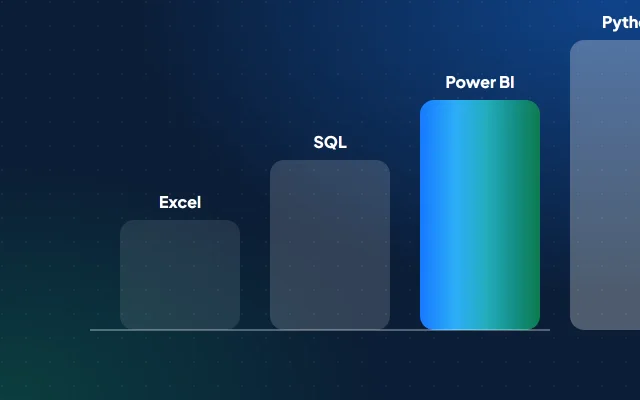
- Two orders work. Excel, SQL, Power BI, then Python reaches analyst jobs fastest; Python, SQL, statistics, then machine learning leads to data science and AI.
- Job profiles show the split: AmbitionBox lists SQL first among Data Analysts’ top skills and Python first for Data Scientists (19 Oct 2026).1
- AI is pulling Python into analyst work: 39% of data and analytics job postings in India mention AI (Indeed Hiring Lab, September 2025).2
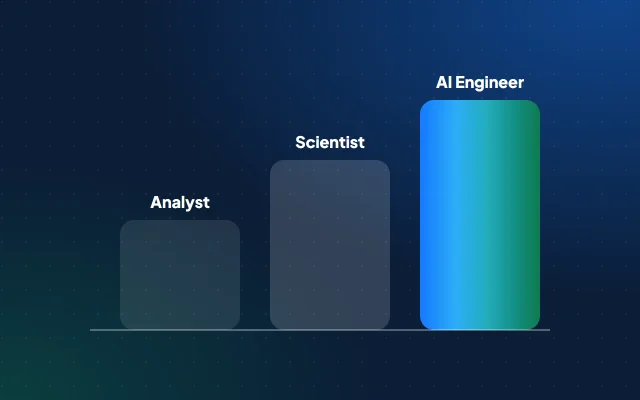
- Pay follows the harder skills: with 1–3 years, Data Analysts earn ₹5.2–5.7 lakh a year and Data Scientists ₹11.3–12.5 lakh (AmbitionBox, 19 Oct 2026).1
The short answer
Choose by the job you want first. For a Data Analyst or MIS role soon, learn Excel and SQL first, then Power BI, then Python. For Data Scientist or AI roles, start with Python, because everything after it, from pandas to machine learning to AI agents, is written in Python.
| If your first target is | Learn first | Then |
|---|---|---|
| An MIS, reporting or Data Analyst job, soon | Excel, then SQL | Power BI, then Python |
| A Data Scientist role | Python | SQL, statistics, machine learning |
| An AI or ML Engineer role | Python | Machine learning, deep learning, LLMs |
| You’re not sure yet | SQL | Python next: both are core skills for analysts and scientists |
Whichever you pick, give each tool one finished project before you move on. Four half-learned tools impress nobody; two tools with projects on GitHub do.
What each tool does at work
Each tool does a different job, and analyst roles often combine them. SQL (Structured Query Language) is the language for asking questions of databases; Python is a general-purpose programming language, and pandas is its library for tables of data.
| Tool | What it does | A typical first task | On our curriculum |
|---|---|---|---|
| Excel | Spreadsheets, formulas, lookups, PivotTables | A monthly MIS report from a sales sheet | Module 3, with Power BI and pandasAbout 30 hours together |
| SQL | Gets, filters and joins data from databases | Last month’s orders by city, from the company database | Module 4About 11 hours |
| Power BI | Interactive dashboards on cleaned data | A dashboard the sales team checks every morning | Module 3 |
| Python | Cleaning, automation, statistics, machine learning and AI | Merge ten messy files in one script | Module 1, from zeroAbout 51 hours |
Hours are our curriculum’s lesson hours; practice comes on top.
Notice the gap in hours. SQL is quick to learn because it describes the data you want rather than every step to get it. Python takes longer because it’s a full programming language, and that’s also why it reaches further: the AI tools you’ll meet later, such as PyTorch, Hugging Face and LangChain, are used from Python.
What to learn first, by background
Start from what you already know. Here are the first two steps for common starting points.
| Your background | Learn first | Then | Why |
|---|---|---|---|
| Fresher with a B.Com, BBA or BA | Excel, then SQL | Power BI, then Python | The quickest route to MIS and analyst openings; Python later widens the roles you can apply for |
| Fresher with a B.Tech, BCA or B.Sc in CS or IT | Python | SQL, statistics | You already think in code, and Python leads straight to data science and AI |
| Working in finance, sales or operations, in Excel daily | SQL | Power BI, then Python | Your Excel is a head start; SQL turns spreadsheet work into analyst work |
| Working in IT: testing, support or development | PythonOr SQL, if your job has none | Statistics, machine learning | You know logic and tools; aim at data science or AI roles |
| Back after a career break | Excel and SQL, refreshed | Python, then Power BI | Quick, visible projects show your skills are current |
| Aiming at AI Engineer, from anywhere | Python | Machine learning, deep learning, LLMs | AI tools such as PyTorch and Hugging Face are Python libraries |
The career-break row matters more than it looks: an Ashoka University study found women who had taken a break got 49% fewer callbacks than similar women who hadn’t,5 and recent projects are the quickest answer to the gap question. Our guide to a career gap to Data Analyst restart has the full plan, and switchers will find theirs in switching to data from a non-IT background.
Is Python necessary for a data analyst?
Not for every analyst job, but for more of them each year. Many MIS and reporting roles run on Excel, SQL and Power BI, and you can start there. Python is what lets you automate, handle bigger and messier data, and use AI in the work.
- Job profiles: AmbitionBox’s Data Analyst page lists SQL first among top skills, with Excel, Power BI and Python also on it; its Data Scientist page lists Python first, then SQL.1
- AI in the job: 39% of data and analytics job postings in India mention AI.2
- Hiring: in September 2026, fresher hiring in AI/ML on Naukri rose 19% on the year, against 1% for fresher hiring overall.4
- Worldwide: in Stack Overflow’s 2025 Developer Survey, SQL (58.6%) and Python (57.9%) were almost level among all respondents, and Python’s use rose 7 percentage points in a year, which the survey links to AI and data science.3
So you can get a first analyst job without Python, but plan to add it in your first year. With 1–3 years’ experience, AmbitionBox shows Data Analysts at ₹5.2–5.7 lakh and Data Scientists, for whom Python is the first-listed skill, at ₹11.3–12.5 lakh.1 Our comparison of the three data roles sets out what each job does day to day.
Why our program starts with Python
Our Data Science & AI Job Guarantee Program starts with Python from zero because it goes beyond analyst work: statistics, pandas, machine learning and deep learning are all done in Python, and the first module already brings in databases.
| Core module | About | Works in | Builds on Module 1 by |
|---|---|---|---|
| 1. Python from zero | 51 hours | Python, SQLite | Logic, files and a first database |
| 2. Probability & statistics | 10 hours | Excel, Python | Putting the maths to work in Python |
| 3. Data analysis & visualisation | 30 hours | Excel, Power BI, pandas | pandas, Python’s library for tables |
| 4. SQL for data analysis | 11 hours | MySQL, Tableau | Databases you first met with SQLite |
| 5. Machine learning | 19 hours | scikit-learn, XGBoost | Python libraries for models |
| 6. Deep learning | 65 hours | PyTorch | Building networks in Python |
From our curriculum. The 6 core modules are on every plan; Modern AI and the AI Engineer Stack come after them.
We’d rather you learn programming logic at the start, while the pace is gentle, than meet it for the first time in machine learning. And you don’t lose the analyst tools: Excel, Power BI and SQL are all in the core.
Is it the fastest way to a first MIS job? Not always: if that’s your only goal for next quarter, Excel and SQL first is quicker. The program is built for Data Analyst, Data Scientist and AI/ML Engineer roles, so it begins where all three meet. If you’ve never written code, in the words of our FAQ:
No. Module 1 starts from zero, with Python fundamentals, logic and working with files, and practice after every lesson. You build up to machine learning, deep learning and AI one step at a time. See the curriculum
- Starts from zero
- Practice after every lesson
- Builds to AI, step by step
Learning on your own: two orders that work
Pick one order, give each step a project, and don’t start the next tool until the project is on GitHub.
| Step | Order A: analyst first | Order B: scientist first |
|---|---|---|
| 1 | ExcelAbout 2 weeks | PythonAbout 6 weeks |
| 2 | SQLAbout 3 weeks | pandasAbout 2 weeks |
| 3 | Power BIAbout 3 weeks | SQLAbout 2 weeks |
| 4 | Python and pandasAbout 6 weeks | StatisticsAbout 2 weeks |
| 5 | StatisticsAbout 2 weeks | Machine learningAbout 6 weeks |
Our estimate for a beginner at about 10 hours a week, including a small project at each step.
Free, official material for each step:
- Excel: Microsoft’s Excel help & learning, from formulas to PivotTables.
- SQL: the MySQL tutorial, the PostgreSQL tutorial or Kaggle Learn’s Intro to SQL.
- Power BI: Microsoft Learn, laid out day by day in our 30-day Power BI roadmap.
- Python and pandas: The Python Tutorial, Kaggle Learn’s Python and pandas, and pandas: Getting started.
- Statistics and machine learning: OpenIntro Statistics, a free textbook, and scikit-learn’s Getting Started.
Three habits slow self-learners down: learning four tools at once, following tutorials without building anything, and collecting certificates instead of projects.
Questions
Should I learn Python or SQL first?
For a Data Analyst or MIS job soon, SQL first, after a little Excel: it’s the first skill AmbitionBox lists for Data Analysts. For Data Scientist or AI roles, Python first: it’s the first skill listed for Data Scientists, and the language of machine learning.
Is Python necessary for a data analyst?
Not for every role: many MIS and reporting jobs run on Excel, SQL and Power BI. But Python is on AmbitionBox’s top-skills list for Data Analysts, and 39% of data and analytics postings in India mention AI, so plan to add it.
Can I learn SQL without knowing programming?
Yes. SQL asks for the data you want rather than spelling out each step, so you don’t need to program first. Start with SELECT, WHERE and GROUP BY on a small sample database.
Should I learn Excel before Power BI?
It helps. PivotTables and lookups teach the ideas Power BI builds on, and Excel itself is on the top-skills list for Data Analysts. A couple of weeks of Excel basics is enough before you start Power BI.
How long does it take to learn Python for data analysis?
On our curriculum, Python from zero is about 51 hours of lessons, roughly five weeks at 10 hours a week, before pandas. Add time for practice: writing small scripts every week is what makes it stick.
Which is better for a career, Power BI or Python?
They do different jobs: Power BI presents data, Python processes and models it. Power BI gets you into analyst roles; Python opens data science and AI, which pay more: ₹11.3–12.5 lakh with 1–3 years for Data Scientists against ₹5.2–5.7 lakh for Data Analysts on AmbitionBox (19 Oct 2026).
Sources
- AmbitionBox, Data Analyst and Data Scientist salaries and top skills in India, both updated 19 Oct 2026 (read 22 Oct 2026).
- Indeed Hiring Lab, September 2025 labour market update, 25 Oct 2025.
- Stack Overflow, 2025 Developer Survey: Technology (all respondents, worldwide), read 22 Oct 2026.
- Naukri, JobSpeak, September 2026, 6 Oct 2026.
- Mahajan and S, Restart: Women, career breaks and employer response, Ashoka University working paper 125, 14 Sep 2024.