Skillcept Online
Key takeaways
- Never pay to get a job. The Home Ministry’s job-fraud brochure is blunt: “No organization/ company ever asks for money to work for them.”1
- I4C, the Home Ministry’s cybercrime centre, describes a job scam as a fraudster posing as an employer or recruiter who asks jobseekers to pay money in advance.2
- “Work from home” CAPTCHA-filling jobs follow one pattern: a registration or training fee, then payouts refused over “inaccuracies” and new charges (I4C advisory, 8 Apr 2025).3
- Lost money? Call 1930 at once. By 30 June 2026, more than ₹11,158 crore had been saved in more than 32.80 lakh complaints through the system behind it (Lok Sabha answer, 21 Jul 2026).4
- A dispute with a course or placement company goes to the National Consumer Helpline: 1915 or 1800 11 4000, or WhatsApp 8800001915.5
How do you spot a fake job offer?
Look at the money, the process and the pay. A fake offer asks you for money, skips a real interview, or pays far more than the role and your experience would; a real employer hires you through its own careers page and email, after interviews, and pays you, not the other way round.
The Home Ministry’s Cyber Dost brochure on job fraud gives the same checks: apply through authentic job portals or newspapers rather than search-engine or social-media ads, look for the job on the company’s own careers page, watch for misspelt email addresses, and research the organisation and its representative before an online interview.1 Walk away if you see any of these:
- A fee before you join, called registration, training, verification, a laptop or a security deposit.
- An interview only on chat, or an offer with no interview at all.
- Pay far above what the role usually pays, for a job that names no skills.
- A free email address, or a domain one letter off the company’s own: the brochure’s example is info@company.net instead of info@company.com.1
- An SMS you didn’t expect saying your CV has been selected, with a link that opens a WhatsApp chat.2
- Pressure to decide today, or to share an OTP, bank details or ID documents before a written offer. I4C notes that fraudsters typically show urgency.2
- Earnings on a dashboard that you can’t withdraw.6
To know what a first data analyst job really pays, read our fresher salary guide. An offer far above it, for little work and no interview, is a warning sign, not luck.
Which scams target data and IT jobseekers?
Six patterns cover most of what freshers and job-changers meet: the fee for a job, the fake recruiter, the task scam, work-from-home CAPTCHA and data-entry jobs, “training first, job later”, and the fake offer letter. A seventh targets people who want a job abroad.
| Scam | How it works | The tell |
|---|---|---|
| Fee for a job | A “recruiter” or “HR team” offers a job, then asks you to pay for registration, training, verification or a laptop before you join. | Any payment before your first day. The National Career Service tells jobseekers not to pay fees to employers.7 |
| Fake recruiter | An SMS says your CV has been selected, with a link that opens a WhatsApp chat. You’re sent to a website to register, then asked to add money to complete verification and registration.2 | You never applied, and the next step is a payment. |
| Task scam | A “part-time job” offered on SMS, WhatsApp or Telegram: you register on a website or app, transfer money, and watch earnings grow on a dashboard. When you try to withdraw, the money isn’t returned.6 | You pay to earn, and the earnings stay on a screen. |
| CAPTCHA or data-entry work from home | High pay for CAPTCHA-filling, after a registration, training or software fee and sometimes a fabricated agreement. Weeks later, payouts are refused for “inaccuracies” and new charges appear for taxes, processing or upgrades.3 | An upfront fee, earnings too high for the effort, delayed withdrawals and a push to recruit others.3 |
| Training first, job later | A “company” offers a job that starts with a paid course, or weeks of unpaid “training”, with the job always one step away. | If you pay for training, you’re buying a course. Judge it as a course, with the contract in hand. |
| Fake offer letter | A polished letter with a real company’s logo, sent from a free or look-alike address, asking for a fee or your documents. | The job isn’t on the company’s careers page, and its HR team, called on its own number, has never heard of you. |
| A job abroad | A job abroad offered on social media or another unverified source. The Embassy of India in Yangon has warned that Indian nationals recruited from India are being trafficked via Thailand to crime syndicates in the Myawaddy region, on the Myanmar–Thailand border.8 | An offer from social media or another unverified source, and an employer you can’t verify through the Indian Embassy in that country.8 |
Sources: the National Career Service,7 I4C’s advisories236 and the Embassy of India, Yangon.8
I4C’s advisory is about CAPTCHA-filling, but the red flags it lists fit any “data entry from home” offer: upfront payment, unrealistic earnings, delayed or denied withdrawals and an overemphasis on referrals.3 Real data-entry work is shrinking, too: the World Economic Forum lists Data Entry Clerks among the fastest-declining jobs worldwide to 2030, while Big Data Specialists and AI and Machine Learning Specialists are among the fastest-growing.9 So an ad promising easy, well-paid data entry should make you more careful, not less: the data work that is growing is analysis and AI, and employers hire for it through tests and interviews.
How do you check a recruiter and an offer?
Check the job at its source. Find it on the company’s own website, confirm the person through a number or address the company publishes, and insist on a real interview. Never confirm anything through the contact details the message gave you.
| Step | What to do |
|---|---|
| 1. Find the job | Look for it on the company’s own website, under Careers: companies usually list their openings there.1 |
| 2. Check the sender | The email should come from the company’s own domain, spelt exactly. A free email address or a look-alike domain is a stop sign.1 |
| 3. Call back | Ring HR on a number from the company’s website, not one from the message or the letter. |
| 4. Look the company up | Search its name with “scam”, “fraud” or “complaint”, as I4C suggests,2 and check that it’s a registered company, with a CIN you can look up on the Ministry of Corporate Affairs website. |
| 5. Read its fraud notice | Many large employers publish one. Amazon’s India fraud alert, for example, says it charges no fee at any stage of hiring and that its offer letters can only be downloaded from its own joining portal.10 |
| 6. Insist on an interview | Ask detailed questions about the job and the team, and research the interviewer before an online interview.1 |
| 7. A job abroad? | Verify the foreign employer through the Indian Embassy in that country,8 and check the agent on the Ministry of External Affairs’ list of active recruiting agents.11 |
No hiring step ever needs your OTP, banking password or card PIN. A recruiter who asks for them isn’t hiring. If you’re looking for real openings, our guides to data analyst jobs for freshers and data science internships show where they’re posted and how to apply safely.
What if a course promises a job?
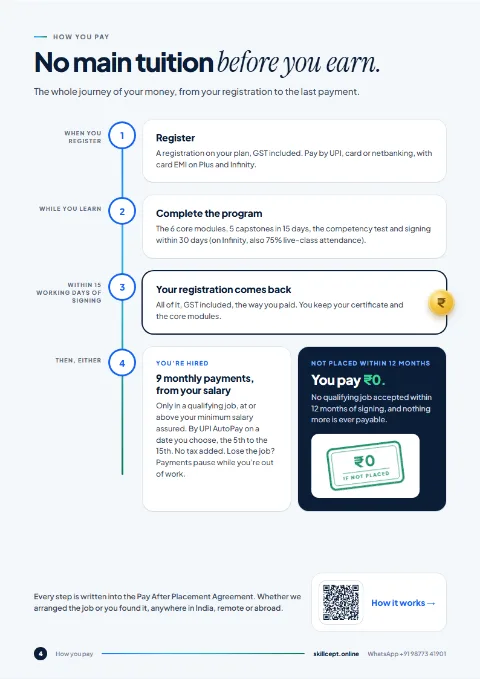
A course that promises a job isn’t fake by default, but its promise is only as good as its contract. Before you pay, read what “placement” means, what you pay before a job, whether a lender is involved and what happens if you aren’t placed.
The law helps. India’s Central Consumer Protection Authority (CCPA) has applied guidelines on coaching ads since 13 November 2024: they cover misleading claims about selections, ranks, job security and false urgency or scarcity, and they apply to endorsers too.12 By March 2025, the CCPA had imposed ₹77.6 lakh in penalties on 24 coaching institutes.13 Slow down if a course claims everyone gets placed, arranges a loan or a credit check, has no written definition of a qualifying job or a minimum salary, offers refunds “at our discretion”, or wants payment before you’ve read the contract. Ask any program these 12 questions, and get the answers in writing.
Scammers also borrow the names of real companies, course providers included. If anyone asks you to pay outside our checkout, in the words of our FAQ:
Someone asked me to pay outside your checkout. Is that you?
No. We take payments only through the checkout on skillcept.online, a UPI AutoPay mandate set up through our payment provider, or a payment link we send you; never to a personal UPI ID, bank account or phone number, and we never ask for your password or one-time code. If anyone else asks, don’t pay or share anything: report it to us at support@skillcept.online. Not sure a link is ours? Email us before you pay.
- Only our checkout
- Never your password or code
- Report it to us by email
Paid or shared details? Do this now
If money has left your account, call 1930 at once, then complete the complaint on cybercrime.gov.in, and call your bank. If a course or placement company won’t keep its word, go to the National Consumer Helpline on 1915.
| What happened | Where to go | How |
|---|---|---|
| You paid, or money left your account | 1930, the national helpline for financial cyber fraud, then cybercrime.gov.in | Call first; I4C says complaints made on 1930 must later be completed on the portal.14 |
| You shared bank or card details | Your bank, then 1930 | Alert your bank immediately, as I4C advises.6 |
| A fake offer, with no money lost yet | cybercrime.gov.in | “Online Job Fraud” is one of the portal’s complaint categories.15 |
| A suspicious call, SMS or WhatsApp | Chakshu, on the Department of Telecommunications’ Sanchar Saathi | Report the number as suspected fraud communication.16 |
| A course or placement company won’t refund or deliver | The National Consumer Helpline | 1915 or 1800 11 4000, every day except national holidays, 8 AM–8 PM; WhatsApp or SMS 8800001915.5 |
Why speed matters
The 1930 helpline exists to report quickly and, where possible, get fraudulent transactions frozen.17 It has helped: by 30 June 2026, more than ₹11,158 crore had been saved in more than 32.80 lakh complaints, and since April 2026 a Money Restoration Module has been working to return defrauded money to victims faster.4 Recovery isn’t certain, so call before you do anything else. Complaints on the portal are handled by the police of your state or union territory.1
Keep the evidence
Before you block anyone, save screenshots of the ad, the chats and the offer letter, the website address, the phone numbers and every transaction ID. You’ll need them for the complaint, the bank and the police.
Disputes with a course or placement company
The National Consumer Helpline is a pre-litigation step: it sends your complaint to the company with a docket number and says redress may take up to 30 days; if you’re not satisfied, you can go to a consumer commission.5 It has worked for students: the Department of Consumer Affairs got ₹1.56 crore refunded to more than 600 students in the education sector through it.18
Questions
How can I check if a job offer is real?
Find the same job on the company’s own careers page, check that the email comes from the company’s exact domain, and call HR on a number from the company’s website. A real employer interviews you properly and never asks you to pay.
Is it normal to pay a fee for a job or an internship?
No. The Home Ministry’s job-fraud brochure says no organisation asks for money to work for it, and the government’s National Career Service tells jobseekers not to pay fees to employers. If you pay for “training”, you’re buying a course, not getting a job.
Where do I report a fake job offer in India?
If you’ve lost money, call 1930 at once and complete the complaint on cybercrime.gov.in, the National Cyber Crime Reporting Portal, where “Online Job Fraud” is a category. Report the number on Chakshu (Sanchar Saathi), and take a dispute with a course or placement company to the National Consumer Helpline, 1915.
Are work-from-home data entry jobs real?
Be very careful with them. Ads promising high pay for easy CAPTCHA, typing or form-filling work often follow the pattern I4C described in April 2025: a registration or training fee, then payouts refused and new charges. Never pay to start work.
Can I get my money back after a job scam?
Sometimes, if you act fast. Call 1930 straight away: it can get fraudulent transactions frozen where possible, and by 30 June 2026 the system behind it had saved more than ₹11,158 crore in more than 32.80 lakh complaints. Recovery isn’t certain.
Sources
- Ministry of Home Affairs (Cyber Dost), Is your job offer fake or real?, a brochure on the National Consumer Helpline, read 22 Oct 2026.
- Indian Cyber Crime Coordination Centre (I4C), Fraudsters sending fake job offer SMSs (Cyber Crime Information 160), 29 Aug 2022, read 22 Oct 2026.
- I4C, National Cybercrime Threat Analytics Unit, Rise in fake CAPTCHA-filling jobs based cybercrime (TAU/ADV/004), 8 Apr 2025, read 22 Oct 2026.
- Ministry of Home Affairs, Lok Sabha unstarred question 251, National cyber crime data, answered 21 Jul 2026.
- National Consumer Helpline, Department of Consumer Affairs, Contact us and About the portal, read 22 Oct 2026.
- I4C, Part-time job frauds and Ponzi scheme frauds using websites or apps (Cyber Crime Information 135), 28 Sep 2021, read 22 Oct 2026.
- National Career Service, Ministry of Labour & Employment, Beware of misleading communication, read 22 Oct 2026.
- Embassy of India, Yangon, Advisory regarding fake job racket targeting Indian youth, 31 May 2024, published by I4C, read 22 Oct 2026.
- World Economic Forum, The Future of Jobs Report 2025, figure 2.2, 7 Jan 2025.
- Amazon, Fraud alert (India), read 22 Oct 2026.
- Ministry of External Affairs, Overseas employment: list of active recruiting agents as on 8 Apr 2026, read 22 Oct 2026.
- Fox Mandal, summary of the CCPA’s guidelines on misleading coaching ads, 14 Nov 2024.
- IANS, CCPA fines 24 coaching institutes over misleading ads, 25 Mar 2025.
- I4C, Frequently asked questions, read 22 Oct 2026.
- I4C, Cyber crime categories, read 22 Oct 2026.
- Department of Telecommunications, Sanchar Saathi, Chakshu: report suspected fraud communication, read 22 Oct 2026.
- Press Information Bureau, Curbing cyber frauds in Digital India, 7 Oct 2025.
- PTI, reported in Outlook Business, 22 Feb 2025.