Skillcept Online
Key takeaways
- Every core data science skill can be learned free from official material: Python, statistics, Power BI, SQL, pandas, machine learning, deep learning and LLMs.
- What self-study lacks is rarely content. It’s an order, feedback, a deadline and a route to interviews.
- Employers hire on proof: 40% prefer demonstrable AI skills or certifications over degrees (NASSCOM and Indeed, May 2026).1
- Entry-level competition is real: fresher hiring on Naukri grew 1% in September 2026, while fresher hiring in AI/ML grew 19%.2
- Test yourself free for four weeks at 10 hours a week before you pay anyone: how those weeks go tells you whether self-study will carry you.
The short answer
Self-study works if you learn well alone, can find someone to review your work, and have a way into interviews, such as campus drives, referrals or a portfolio that gets replies. A paid program is worth it when it supplies what you can’t: a fixed path, doubt support, checked projects, a deadline and interviews committed in writing, at a cost and a risk you can carry.
Content alone isn’t worth paying for, because the content is free. If you pay, pay for structure, feedback and a route to a job, and check that each one is in the contract rather than only in the ad.
What you can learn free, from official material
All of it. Here is a free, official source for each skill that data science and analytics jobs test, in an order where each builds on the last.
| Skill | Free and official | What it covers |
|---|---|---|
| Python from zero | The Python Tutorial | Syntax, data structures, files, modules |
| Statistics | OpenIntro Statistics, a free textbook | Distributions, inference, regression |
| Power BI | Microsoft Learn: Power BI | Power Query, data models, DAX, reports |
| SQL | The MySQL tutorial · Kaggle Learn: Intro to SQL | Queries, joins, aggregates |
| pandas | pandas: Getting started | Cleaning, grouping, joining, reshaping |
| Machine learning | scikit-learn: Getting started · Kaggle Learn: Intro to Machine Learning | Models, pipelines, evaluation |
| Deep learning | PyTorch: Learn the Basics | Tensors, training loops, saving models |
| LLMs and generative AI | The Hugging Face course, free and without ads | Transformers, fine-tuning, LLM techniques |
| Data for projects | data.gov.in, India’s open government data | Real Indian datasets for a portfolio |
Every link opened on 22 Oct 2026.
For proof an employer can check, add an industry exam. Microsoft’s PL-300 exam, for the Power BI Data Analyst certification, lasts 100 minutes and is proctored; the certification is renewed every 12 months by a free online assessment, and Microsoft Learn offers a practice assessment before you book.3 For an order to follow, use our free Data Analyst roadmap: six stages, each ending in a project.
What self-study doesn’t give you
Four things, and none of them is content: an order, feedback, a deadline and a route to interviews. Each has a free workaround, and each workaround takes effort you should plan for.
| What’s missing | Why it matters, and the free workaround |
|---|---|
| An order | Free material is organised by topic, not by job, so it’s easy to keep relearning basics and never reach SQL or a project. Workaround: follow one roadmap end to end, with a date for each stage. |
| Feedback | Documentation doesn’t review your code, and a wrong analysis can look right. Workaround: a study partner, a friend who works in data, or public notebooks to compare with. |
| A deadline | Nothing ends, so work, exams and family win the week. Workaround: fixed weekly hours, and a finish date you tell someone else. |
| A route to interviews | Free courses don’t introduce you to employers. Workaround: referrals, off-campus applications and projects on Indian data. |
Size the job before you start. On our program, the 6 core modules are about 186 hours of lessons (Python about 51, statistics 10, Excel, Power BI and pandas 30, SQL 11, machine learning 19 and deep learning 65), which comes to about 6 months at 10 hours a week once practice and projects are added. A self-learner covering the same ground should plan for a similar span, and for the job search after it.
Is a data science course worth it?
A course is worth paying for only if it supplies what free material can’t, in writing, at a risk you can carry. What employers want is proof, and the hiring data shows which kind:
- Skills count more often than degrees. 30% of Indian employers found skills-based hiring, which drops degree requirements, effective, against 19% of employers globally (World Economic Forum, January 2025).4
- Proof beats claims. 40% of employers prefer demonstrable AI skills or certifications over degrees (NASSCOM and Indeed, May 2026).1
- AI is part of the job. 39% of data and analytics job postings in India mention AI (Indeed Hiring Lab, October 2025).5
- Entry-level competition is real. Fresher hiring on Naukri grew 1% in September 2026, while fresher hiring in AI/ML grew 19%.2
So the question to ask any program isn’t “will you teach me?” but “what will I be able to prove, and who will see it?” A course that ends in a certificate of attendance adds little to free material; one that ends in checked projects, a tested standard and interviews can add a lot.
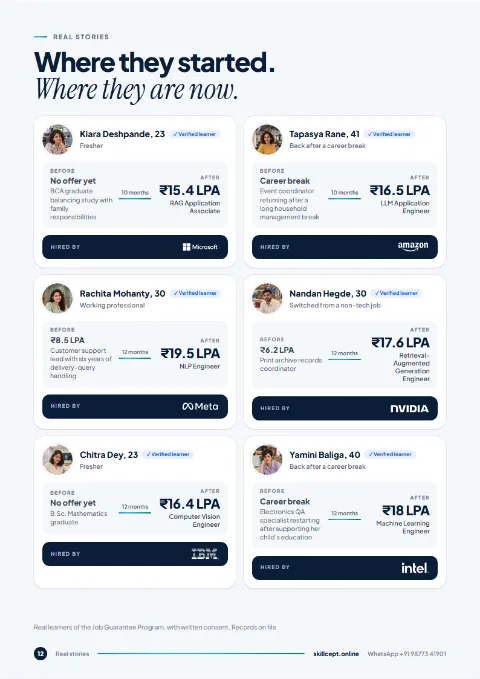
Who it has worked for: of the learners we placed in 2025, 46% came from a non-tech degree and 24% were freshers with no work experience. Records on file. Their stories are on Success stories.
Self-study or a program: by background
Self-study suits people who already have two of three things: comfort with code, someone to review their work, and a way into interviews. Here is how that plays out by background.
| Your background | Self-study can work if | A program helps most with | Start free with |
|---|---|---|---|
| Fresher with a CS or IT degree | You already code, and campus drives or referrals bring interviews | A portfolio employers notice, and interviews beyond campus | Kaggle Learn: SQL and pandas |
| Fresher from a non-tech degree (B.Com, BA, B.Sc) | You’re at ease with numbers and can study alone for months | An order from zero, doubts answered, and interviews | The Python Tutorial, then OpenIntro Statistics |
| Working in IT services: testing, support, operations | You know some Python and can protect 10 hours a week | A deadline that fits around a job, and a move to a better-paid role | pandas and scikit-learn: Getting started |
| Working outside tech: sales, BPO, finance, teaching | You use Excel daily and have a mentor who works in data | Structure, feedback and interviews as a career switcher | Microsoft Learn: Power BI |
| Back after a career break | Your skills are recent and your time is your own | A current path, and interviews that look past the gap | A Power BI report on a data.gov.in dataset |
If two of the three are already in place for you, start free and stay free for as long as the work keeps moving. If none is, that is exactly what a good program should sell you, and it should say so in writing.
How to judge any program before you pay
Judge a program by what it commits to in writing, not by its ads. These six checks cover most of it, and our 12 questions to ask before you pay cover the money and any guarantee in detail.
- A syllabus with hours, topic by topic, and the tools you’ll use. Compare it with the free list above: you’re paying for what’s added, not what’s listed.
- Projects checked against a rubric, not just “submitted”.
- Doubt support with a response time, written down.
- Teachers whose experience you can check.
- Interviews and placement support as numbers, in the contract.
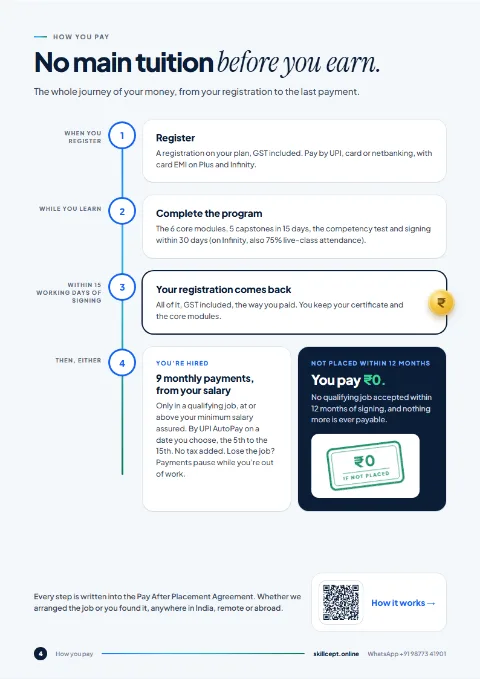
- Money terms you can live with: no loan you didn’t choose, a refund with a deadline, and what you pay if no job comes.
Check recognition, too. A certificate from a private program isn’t a degree or a diploma unless a recognised university or an approved institution awards it, and India’s coaching-ad guidelines require any claim of approval by bodies such as AICTE or UGC to be truthful.6 Here is our own answer, word for word:
No. Our program and certificate are not approved or recognised by AICTE, UGC or any government body, and the certificate isn’t a degree or diploma. It certifies that you completed our program; the free exams lead to the providers’ own industry certifications.
- Not a degree or diploma
- Proof you completed the program
- Industry exams, included free
In writingLegal notices 7.5
A 4-week test before you decide
Before you pay anyone, spend four weeks at about 10 hours a week on free material. How those weeks go tells you whether self-study will carry you.
| Week | Do this | You’re on track if |
|---|---|---|
| 1 | The Python Tutorial, sections 3 to 5 | You can write a 30-line script without copying one |
| 2 | Kaggle Learn: Intro to SQL | You can answer 10 business questions with joins and GROUP BY |
| 3 | pandas: Getting started, then a data.gov.in dataset | You can clean the dataset and summarise it in a notebook |
| 4 | A one-page Power BI report, or a notebook with three findings, on GitHub with a README | Someone else can follow what you found, and why it matters |
If you finished all four weeks on time and enjoyed them, self-study can work: follow a full roadmap, build a portfolio from projects on Indian public data, and plan your route to interviews with our off-campus job plan. If you stalled in week 1 or 2, that’s information, not failure: structure and support are what you’d be paying for.
Questions
Can I learn data science for free?
Yes. Every core skill is covered by free, official material, from the Python Tutorial and Microsoft Learn to the pandas, scikit-learn and PyTorch docs and Kaggle Learn. What free material doesn’t give you is an order, feedback on your work, a deadline and a route to interviews.
Is a data science course worth it in India?
Only for what you can’t get free: a fixed path, doubt support, checked projects and interviews, committed in writing. Before you pay, check what you would owe if no job comes.
Can a self-taught data analyst get a job in India?
Yes, if you can prove the skills. 30% of Indian employers found skills-based hiring effective (World Economic Forum, January 2025), and 40% of employers prefer demonstrable AI skills or certifications over degrees (NASSCOM and Indeed, May 2026), so build projects on real data and use referrals and off-campus applications.
How long does it take to learn data science on your own?
Plan on about six months at 10 hours a week to reach interview level for analyst roles, and longer for machine learning roles. For scale, our 6 core modules alone are about 186 hours of lessons, before practice and projects.
Is a free certificate enough to get a job?
A certificate shows you finished something; a project shows you can do the work. An industry exam such as Microsoft’s PL-300 adds proof an employer can check, and the certification is renewed every 12 months by a free online assessment.
Is a paid data science certificate the same as a degree?
No, unless a recognised university or an approved institution awards it. India’s coaching-ad guidelines require any claim of AICTE or UGC approval to be truthful, so ask exactly what the certificate is before you pay.
Sources
- NASSCOM and Indeed, India’s AI Talent Inflection Point, May 2026.
- Naukri, JobSpeak, September 2026, 6 Oct 2026.
- Microsoft Learn, Microsoft Certified: Power BI Data Analyst Associate, read 22 Oct 2026.
- World Economic Forum, Future of Jobs Report 2025, 7 Jan 2025.
- Indeed Hiring Lab, September 2025 labour market update, 25 Oct 2025.
- Central Consumer Protection Authority, Guidelines for Prevention of Misleading Advertisement in Coaching Sector, 2024, 13 Nov 2024 (read 22 Oct 2026).